Rechercher dans ce blog

Sunday, May 23, 2021

Huawei's HiSilicon Develops First RISC-V Design to Overcome Arm Restrictions - Tom's Hardware

huawei.indah.link

In a bid to overcome US restrictions on its Arm designs, Huawei's HiSilicon has turned to the open-source RISC-V architecture and has even released its first RISC-V board for Harmony OS developers. Due to being blacklisted by the U.S. government, Huawei and its chip division HiSilicon do not have access to development and production technologies designed in America. The restrictions include many Arm processor architectures, including those used in various microcontrollers that Huawei uses widely.

HiSilicon's HiSilicon Hi3861 development board is based on the company's own Hi3861 controller. Huawei's documentation doesn't disclose exactly what the chip does, but it describes it as a main controller chip. The Hi3861 chip is accompanied by a serial port controller as well as a USB-C port. Among the more important aspects, the Hi3861 seems to have all the logic that enables USB-C functionality (e.g., synchronization and port alignment) and GPIO (general-purpose) pins. 

HiSilicon

(Image credit: HiSilicon)

Overall, the HiSilicon Hi3861 development board has rather vast (at least Raspberry Pi-like) capabilities, but not for a world that Huawei's HiSilicon is used to, at least in terms of public opinion.

HiSilicon

(Image credit: HiSilicon)

The Hi3861 is aimed mostly at the IoT market, whereas HiSilicon's development efforts were historically aimed at high-margin smartphones, tablets, PCs, and embedded systems. But Huawei needs computing platforms to use for its other devices, so the HiSilicon Hi3861 is just what the doctor ordered at this time.

When it comes to high-volume products made by Huawei, a non-Arm-based chip makes exceptional sense and also gives the company experience working with an open-source architecture. Only time will tell if the company uses its RISC-V experience to develop other, more powerful devices. 

The Link Lonk


May 24, 2021 at 03:25AM
https://ift.tt/3bQub8J

Huawei's HiSilicon Develops First RISC-V Design to Overcome Arm Restrictions - Tom's Hardware

https://ift.tt/3eIwkCL
Huawei

By: HUAWEI Mate X2 review: the phone I'd choose for the next 5 years – TheReviews - Pocketnow

huawei.indah.link

I’ll be honest from the get-go: I haven’t spent nearly enough time with the HUAWEI Mate X2. And no, I’m not referring to the fact that I would have preferred to have it forever, but, for the purpose of this HUAWEI Mate X2 review, having it for a little bit more than the one week I spent with it would have allowed me to experience it in a deeper fashion. That being said, if I am ever offered the opportunity to take it for a longer spin, I’ll look forward to elaborating on the below.


That being said, I used HUAWEI’s latest and greatest foldable for five days as my primary phone, and I think I have a pretty good grasp at what the product is, and who it is aimed towards. No, it’s not for everyone, even if everyone would afford to purchase it at this prohibitive price point.

Before we get into our HUAWEI Mate X2 review, it’s important to remember that the company made a huge design shift from the previous two models, the Mate X, and the Mate Xs, as I anticipated in my February editorial. You see, the predecessors had an out folding design, which had the advantage of utilizing only a single screen. The main disadvantage: the display was, at all times, exposed to the elements.

HUAWEI Mate X2 review

With the Mate X2, HUAWEI did what Samsung did all along. Added a secondary display to act as the main screen when the now in-folding Mate X2 is closed up. With that in mind, this is our HUAWEI Mate X2 review.

Design

There’s just something about the way HUAWEI designs its smartphones that I’ve always found intriguing. The Editor’s Choice Design award the Mate 40 Pro won is a testimony to that.

If it weren’t for the thickness and the tapering (more in that later), you’d be tricked into believing you’re holding a Mate 40 Pro from the front, and a P40 Pro+ from the back.

The ingenuity of the company’s engineers and designers lies in how they built the phone, at the concept level. The two halves, while almost identical in real estate, are varying in thickness, employing a wedge shape. That not only helps with the center of gravity of the device, making it easier to use while unfolded but plays an important role in the entire folding mechanism.

HUAWEI Mate X2 review

The second aspect to the actual “fold” is the revolutionary Teardrop hinge, replacing the old Falcon Wing hinge from previous models. This new approach, in order to avoid creasing up the display, bends the screen into a teardrop shape. And with the usage of zirconium-based liquid metal inside the hinge, HUAWEI claims this particular component is twice as strong as before on the Mate Xs.

The downside to this hinge is that, except for the two anchor points in the folded and unfolded states, anything in between is spring-loaded. This means that the device if left alone, will more often than not default to one of the two states: folded or unfolded. Because of this, you can’t easily prop it up by itself to use it half unfolded (like a laptop), but you can emulate this state with the use of a case that helps the device prop up.

HUAWEI Mate X2 review

Another aspect to consider is that it’s no easy task to unfold the device using one hand, because of the magnets that hold it in place in its folded state. Luckily, this isn’t such a big deal, because, opposed to its main competitor, the Z Fold 2, the Mate X2 has a larger outer display that doesn’t require you to resort to the inner display for day-to-day operations.

recommended award

Because of nifty tricks like these, and what it translates to (a really flat, relatively crease-free unfolded display) we believe the Mate X2 deserves our recommendation for the best foldable smartphone design.

Hardware

When it comes to horsepower, HUAWEI didn’t hold back and threw in everything they’ve got, including the kitchen sink. And, it makes sense, if you come to think of it. If you’re shelling out close to $2,800 (in Chinese Yuans, as the phone is only available in China), you better make sure it’s future proof.

HUAWEI Mate X2 review

At the heart of the Mate X2 lies the 5G Kirin 9000 chip, with eight cores and its Mali-G78 MP24 GPU. There’s only one memory option, at 8GB, but there are two storage variants to choose from: 256GB and 512GB, expandable via the company’s own NM memory cards.

The outer (cover) display is a 6.45-inch OLED panel with a 90Hz refresh rate and 1160 x 2700 resolution. Flip it open and you reveal an uninterrupted 8-inch panel with 2200 x 2480 resolution. Yes, by uninterrupted we mean that there are no punch holes or notches, which adds to the entertainment and media consumption but dials it back on the user experience side for those who would want to video-call while unfolded.

And, since we’re talking cameras, the cover display houses the front camera, a 16MP unit, together with sensors and other hardware in the oval punch hole.

HUAWEI Mate X2 review

The back features a quad-camera Leica system that is made up of the following:

  • 50 MP Ultra Vision Camera (Wide Angle, f/1.9 aperture, OIS);
  • 16 MP Cine Camera (Ultra-Wide Angle, f/2.2 aperture);
  • 12 MP Telephoto Camera (3x Optical Zoom, f/2.4 aperture, OIS);
  • 8 MP SuperZoom Camera (10x Optical Zoom, f/4.4 aperture, OIS), support AF.

The rest consists of the usual suspects, with notable mentions going out to Bluetooth 5.2 and Wi-Fi 6, a side-mounted fingerprint scanner (inside the power button), and a 4,500mAh battery with 55W fast-charging via HUAWEI SuperCharge.

Software

When it comes to the software, the story is unchanged. Android 10 AOSP-based EMUI 11, with no Google Services, but a continuously expanding HUAWEI ecosystem via HMS.

HUAWEI Mate X2 review

The software experience is pretty identical with the Mate 40 Pro, so check out the Experience segment of that review to get a general view of what to expect.

However, there are some foldable specific features that make the experience pretty smooth, even if these features are not in your face. Handing off between the two displays, as a result of folding or unfolding the device, is seamless.

The operating system itself is packed with some China-specific software out of the box, which makes sense, knowing it’s the only market this phone is available in.

App scaling works well, at least on the apps that we had access to and managed to use. It also helps that there’s a dedicated segment inside Settings especially for this. And, with an 8-inch display, it makes a lot of sense to use apps side-by-side, which (for the supported apps) the Mate X2 does a great job at.

There’s one caveat though: you can’t change the sizes of the apps that are being displayed side-by-side, but this might be my design, rather than a bug, in order to keep the aspect ratio and app scaling problems out of the equation.

Experience

When it comes to the experience, it is one you have to witness first hand in order to really appreciate. From the snappiness of the folding mechanism to sliding your finger across the barely visible crease, all the way to holding it easily with one hand due to the offset center of gravity. HUAWEI really nailed the Mate X2 in most of its aspects, which shouldn’t come as a surprise for a 3rd generation foldable smartphone.

HUAWEI Mate X2 review

Basic phone operation

Basic phone functionality just works. Nothing to report here. Calls and reception are good, data speeds are in line with every other device (only tested on 4G as 5G is not yet available on my carrier in my region).

A special shout-out is due for the speaker system, which is really loud, crisp, clear, and packs enough oomph to silence an entire room awed in surprise.

HUAWEI Mate X2 review

Battery life

Battery life is good for at least two days of regular use. Disclaimer: we didn’t count the amount of time we spent on the 8-inch screen compared to the Cover display. While it will influence your battery life, you won’t spend most of your time with the phone unfolded. But, it’s safe to say that with regular use, you’ll get through two days. If you ever need to charge it, you’ll be assured to know that 30 minutes will give you close to 80 percent of battery juice.

Cameras

When it comes to cameras, HUAWEI has been a benchmark for quite some time. Testifying to all of this is my colleague Adam Lein’s recent take on the Mate 40 Pro, and he’s a professional photographer.

That’s also the case with the Mate X2. Since we’re talking about a hyper-flagship, the company made sure to add all of the best features, sensors, and optics.

There’s no breakthrough here, just delivering the same solid performance we’ve gotten used to from the HUAWEI and Leica partnership. Whether you’re shooting wide-angle, regular, telephoto, day or night, portrait or classic, you can rest assured that you’re going to end up with great quality shots. If we were impressed by the camera on the Mate 40 Pro, the Mate X2 is almost entirely replicating the setup from the Mate 40 Pro+, so, you know, it takes it up a notch (or two).

When it comes to the front camera, since this is an in-folding design, you no longer have to turn the phone around, like with the previous two models, in order to take a selfie with the main cameras. Since it has a dedicated selfie shooter, you’re taking your selfies with the phone folded, like with any regular phone.

What we would like to see is the ability to have both displays on at the same time. This could be useful in showing a preview to your subject on the outer display, before snapping the picture while unfolded. You can, of course, use the main cameras to take a selfie, and it looks kind of awkward, as seen below.

HUAWEI Mate X2 review

HUAWEI Mate X2 review conclusion

Over the past couple of years, I’ve started breaking down flagships even more. Yes, the flagship category still defines a certain type of smartphone characteristics, but there are more levels to flagships. The way I see things is this: the Mate 40 Pro is a flagship. The Mate 40 Pro+ is a super-flagship. …and then the devices like the Mate X2 are, in my book, hyper-flagships. Yes, I guess you got my car analogy.

Whether you think spending north of 2,300 Euros ($2,800) is insane or not doesn’t really matter. The Mate X2 is a niche product, and, it not being for the masses, can wear the price tag with pride.

HUAWEI Mate X2 review

But even if you had the money you wouldn’t be able to buy it outside of China. For whatever reason, HUAWEI made this decision and they seem to be really determined to keep things this way.

Nonetheless, as I alluded to in the headline, if I had to choose a single device to use for the next quinquennial, the Mate X2 would be the one I would go for.

HUAWEI Mate X2 review

Pros

+ superb design;
+ awesome displays;
+ excellent cameras;
+ great battery life;
+ amazing speakers;
+ solid performer.

Cons

– no wireless charging;
– prohibitive price/limited availability;
– lack of Google Services (if that’s still a thing that bothers you).


Anton is the Editor-in-Chief of Pocketnow. As publication leader, he aims to bring Pocketnow even closer to you. His vision is mainly focused on, and oriented towards, the audience. Anton’s ambition, adopted by the entire team, is to transform Pocketnow into a reference media outlet.

Contact: [email protected]

The Link Lonk


May 23, 2021 at 08:00PM
https://ift.tt/3f8EUNH

By: HUAWEI Mate X2 review: the phone I'd choose for the next 5 years – TheReviews - Pocketnow

https://ift.tt/3eIwkCL
Huawei

Huawei's HarmonyOS alternative to Android is tipped to launch on June 2 - TechRadar

huawei.indah.link

We've heard plenty of official news and unofficial tidbits about the Huawei HarmonyOS in recent weeks, and it looks as though the new software is going to be unveiled at a launch event scheduled for June 2.

That's according to sources speaking to HuaweiCentral, which also has a leaked promo poster associated with the event. It's scheduled to start at 8pm China time (6am PT / 9am ET / 1pm BST / 3pm AEST) – with that timing hinting that this might be a global event.

Two brand new devices – the Huawei MatePad Pro 2 and the Huawei Watch 3 – will apparently be coming along to the party to help launch the updated version of the operating system, which is technically HarmonyOS 2.0.

This all matches up very neatly with previous rumors we've heard, both about the date of the launch and the devices that will be first in line for the software. Older hardware, including the Huawei Mate 40 phones, will reportedly join a HarmonyOS 2.0 beta program.

HarmonyOS leak

(Image credit: HuaweiCentral / Huawei)

As we've mentioned, HarmonyOS is actually already out in the wild and in use on some IoT devices and TVs. This new launch, HarmonyOS 2.0, is the big one though: it'll see the software arrive on consumer-facing devices like phones and tablets as a true rival to the Android OS that Google develops.

Since the start of the US government ban prohibiting Huawei from doing business with US companies such as Google, devices such as the Huawei P40 have arrived running a stripped-down version of Android, without any Google apps or the Google Play Store.

Those software flaws have been holding back what is otherwise excellent hardware, but HuaweiOS 2.0 should mark a new chapter in the Huawei story – even if app availability is still going to be a problem until Huawei convinces all the big developers to port their apps over to the new OS.

When June 2 rolls around we should learn a lot more about HarmonyOS 2.0 and how it might work on phones such as the Huawei P50. As soon as the event or the software is made official by Huawei, we'll let you know.

Via NotebookCheck

The Link Lonk


May 23, 2021 at 08:30PM
https://ift.tt/3oIGrxl

Huawei's HarmonyOS alternative to Android is tipped to launch on June 2 - TechRadar

https://ift.tt/3eIwkCL
Huawei

Huawei outshines Western rivals, braving US' constant attacks - Global Times

huawei.indah.link
Illustration: Chen Xia/GT

Illustration: Chen Xia/GT

Facing the US government suppression, China's technology giant Huawei has reshuffled its business structure since late 2019, investing more resources in software innovation to become a top provider of smart digital solutions to help strengthen a broad variety of Chinese enterprises - industrial manufacturers, public utilities, internet-based platforms, financial service providers, catering and entertaining businesses.

Huawei's forced business transformation, ironic in the eyes of many Western industrial analysts, is instrumental to enhancing the global competitiveness of Chinese companies, while make itself even more a formidable ICT hardware and software technology colossal, enabling it to stand shoulder-to-shoulder with Google, Apple, Microsoft and other global technology leaders.

Armed with Huawei's state-of-the art integrated digital solutions - borne from the company's advanced 5G, cloud and AI technologies, Chinese businesses across a wide spectrum of industrial lines are poised to gain in the level of technology upgrade, corporate governing efficiency and business profitability.

Huawei has worked out a plan to make new inroads into expanding its enterprise business sector, in addition to its mobile telecom gear and consumer devices business, and the enterprise business helped the company win more than 100 billion ($15 billion) of business revenue in 2020, growing 23 percent from 2019. At the end of 2020, the company had over 30,000 corporate partners in China. And, more than 19,000 other partners have joined Huawei Cloud Partners program.

It is believed that a thriving technology ecosystem centered on Huawei's smart solutions will thrust many Chinese businesses to a new level of modernization, which will enable them to better compete with rivals from the US and other developed economies.

At a time when US President Joe Biden refuses to abandon his predecessor Donald Trump's notorious trade and technology war, obsessively chanting his slogan to engage in a "fierce competition" with China, the strategy switch of Huawei and other leading tech companies in China is expected to keep in lockstep with the Chinese central government's new pivot to the "Dual Circulation" economic growth, by focusing on domestic market expansion, and, at the same time supplemented with exploration of overseas markets.

The former Trump administration, concerned about the rising capability of Huawei, imposed very strict restrictions on the company by putting it on US government's Entity List in middle 2019, banning export of all advanced semiconductor chips and other technologies to Huawei.

In 2020, Huawei was forced to spin off the Honor phone business, and the production of other advanced Huawei smart phones, tablets and digital devices was largely impaired, leading to withering sales and market shares both at home and abroad.

But the technology giant won't cower to the US' reckless crackdown.

Realizing the world's leading semiconductor makers are forbidden by Washington to manufacture semiconductor chips for the company, Huawei decided to shift to explore new frontiers of technology. Thanks to its strong financial fundamentals, Huawei has invested heavily in recruiting thousands of talented people, who are driving new technology innovations.

And, the company's efforts have led to "pops" in new technologies, which will help Huawei to garner streams of new revenues in the coming months and years.

Lately, Huawei has officially launched its Harmony or Hongmeng operating system which is expected to be embedded with more than 300 million digital consumer devices in 2021, mostly in China's mainland market. The integrated software system, connecting smart phones, laptops, tablets, smart TV sets, other home appliances and the inner-car screens and more, is innovated for the upcoming new era of "Internet of Things (IOT)".

Huawei hopes its proprietary operating system, while constantly being improved, will in the coming years help it gain lucrative market share from industry rivals including Google's Android, Apple's iOS and Microsoft's Window operating system.

Also, Huawei, seeing the opportunity in autonomous driving and carbon-free electric vehicle industry in the world, has jumped to the bandwagon of developing intelligent car-driving systems.

Prior to the Shanghai Auto Show held in March this year, domestic electric cars, equipped with Huawei's brand-new autonomous driving system, shrilled the auto industry and won widespread acclaims from Chinese car drivers.

The electric car named "ARCFOX", printed with Huawei Inside (HI) logo, were shown running smoothly and autonomously on downtown Shanghai streets. The system consists of a computing system, 4D imaging radar, an autonomous driving platform and intelligent thermal management. It runs on Huawei's Harmony OS and high-quality lidar chips, and has its proprietary 5G connectivity.

The self-driving HI system developed by Huawei's intelligent car unit, which has over 5,000 scientists and technicians and plans to invest $1 billion annually in R&D, is now a hit among Chinese car lovers. The driving system will help Huawei capitalize on China's exploding EV market. As the world's top electric vehicle market, China is forecasted to see annual EV sales of 6-7 million vehicles in 2025.

The company has already signed with 18 carmakers to form a so-called "5G Automotive Ecosystem" in China. As a supplier, rather than a competitor, Huawei can access a variety of carmakers for partnerships in using its smart driving technology.

As Huawei has constantly made breakthroughs in new technology fronts and entered a broad alignment with many Chinese businesses, the tech giant will naturally have access to new larger streams of revenues. Huawei reaped in a quarterly profit of 16.9 billion yuan in the first three months of 2021, which grew 26 percent from the corresponding period last year - a vindication of Huawei's technology prowess and ability to make profits and outshine its competitors, despite US government's constant and merciless attack.

The author is an editor with the Global Times. bizopinion@globaltimes.com.cn

The Link Lonk


May 23, 2021 at 03:20PM
https://ift.tt/3ysPbfv

Huawei outshines Western rivals, braving US' constant attacks - Global Times

https://ift.tt/3eIwkCL
Huawei
Saturday, May 22, 2021

Huawei Extends Chongqing Changan Smart Car Partnership to Include Chip Development: Reuters - Benzinga

huawei.indah.link
Huawei Extends Chongqing Changan Smart Car Partnership to Include Chip Development: Reuters
  • Huawei Technologies Co Ltd extended its smart car partnership with Chongqing Changan Automobile Co Ltd to add automotive semiconductor design and development, Reuters reports.
  • The auto sector is estimating $110 billion in lost revenue this year from the semiconductor chip crisis. The U.S. Commerce Ministry refused any partiality towards the industry.
  • Huawei and Changan have been working unofficially on chips for the last few months since their November smart car partnership.  
  • Huawei will lead the smart vehicle’s operating system and cabin technologies, Changan will head the smart vehicle design and engineering, and Battery maker CATL will also be a part of the smart car partnership.
  • The companies aim to tap the mid to high-end market from 2022, challenging the likes of Tesla Inc (NASDAQ: TSLA) and Nio Inc (NYSE: NIO).
  • The business will be held in an old venture with Nio that has been renamed Avatar.
  • Avatar has started hiring staff for its Shanghai office and could go public.
  • Huawei and Changan are likely to forge a chip development joint venture. Changan’s chip development plans have met little success.
  • Huawei is also planning electric vehicles (EVs) under its brand and is in talks to acquire a small domestic automaker’s EV unit. Huawei is trying to offset the U.S. embargo-induced smartphone business hit by focusing on the booming EV industry. It plans to spend over $1 billion in the industry.
  • Changan also harbors listing plans for its EV unit on Shanghai’s STAR Market.
The Link Lonk


May 22, 2021 at 03:46AM
https://ift.tt/3f4HnIZ

Huawei Extends Chongqing Changan Smart Car Partnership to Include Chip Development: Reuters - Benzinga

https://ift.tt/3eIwkCL
Huawei
Friday, May 21, 2021

How Australia came to ban Huawei - Light Reading

huawei.indah.link

Australian cybersecurity experts spent eight months trying to find a way to secure Huawei equipment but concluded they could not prevent it being shut down on Beijing's orders, according to revelations in a new book.

The book, Red Zone, reports that after war-gaming a Huawei 5G deployment hackers from intelligence agency Australian Signals Directorate (ASD) estimated it would need around 300 security measures.

Yet even that could not guarantee network safety and they advised that the risk could not be contained, according to the book by Sydney Morning Herald journalist Peter Hartcher.

Australia's formal ban on Huawei of 2018 was the first by any country and still rankles with Beijing, which has placed it high on its list of 14 grievances against Australia.

Underlying the specific problems around the risks were two larger factors.

First was China's 2017 National Intelligence Law, which requires all Chinese companies and citizens to comply with security agencies on intelligence matters.

At one level this hardly matters. There is little chance any Chinese person or company would reject a request for assistance on security matters.

But critics point out the law really codifies the government view that intelligence-gathering is an obligation of every Chinese citizen, like paying taxes. It is not just a legal requirement, it is expected of them.

The second part is around the anticipated role of 5G as an enabler of massive IoT.

"It's not about the interception of telephone calls. We've got that problem with 4G, we had it with 3G," an unnamed senior ASD official told the author.

Control over a 5G network would mean that vast parts of the national infrastructure would be vulnerable.

"The sewerage pump stops working. Clean water doesn't come to you. You can imagine the social implications of that. Or the public transport network doesn't work. Or electric cars that are self-driving don't work," the intelligence officer said.

The 5G network would be "number one on our critical infrastructure list in need of protection once it's fully operational."

That view had always been implied, but this is the first time a Western intelligence official has put it so clearly.

The China 5G threat is not about "backdoors" as was claimed for so long but about 5G's role as a critical digital enabler.

The then-prime minister, Malcolm Turnbull, a successful businessman and tech investor, took a hands-on role in the decision. His starting point was to see if the risks of a Chinese-designed and -built 5G network could be managed effectively.

In what is surely a first for a national leader, he even bought and absorbed the contents of a 500-page book called A Comprehensive Guide to 5G Security.

The ASD set up a red-versus-blue war game over eight months and compiled a spreadsheet of 300 risks and possible migitations. These included, for example, "full and sole access to the source code, updates being done in Australia only, and full access to hardware schematics."

But they determined these would not be enough. The problem was not the specific threats, but in knowledge of the system design. As the intelligence officer explained: "It's the control of the design that gives you zero cost of entry."

"If I want to understand how to break in, I don't have to break in. I just look at the blueprints – I understand the software, I know how it works ... That allows me to gain access, to switch things off, and that disrupts the country – elements of it, or the whole country. That's why you've got to be concerned."

As the New York Time reported, in one of the very last acts of his prime ministership, Turnbull announced the ban on Chinese vendors on August 22, 2018.

— Robert Clark, contributing editor, special to Light Reading

The Link Lonk


May 21, 2021 at 07:21PM
https://ift.tt/3u8mZeq

How Australia came to ban Huawei - Light Reading

https://ift.tt/3eIwkCL
Huawei
Huawei MateBook X Pro 2021 review: Still an elegant ultraportable, but issues remain Review - ZDNet

huawei.indah.link

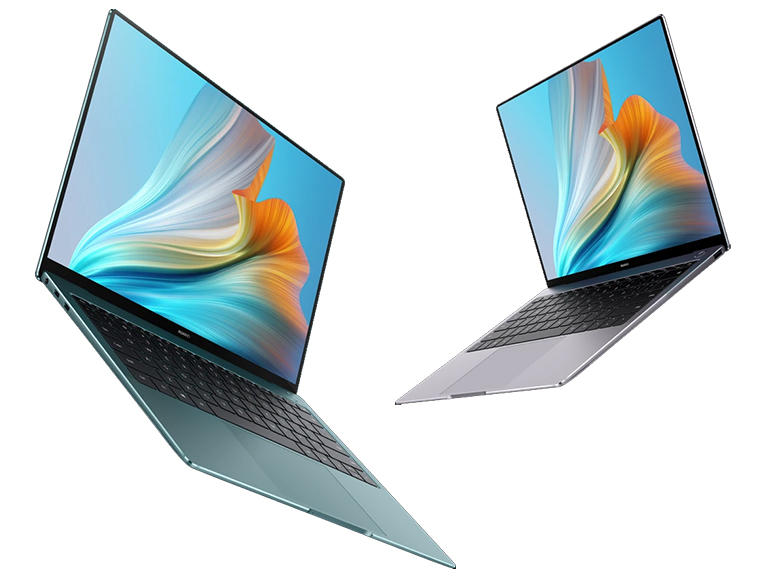
Huawei's difficulties in the smartphone business have received a lot of attention, making it easy to overlook the company's laptops. Last year I found the MateBook X Pro (2020) very attractive despite a couple of niggly annoyances. The MateBook X Pro 2021 is expensive at £1,599.99, but the 11th generation Intel Core i7 processor, 16GB of RAM and 1TB SSD might be enough to justify that. But what else does this elegant 13.9-inch laptop have in store? 

There is just one MateBook X Pro 2021 model, and it's intended to be a more than competent all-rounder, from the chassis design to the internal components. And there really is a lot of goodness here. 

huawei-matebook-x-pro-2021-main.jpg

The 2021 MateBook X Pro runs on an 11th-generation Core i7 processor with 16GB of RAM and a 1TB SSD. Its 13.9-inch display is bright (450 nits) and sharp (3000 x 2000 pixels).

Images: Huawei

The MateBook X Pro 2021 is available in two colours, and I was slightly disappointed to be sent the Space Grey version to review. It looks sleek enough in a MacBook Pro sort of way, the chassis is tough, and the long divot cut into the centre of the bottom section makes it easy to lift the lid one-handed. But the alternative colour, Emerald Green, would have made a change on the review bench, and I suspect it would be something of an eye-catcher out in the real world. 

While the primary colour is matte, there are bright, shiny silver bezels around the base and lid which add a little panache. On the underside, four reasonably well sized circular feet help to anchor the MateBook X Pro 2021 to a desk or table. 

The MateBook X Pro 2021 houses a 13.9-inch screen in a chassis that's deceptively small and gratifyingly lightweight, although it's worth noting that not a millimetre or a gram have been shaved off last year's dimensions of 304mm wide by 217mm tall by 14.6mm thick and 1.33kg. Similarly, the speaker grilles flanking the keyboard and the circular power button in the top right corner of the keyboard, which incorporates a fingerprint sensor, are also unchanged. 

The screen is another area that's seen little change. It's the same 3,000-by-2,000, touch-responsive LTPS panel as before, with minimal bezels resulting in a 91% screen-to-body ratio. The 3:2 aspect ratio really comes into its own when you're working on documents and large spreadsheets, although you can expect some letterboxing when watching video. The ambient light sensor that I found irritating last time round seems to be fixed, adjusting screen brightness well. Viewing angles are good, and for those that do a lot of screen capturing, the ability to sweep three fingers down the screen to take a screenshot might prove useful.  

Top ZDNET Reviews

A good display like this deserves good speakers. There are four here, throwing sound out from the sides of the keyboard. Maximum volume isn't all that high, but there's no distortion when it's maxed out. Still, bass tones are not as strong as they should be, which is a little disappointing. 

If you use a Huawei phone (some models), you can take advantage of Huawei Share to create a connection between the handset and the MateBook X Pro. Make a link and the phone's screen can be seen on the laptop, from where it can be controlled. You can share files between the two devices as well. 

huawei-matebook-x-pro-2021-webcam.jpg

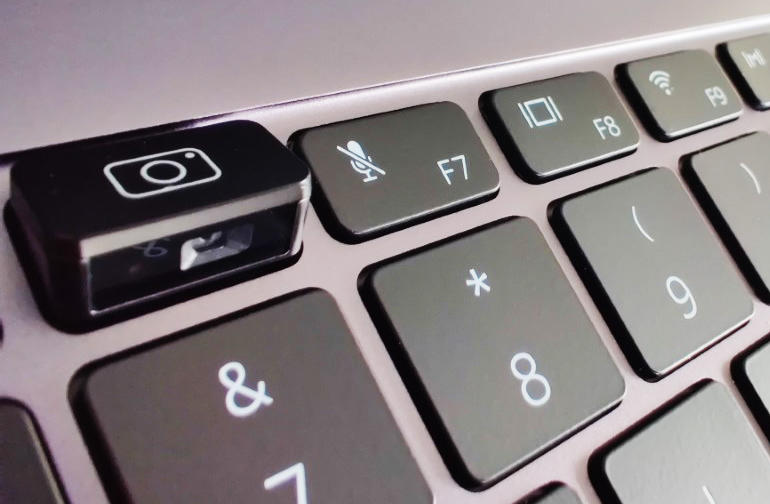
As in the 2020 model, the webcam is embedded in the keyboard, popping up ready for use when you press the camera key. This placement makes for an unflattering camera angle on video calls.

Image: Sandra Vogel / ZDNet

The tiny top screen bezel means that, just as with last year's model, there's no room for the webcam in its traditional location. So the MateBook X Pro 2021 reprises the arrangement used in its predecessor, housing it in the centre of the Fn key row: press down on the key marked with a camera icon, and the webcam pops up ready to use. Although this means there's no need for a privacy cover, the viewing angle is terrible: no-one wants or deserves the up-the-nose view it presents. Having spent many hours in the last year on video calls for work, family and fun I can say that an external webcam would be a must-have for me if this were my everyday laptop.  

huawei-matebook-x-pro-2021-keyboard.jpg

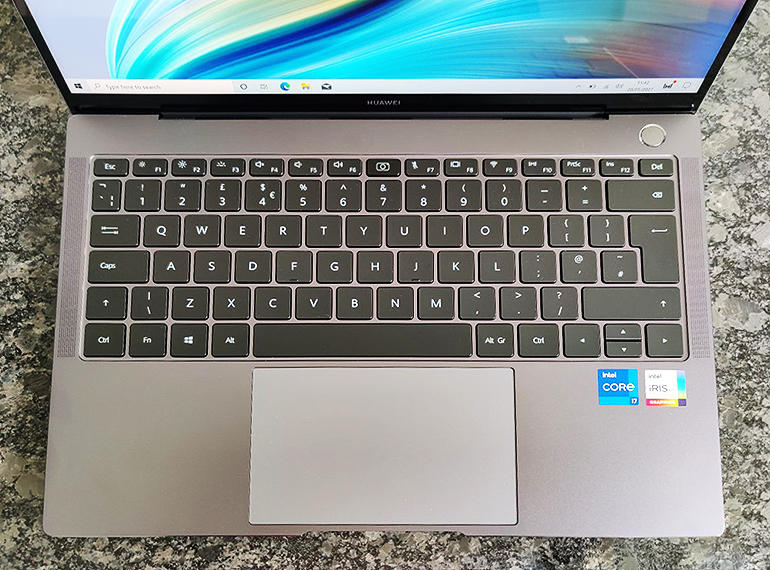
The keyboard, flanked by speaker grilles, delivers an excellent typing platform.

Image: Sandra Vogel / ZDNet  

The keyboard is very rewarding to use. Springy, well-spaced keys behave as if they want to be tapped, and there's almost no aural feedback, making this an ideal laptop for working in quiet spaces. All the keys are large, with the arrow and Fn keys benefitting as well as the QWERTY array. I found it easy to achieve my full touch typing speed, and there's a two-stage backlight for working in low light conditions. The touchpad is enormous and you can easily sweep the cursor across the screen in one single motion. I had no issues with gestures, and the whole navigation experience was smooth and trouble-free. 

The MateBook X Pro 2021 runs on Windows 10 Home and comes in just one specification, powered by an 11th generation Intel Core i7-1165G7 processor with integrated Iris X graphics, 16GB of RAM and a 1TB SSD. It's great to see such a large amount of storage provided by default. 

There's only a minimal selection of on-board ports: two USB-C, one USB 3.2 and a 3.5mm audio jack. The USB-C ports don't list Thunderbolt support in the online specifications, although it's stated that they support two 4K monitors at 60Hz and can handle data throughput up to 40Gbps, which is bang on for Thunderbolt 3

Huawei rates the MateBook X Pro 2021's 56Wh battery as good for 10 hours of local video playback, whereas last year's model was quoted at 13 hours with the same battery capacity. In my battery rundown test, which involves a mix of document creation, video and music streaming, the MateBook X Pro 2021 battery went from full to 56% in three hours (~7h battery life), compared to 66% last year (~9h battery life). A day's work was achievable with the 2020 MateBook X Pro, but I'm not so sure about that with this year's model. 

Conclusions 

huawei-matebook-x-pro-2021-colours.jpg
Image: Huawei

Huawei's MateBook X Pro 2021 looks very similar to its predecessor, with the 11th-generation Core i7 CPU being the main upgrade. In some ways that's perfectly acceptable: build quality, screen and keyboard were all great in last year's model, and remain so. 

However, the speakers still leave something to be desired, which is more noticeable when the screen is so good. This is not the main failing, though: battery life seems to have got worse since last year, and that keyboard-embedded webcam really needs a rethink. Lack of bezel space does create an issue here, but the unflattering camera angle is no longer acceptable (if it ever was) in this era of widespread video communication. 

RECENT AND RELATED CONTENT

Huawei MateBook X Pro (2020) review: An excellent ultraportable, with a couple of flaws

Huawei continued to earn profit in 2020 but did not see growth outside of China

The laptop with the best battery life in 2021

Best laptop docking station in 2021

Best laptop 2021: Mac, PC, and Chromebook top picks compared

Read more reviews

The Link Lonk


May 21, 2021 at 09:44PM
https://ift.tt/3fAe7J7

Huawei MateBook X Pro 2021 review: Still an elegant ultraportable, but issues remain Review - ZDNet

https://ift.tt/3eIwkCL
Huawei
Featured Post

Huawei lawyers claim emails prove US has no grounds to extradite CFO from Canada - The Guardian

huawei.indah.link US justice department’s battle to extradite Meng Wanzhou from Canada has taken a fresh turn as lawyers for Huawei’s chie...

Popular Posts