Rechercher dans ce blog

Saturday, March 27, 2021

What are Huawei phones? A brief overview of the company and its smartphones - TechRadar

huawei.indah.link

If there’s one Chinese phone brand of which you will be aware, it’s Huawei. The super-giant tech company is a huge player, second only to Samsung in the mobile market.

Other phone brand guides

Huawei frequently makes the news, both the tech news and global, whether that’s for launching new, super-powerful camera phones, or for getting banned from the US by Donald Trump.

Much of the company’s business concerns hardware, including smartphones, watches, tablets and more, but it’s also big on infrastructure, since it’s part of the push to set up 5G networks in countries around the globe. 

We won’t be delving into the infrastructure side of Huawei, nor will we explore accusations levelled at the company for spying for the Chinese government or other such allegations. Here, the focus will be the brand’s smartphones and consumer tech.

A brief history of Huawei

Huawei P40

Huawei P40 (Image credit: TechRadar)

Huawei was formed in China as a telecoms company in 1987, but brought its first smartphone to market in 2004. However, it took until 2009 for the company to release an Android phone, and from there we’ve seen a steady stream of the handset types you see today.

In 2013, Huawei created sub-brand Honor, which produces much of the same tech. Huawei sold Honor in late 2020. We have a separate guide to Honor phones, which you can read here.

In 2019, Huawei revealed HarmonyOS, its own operating system to rival Android and iOS, and 2021 has seen the company begin user testing by smartphone users – although, at the time of writing, there haven’t been any handsets to appear with it. Alongside smartphones, Huawei entered the markets for wearables in 2015, laptops in 2016, and tablets in 2019.

The biggest change for Huawei in recent years came in early 2019, in what has been dubbed the ‘Huawei ban’. This is when then-US-president Donald Trump placed Huawei on the ‘entity list’ of companies that US corporations could no longer work with – and this included such firms as Google. 

Until that point, Huawei phones – like all Android handsets – had come with Google apps installed including Maps, Gmail and, most importantly of all, the Play Store for downloading new apps. The ban meant that Huawei phones were barred from these apps, a situation that has continued to this day. 

As a result, the company’s market share has dwindled, although Huawei has taken steps to mitigate the damage. These include introducing the AppGallery, the company’s own take on the Play Store that holds a limited number of apps; and Petal Search, which on occasion will let you download apps that aren’t available on AppGallery.

Since the Huawei ban, new phones from the company haven’t been met with the level of fanfare they once were, and we’re still waiting for the company to make a big comeback.

What phones does Huawei make?

Huawei Mate 40 Pro

(Image credit: Future)

Huawei has a number of phone lines across the globe, but here we’ll detail only those that make their way to the West – and, for reasons described above, we’re not including Honor phones.

The company’s main line of phones is the P series. These fantastic camera phones typically come with a standard device as well as a Pro, Lite and even Pro Plus model. Their launch will often see the introduction of new camera tech.

There’s also the Huawei Mate series. Typically higher-end than the P series, these handsets are known for presenting supercharged specs and designs, and are intended for professional users. A good comparison is to view these as Samsung’s Note phones, which again are for pro users, although the Mate devices don’t have styli.

Huawei puts out foldable phones, too, under its Mate X banner – in fact, after Samsung it’s the most prolific maker of folding handsets. So far, all Mate X devices have been ‘book-style’ foldables; Huawei hasn’t yet put out a clamshell-style phone.

Fans of budget devices have found plenty to like in Huawei’s P Smart line, whose models have previously topped our list of the best cheap phones. These low-cost devices bring specs from the P series but at lower prices than those phones.

Huawei phone availability information

Huawei P Smart (2019)

(Image credit: Future)

Huawei tends to follow fairly predictable release schedules, which makes this section easy to write.

The Huawei P series usually launches around April or May, although the Lite device is often unveiled a few weeks ahead of the main phone. The Mate device then follows around six months later, near the end of the year.

There’s less of a pattern for the Mate X phones, since these are fairly new – but, so far we’ve usually seen them near the beginning of the year, in close proximity to the P phones.

The Huawei P Smart handsets aren’t accompanied by big launch events, and it’s harder to pin-point their release. Typically we see a new model each year, and it tends to be named after the year – for example, the Huawei P Smart (2019).

Other tech Huawei sells

Huawei MateBook X

(Image credit: Ida Blix)

Huawei is a huge tech company, and as such launches numerous products all the time – but we’ll look at its consumer ones.

When it comes to wearables, the company sells both fitness trackers such as the Huawei Band line, and smartwatches such as the Huawei Watch Fit and Watch GT Pro. In the past, the company’s wearables have been near-identical to those launched by Honor, but with the latter now sold, future products are likely to have more differences.

Huawei started selling tablets in 2019, under the MatePad line – but, like its phones, these tablets don’t have Google apps.

Finally, there’s the MateBook line of laptops. These devices tend to be quite stylish and premium-looking, and sometimes offer extra functionality if you also own a phone from the brand. Here at TechRadar, Huawei MateBook laptops have impressed, earning very high scores in our reviews.

The Link Lonk


March 27, 2021 at 10:00PM
https://ift.tt/3lWAECI

What are Huawei phones? A brief overview of the company and its smartphones - TechRadar

https://ift.tt/3eIwkCL
Huawei

Huawei P40 Pro one year on: Last call for Huawei’s Western ambitions - Android Authority

huawei.indah.link
Huawei P40 Pro review 2021

Credit: Robert Triggs / Android Authority

The 2020 release of the Huawei P40 Pro and its siblings marked the first entries in the P series without Google apps. It was a big deal then and it remains the headline issue for Huawei today. The lack of popular Google apps and services made the phones a tougher sell to Western audiences than the previous generation. Ultimately, this move halted Huawei’s rapid rise toward the top of the market in its tracks.

Months have passed since then and Huawei’s market share is still reeling from the US trade embargo. Its Honor sub-brand has been sold off and rival brands, such as Xiaomi, are quickly growing to fill the void. Huawei has plugged along, attempting to paper over the software cracks with improvements to App Gallery and Petal Search functions. There’s even been some dubious-looking progress on its “in-house” alternative, Harmony OS.

The Huawei P40 Pro may have suffered these same software woes, but it also offered bleeding-edge hardware, particularly in the camera department. The package hasn’t gone out of style in just a year. In our review, we praised the handset for a range of sizzling specs, from tweaks to Huawei’s already excellent camera system, to a new 90Hz display, and stellar ergonomic design. One year on, have Huawei’s software efforts finally made the Huawei P40 Pro a phone worth spending your hard-earned cash on? Let’s find out.

€679 .00

Huawei P40 Pro

Save €320 .00

Buy it Now

Save €320 .00 €679 .00

Huawei P40 Pro review recap

Before we dive in, be sure to check out our original video review of the Huawei P40 Pro above and read our written review.

About that software …

The Huawei P40 Pro has been running the company’s latest EMUI 11 software version for months now. If you’re a fan of Huawei’s Android skin, EMUI 11 is a familiar refinement. Huawei made a few changes to its interface, animations, and the always-on display. EMUI 11 also presented closer integration with the brand’s other devices, like multi-screen collaboration for laptops. It’s a heavily customized skin loaded with Huawei flavor on top, but in keeping with the direction EMUI has been heading over the years. Even without Google, EMUI still feels like EMUI.

However, EMUI 11 remains running on Android 10 rather than the more modern Android 11. Even though Huawei’s in-house features go above and beyond the basic Android package, EMUI 11 doesn’t include everything that Android 11 offers. Huawei told Android Authority that it plans to integrate select Android 11 features into EMUI 11. We’re still not sure what this means for the future of Huawei’s handsets regarding OS and security updates, though. Going forward, Huawei’s software situation remains a big unknown for potential customers, and that doesn’t compare well when other manufacturers are increasingly promising three years of upgrades.

Still, Huawei’s Play Store alternative — App Gallery — has been given a couple of makeovers lately. It’s more pleasant to look at and use, with many familiar app store features. Although the store start-up ads and home screen app recommendations remain an irritant. Searching for apps is better than before, but it’s still very hit-or-miss if you’ll be able to find what you’re after. Petal Search steps in to pull a wider range of apps from websites and third-party APK stores like APKPure and Apitode. It has also expanded to become a more comprehensive search tool and, to Huawei’s credit, Petal Search has grown into a reasonably good workaround. Although, it still can’t find every app you need, as it’s pulling from GMS not HMS compatible APK stores.

We still can't recommend the app setup to anyone looking for a 'just works' smartphone experience.

It is easier to find apps now than when the phone launched. Unfortunately, the broader process is still patched together (see running web apps in a browser), and sourcing from multiple locations is less secure than Google’s ecosystem. Despite the growing capabilities of HMS core, some apps are still built to be Google-first. The ability to find apps you want and that actually work remains a hassle. It’s still not a setup we can recommend to anyone looking for a “just works” smartphone experience.

Continue reading: What is HMS? All you need to know

What about the hardware?

Huawei P40 Pro AppGallery

Credit: Robert Triggs / Android Authority

The rest of the Huawei P40 Pro’s package fairs better a year down the line. While not boasting bleeding-edge processor specifications, the phone’s Kirin 990 chipset is more than fast enough for most tasks and moderate gaming. I’ve included some benchmarks below for those who are interested.

The key takeaway is that Huawei’s last-gen chip is rather underwhelming for gaming and definitely isn’t one for performance enthusiasts. For the rest of us, the Huawei P40 Pro is a reliable day-to-day performer.

While the processor may be a little behind the curve, the Huawei P40 Pro still packs in very competitive hardware across the rest of its spec sheet. The package is still competitive with slightly new high-end smartphones. With 5G support in tow, this device comes with an IP68 rating, an in-display fingerprint reader, 40W fast wired and 27W snappy wireless charging, and a 90Hz QHD OLED display. The 4,200mAh battery is also plenty for a full day of use and then some.

The Huawei P40 Pro has a few niggles, though. The company’s comparatively expensive proprietary expandable storage — dubbed Nano Memory — remains an irritant when a microSD card would do the same job. I can well imagine that power users with just 128GB of internal storage may have run into this issue a year down the line. I also find the phone rather bulky which, combined with a slippery glass back, makes it a little more awkward to hold than other flagship phones.

Overall, the Huawei P40 Pro’s hardware package is a steal as you can now grab it well below its original price-tag.

Still a solid camera package

Huawei P40 Pro review 2021 outdoor

Credit: Robert Triggs / Android Authority

One of the biggest reasons to own a Huawei P series smartphone is for the camera. The Huawei P40 Pro is no exception. It’s not as powerful as the 10x periscope zoom options appearing at the ultra-premium end of the market or its larger sibling, the Huawei P40 Pro Plus. However, with a high-quality wide-angle lens, large main sensor, 5x periscope zoom, and dual selfie setup, the Huawei P40 Pro still offers a very competitive camera package at around the €700/£700 mark.

Related: The best camera phones you can get

I’ve spent a lot of time with some of the best smartphone cameras on the market today, and the Huawei P40 Pro still ranks pretty highly in my estimations. Although it’s not without some issues and isn’t as consistent as some other cameras. I’ve grabbed a few snaps against the Samsung Galaxy S21 Ultra, Google Pixel 5, and more in the past few months. I’ll let you be the judge of the results.

Without writing out thousands of words on the differences, the Huawei P40 Pro remains very competitive with both phones. Camera technology doesn’t change all that fast anymore, after all. I’d say it’s a fraction behind the much more expensive Samsung Galaxy S21 Ultra in terms of image quality and shooting flexibility, but not by much.

For me, photography is still the handset’s biggest selling point. There’s a reason it came out on top in our 2020 mega shootout. You can dive deeper into the Huawei P40 Pro’s camera capabilities at the links below:

Huawei P40 Pro long-term review: The verdict

Huawei Petal Search

Credit: Robert Triggs / Android Authority

Huawei handsets rose to popularity on the back of great hardware, and the Huawei P40 Pro remains compelling. Processor aside, the Huawei P40 Pro still offers specs a year down the line that compete with other phones at this price point and even above. Throw in a camera that remains one of the better packages on the market — especially if you spend a little more on the P40 Pro Plus variant — and you have a recipe for a smash hit.

Hardware is just half the equation, though. There’s no escaping that Huawei’s recent phones are hard to sell to Western audiences who are ingrained in Google’s ecosystem. Even if you don’t use Google apps, the situation with updates and the difficulty with finding apps isn’t up to par with what we expect from a flagship smartphone. You shouldn’t have to turn to ad-infested third-party stores to find the apps you need. Even a year down the line, the Huawei P40 Pro hasn’t solved these issues completely.

Petal Search is surprisingly powerful but it shows how poor the AppGallery's selection is.

I took another look at the Huawei P40 Pro six months after release, and my conclusions are surprisingly unchanged since then. At the time, it felt like Huawei had gained some momentum towards solving its app issues; introducing Petal Search and its Celia assistant, for example, to fill in the gaps left by Google. App Gallery also underwent a few improvements and Huawei, to its credit, has worked with a small selection of developers to offer replacements to popular Google apps like Maps.

Huawei P40 Pro back 2

Credit: Robert Triggs / Android Authority

That momentum feels like it has slowed down in the past few months. Yes, Huawei likes to talk about the hundreds of millions of active App Gallery users, but its best efforts can be found in Petal Search. It’s a reasonably good way to find apps from third-party stores, such as Netflix or Spotify, and has grown into a more universal search tool too. However, it still can’t guarantee the availability of your favorite banking or fitness subscription apps. The app experience remains second class when compared to Google’s ecosystem, not to mention Apple’s.

Apps are still by far the phone's biggest weakness, and not enough has changed to recommend Huawei's phones to most consumers.

A year from release, it’s looking more like these patchwork solutions are the best the Huawei P40 Pro will ever see. A few more popular apps may be months down the line, but who knows. It’s also looking likely that the handset will remain stuck on Android 10, or some hybrid form, while other smartphones will see Android 12 this year. What we’ve seen and heard about Harmony OS looks no more promising for solving these issues either.

There are certain consumers out there who can happily live outside of the Google ecosystem and could love the Huawei P40 Pro, warts and all. However, as much as I’ve tried to fall for the phone’s solid hardware, the software situation is still the heart breaker.

Huawei P40 Pro A stunner of a device, with caveats

A great screen, superb build quality, incredible battery life, and of course that world-class camera system. A shame Google apps are missing.

The Link Lonk


March 27, 2021 at 07:00PM
https://ift.tt/31rkAPU

Huawei P40 Pro one year on: Last call for Huawei’s Western ambitions - Android Authority

https://ift.tt/3eIwkCL
Huawei
HarmonyOS will officially launch in April, the Huawei Mate X2 will be the first to get it - GSMArena.com news - GSMArena.com

huawei.indah.link

Huawei started testing a third beta version of HarmonyOS earlier this month and it has another one on the way. This upcoming version will arrive on March 31 and it will be the final beta.

Today the company announced that a stable release is coming in April and that the foldable Mate X2 will be the first phone to receive it as an update. The phone launched with Android 10, but it will soon jump ship. And many other devices are expected to follow it.

HarmonyOS (stable) will launch in April, the Huawei Mate X2 will be the first to get it

The Huawei P50 phones were supposed to be the first to run Harmony out of the box. Though it was never officially confirmed, the new flagships were originally scheduled for a March reveal, presumably going on sale a bit later (enough to give the OS team time to put the finishing touches).

However, the latest information on the P50 series is that the announcement has been pushed back to May. By the time the P50s arrive, HarmonyOS will have been around for a month or two.

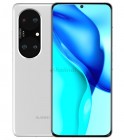
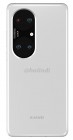
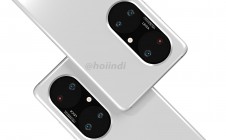
Huawei P50 (unofficial renders) Huawei P50 (unofficial renders) Huawei P50 (unofficial renders) Huawei P50 (unofficial renders)
Huawei P50 (unofficial renders)

Speaking of the P50 series, @HoilNDI has posted renders of the vanilla Huawei P50 (a couple of days ago the same leakster posted P50 Pro+ renders). The renders show a triple camera (no periscope lenses here, of course), what looks like a 3D ToF sensor and a flash, all spread out across the characteristic camera bump.

Source 1 (in Chinese Via 1 | Source 2 | Via 2

The Link Lonk


March 26, 2021 at 10:11PM
https://ift.tt/3lUPoC5

HarmonyOS will officially launch in April, the Huawei Mate X2 will be the first to get it - GSMArena.com news - GSMArena.com

https://ift.tt/3eIwkCL
Huawei
What Apple and Samsung should nab from Huawei's folding phone - Wired.co.uk

huawei.indah.link

From hoverboards to scientific research, and, of course, selling smartphones, no idea is original for long.

Apple is probably the worst culprit when it comes to ‘inventing’ something new we’ve all seen before. From its blurred background portrait mode and multiple lens camera, through to waterproofing and UI widgets — Android phones wore it first, even if iPhones wore it best.

It works both ways though. An iPhone X-style notch found its way onto countless mid-range Android phones in 2018. And Samsung’s AR Emoji was launched swiftly after the Apple Memoji was unveiled.

With all this borrowing and lending, it’s worth looking at the future of folding phones as something of a collaborative effort, and right now, Huawei and Samsung are leading the way.

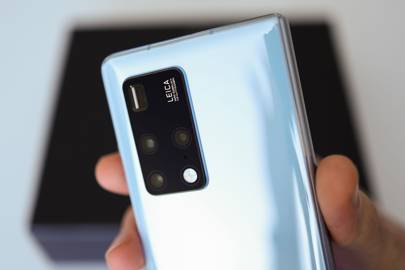
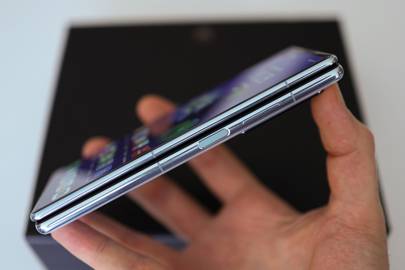
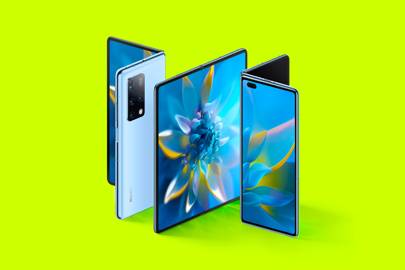
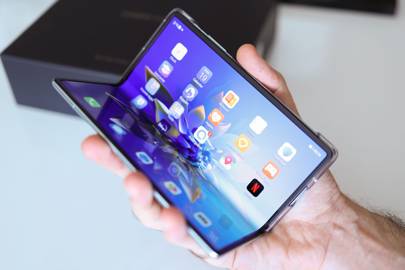
The Huawei Mate X2 recently launched in China. It’s Huawei’s third foldable, and clearly borrows a lot from the Samsung Galaxy Z Fold 2. While Huawei’s previous Mate X phones had wraparound folding displays, Samsung has always opted for inward folding displays — a miss with the Z Fold, but a hit with the Z Fold 2. Now, Huawei has joined the club, clearly inspired by Samsung’s best foldable to date.

On first glance, the Mate X2 (£1,985) looks like a Z Fold 2, P40 Pro Plus lovechild. Huawei’s clearly conceding foldable displays are too fragile to adorn the outside of a smartphone.

Our old Mate X is a testament to the fact, with the screen denting and discolouring after a chance encounter with the corner of another phone. A week in using its successor as our primary, and the Mate X2 is clearly the best folding hardware we’ve seen in five key ways.

It stands up

What do you do with a tablet or big-screened foldable? You watch it. What makes watching anything on your phone a thousand times easier? A hands-free experience, and in turn, a kick stand.

The Huawei Mate X2 ships with a fantastic kickstand case, or as Huawei calls it, a Flip Stander. Available in four colours, black, blue, pink and white, the case styling matches the phone’s curved glass back panel beautifully and adds a vegan leather finish to the mix for a soft-touch sensation. An instant win in the looks department, when you’re spending almost two grand on a phone, you don’t want to hide it in an ugly, chunky case.

Securely propping the Mate X2 up at two angles, the spring-loaded arm puts the phone at a 70-degree pitch, or a 30-degree angle when rested on a surface. We understand Apple and Samsung have never shipped cases with their phones — why cannibalise on all those accessory sales? But given the price of foldables, that’s one cash cow that could be worth ditching in favour of user experience.

A usable front-display

The Galaxy Z Fold 2 is great on paper, with two quality AMOLED screens, one flexible, one fixed. The outer display, however, has a 25:9 aspect ratio screen. Despite being much better than the tiny screen on the front of the original Z Fold, the Z Fold 2’s beanpole display is tall, thin, and very difficult to type on. Swiping through photos on it feels like you’re looking at thumbnails, and even 16:9 movies are a challenge thanks to ridiculous amounts of letterboxing. By contrast, the Huawei Mate X2’s front screen is much better.

With a Sony Xperia 1 II aspect ratio of 21:9, the Mate X2’s main display is tall without being totally impractical. The 90Hz refresh rate glides, and matches the inner-screen smoothness, picture quality is tastefully, naturally calibrated, and that handy kickstand helps show off the outer screen when watching widescreen, cinema aspect ratio content.

A decent front-screen is imperative for battery optimisation on a foldable as well. After all, whether you’re Apple, Huawei or Samsung, if your foldable constantly forces users to switch to the 8-inch tablet-sized flexible display, your foldable’s battery won’t go the distance.

Flagship cameras

Samsung’s camera phones only caught up with Huawei’s P and Mate series’ in 2021, with the Galaxy S21 Ultra hitting a 10x zoom home run. Unfortunately, Samsung’s foldable is falling behind. The Galaxy Z Fold 2’s camera is a humble 12MP trinity with a 2x zoom.

Meanwhile, in the Huawei camp, the Mate X2 has the best camera we’ve ever used on a foldable, with its 50MP main sensor, ultra-wide camera with macro capability and two telephoto cameras, one 3x and one 10x zoom.

Huawei’s image processing is always sensational on its flagships, and that the camera array on the Mate X2 is identical to that of the P40 Pro — a masterclass in how to make a fantastic camera phone — is exactly what we’d expect in future from flagship foldables.

For the Galaxy Z Fold 3, or Apple’s iFlap, iFlex or iFold, a compromise-free, true flagship camera would be a must to keep it competitive with the best from Huawei.

Fast charging

Compared to Huawei and OPPO, Apple and Samsung are trailing behind when it comes to charging speeds. While Huawei’s Mate X2 Pro charges at up to 55W, powering up almost 70 per cent in just half an hour, the Z Fold 2 charges at 25W, just over half that speed.

Even Samsung’s flat phones aren’t breaking through these speed barriers, with the only Samsung device currently showcasing nippier 40W charging being the Tab S7+, and it doesn’t even ship with a 40W charger.

Meanwhile, Apple’s trailing behind everyone with the iPhone 12 Pro Max charging capping at 20W, and missing out on any charger in the box, let alone a fast one.

Just like front-display quality, charging speed matters more for foldables. They drain faster when watching or gaming on their big screens. In turn, there’s a greater chance foldable owners will need a fast top-up to get them through the day without running dry.

Size matters

The whole point of folding phones like the Galaxy Z Fold 2 and Huawei Mate X2 is to enjoy a tablet experience that fits in your pocket.

Tablets tend to be about 10 inches, with anything smaller generally constituting a big phone. The Huawei Mate 20X has a 7.2-inch screen, which isn’t much smaller than the Galaxy Z Fold 2’s 7.6-inch ‘tablet’ screen. As for the Z Fold 2’s outer display, it’s 6.23 inches.

Huawei has been much more generous when bestowing those inches on its foldable. Opened up, the Mate X2 is a full 8-inch tab, while the front display is 6.45 inches. Both screens on the Mate X2 are also sharper than those of the Galaxy Z Fold 2, clocking in at more than 400 pixels per inch, and the inner display ditches a tablet selfie camera in favour of an interruption-free, virtually square screen.

A decent size to type on, edit documents with a Bluetooth keyboard and mouse hooked up, and – game on – the Mate X2 really is dream foldable hardware.

We can’t stress enough, it’s riding on the coattails of the Galaxy Z Fold 2, and Samsung deserves a huge amount of the credit for Huawei’s latest foldable triumph. Additionally, in the West, Samsung’s smartphone is a much easier sell than Huawei’s, given the fact it’s available locally, not just on import from China, and it also offers full access to the Google Play Store.

Mark Twain famously said it: “There is no such thing as a new idea. It is impossible. We simply take a lot of old ideas and put them into a sort of mental kaleidoscope. We give them a turn and they make new and curious combinations.”

With the foldable market expected to generate $105.3bn by 2025, it probably won’t be long before Apple announces its own curious foldable combination, and Samsung is definitely due a Z Flip successor in 2021.

And with the Mate X2, among the best smartphone hardware we’ve used, as a template for success, for one of the first times to date, we actually have faith in the future of foldables.

More great stories from WIRED

🇪🇺 Blood clots and misinformation. Europe’s AstraZeneca debacle will have devastating consequences

📦 Brexit is causing havoc for the UK’s legion of dropshippers

📱 Upgrade your device. The best iPhone 12 cases you can buy right now

🔊 Listen to The WIRED Podcast, the week in science, technology and culture, delivered every Friday

👉 Follow WIRED on Twitter, Instagram, Facebook and LinkedIn

The Link Lonk


March 27, 2021 at 01:05PM
https://ift.tt/31o3pii

What Apple and Samsung should nab from Huawei's folding phone - Wired.co.uk

https://ift.tt/3eIwkCL
Huawei
Friday, March 26, 2021

US government's Huawei ban pushes business to Qualcomm's rival - Light Reading

huawei.indah.link

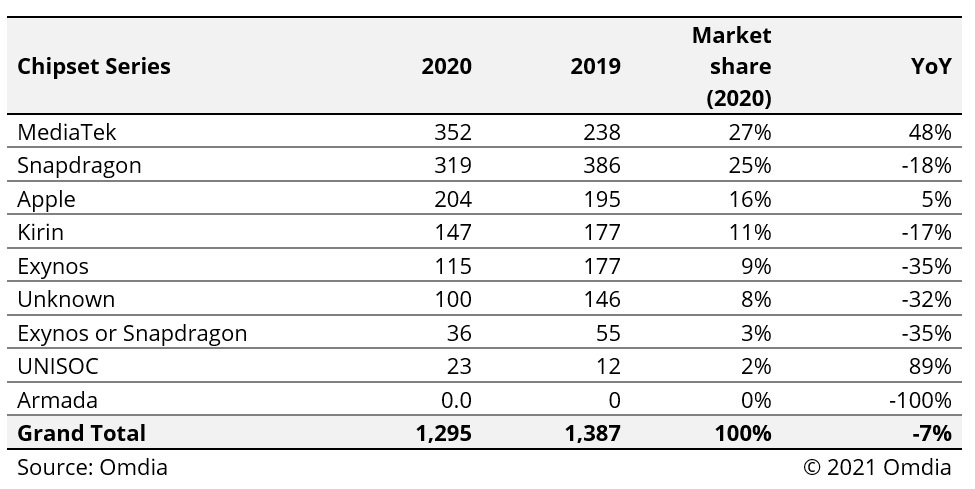
Taiwan's MediaTek recently passed San Diego-based Qualcomm as the world's largest supplier of chips for smartphones. According to analysts, the development is partly due to the US government's actions against China's Huawei.

"After the US government's ban on Huawei, Huawei started to use MediaTek chips," wrote research and consulting firm Omdia in a recent report. The firm is owned by the same parent company, Informa, as Light Reading. "As a result of leading brands utilizing MediaTek technology, other brands also followed, diversifying their respective supply chain. The US technology ban highlighted the need to consider potential political impacts on established supplier relationships."

Other analyst firms agree.

"MediaTek was also able to leverage the gap created due to the US ban on Huawei. Affordable MediaTek chips fabricated by TSMC became the first option for many OEMs to quickly fill the gap left by Huawei's absence. Huawei had also previously purchased a significant amount of chipsets ahead of the ban," wrote Counterpoint Research Director Dale Gai in a report late last year.

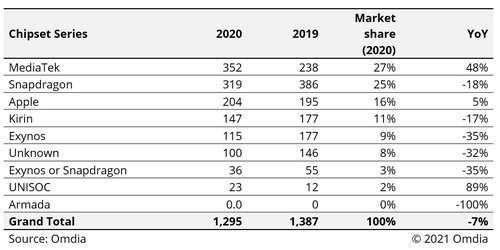
MediaTek commanded 27% of the smartphone chipset market in 2020, according to Omdia, just ahead of Qualcomm's 25%. However, Qualcomm still leads in the growing 5G sector, according to Counterpoint. The firm reported Qualcomm powered 39% of the 5G phones sold worldwide in the third quarter of 2020.

According to Omdia's latest Smartphone Model Market Tracker that tracks chipset shipments by the millions, MediaTek led the market in 2020. Click here for a larger version of this image. (Source: Omdia)
According to Omdia's latest Smartphone Model Market Tracker that tracks chipset shipments by the millions, MediaTek led the market in 2020. Click here for a larger version of this image.
(Source: Omdia)

To be clear, analysts attributed MediaTek's rise to a number of factors, such as Xiaomi's growth in the market and MediaTek's gains at Samsung. However, the findings help to yet again highlight the wide-ranging ramifications of the US government's ban against China's Huawei.

The ban is explicitly intended to help protect Americans from Chinese espionage through Huawei equipment, but in the wider economic context it's also become a leverage point in overall geopolitical positioning between what are becoming the world's two great economic superpowers. Former President Trump championed the Huawei ban amid a trade war with China, and President Biden has so far largely adhered to that trajectory.

This is not the first time Qualcomm's corporate fortunes have been buffeted by the geopolitical climate. The company's proposed acquisition of NXP ultimately collapsed due to opposition from Chinese regulators, while Broadcom's hostile takeover of Qualcomm was halted by American officials. Amid these machinations, Qualcomm itself has worked diligently to retain its business selling its chipsets to Chinese customers.

But Qualcomm isn't burying its head in the sand. US-China relations is one of many risks listed by the company in its financial filings. "A significant portion of our business is concentrated in China, and the risks of such concentration are exacerbated by US/China trade and national security tensions," the company notes.

Related posts:

Mike Dano, Editorial Director, 5G & Mobile Strategies, Light Reading | @mikeddano

The Link Lonk


March 26, 2021 at 11:29PM
https://ift.tt/2PzIR3v

US government's Huawei ban pushes business to Qualcomm's rival - Light Reading

https://ift.tt/3eIwkCL
Huawei
Huawei Upgrades Three Intelligent Cloud-Network Solutions, Accelerating the Digital Transformation of Industries - PRNewswire

huawei.indah.link

Huawei's Global Industry Vision (GIV) 2025 predicts that by the year 2025, there will be 100 billion global connections, 85% of enterprise applications will be cloud-based, and high-speed network connectivity will be available in every corner of the physical world.

The network is integral to the digital transformation of enterprises, and future-proof enterprise networks must offer optimal cloud access experience, carry and deploy services in an agile manner, proactively detect service changes, and constantly predict network risks.

"In the IP networking field, Huawei remains committed to developing intelligent cloud-network solutions, in collaboration with global partners, to accelerate the digital transformation of industries," said Kevin Hu, President of Huawei's Data Communication Product Line. "We believe that our newly upgraded CloudCampus, CloudFabric, and CloudWAN solutions will supply endless power to the digital transformation of industries."

  • CloudCampus 3.0

Huawei's CloudCampus 3.0 Solution is an ideal choice for enterprises to future-proof their campus networks in the cloud era. This solution stands out by offering a "100 Mbit/s everywhere" wireless experience, one global network with high-speed SD-WAN interconnection, SDN-driven cloud management, and intelligent operations and maintenance (O&M) for users and applications. It also comes with a number of all-new products, including Huawei's AirEngine Wi-Fi 6 APs, CloudEngine S multi-GE switches, Wi-Fi 6 CPEs, and the NetEngine AR8000. These exciting new products enable enterprises to inspire further innovation, unleash the value of data, improve O&M efficiency, and ensure service stability and reliability in the cloud era.

  • CloudFabric 3.0

Huawei's CloudFabric 3.0 Hyper-Converged Data Center Network Solution is the first to achieve Level-3 autonomous driving network capabilities. It offers full-lifecycle automation capable of reducing time to market (TTM) by 90%, and also delivers network-wide intelligent O&M to proactively predict 90% of faults. Built on all-Ethernet architecture, this solution is ideally equipped to construct lossless computing and storage networks, unleashing 100% of computing power and further advancing the intelligent upgrade of enterprises.

  • CloudWAN 3.0

Huawei's CloudWAN 3.0 Solution enables enterprises worldwide to build future-proof intelligent WANs, thereby accelerating their digital transformation. As enterprises migrate to the cloud and production networks become IP-based, CloudWAN 3.0 integrates new "five ones" capabilities: one-hop cloud access, one-fiber multipurpose transport, one-click fast scheduling, one-network wide connection, and one-stop integrated security. These features accelerate service deployment to a matter of minutes, create a converged bearer for all services through a single network, facilitate intelligent traffic optimization and load balancing, and enable intelligent O&M and end-to-end security.

Huawei's intelligent cloud-network offerings have received widespread acclaim across such sectors as government, finance, transportation, and energy. At the Huawei Industrial Digital Transformation Conference 2021, Huawei further showcased an extensive range of scenario-tailored network solutions, including the Smart Customs Network Solution, Smart Campus Network Solution for Higher Education, Smart Airport Integrated IP Network Solution, Smart Financial Network Solution, Intelligent IP Network Solution for Power Transmission and Transformation, and CloudCampus Network Solution for Oil & Gas.

To elaborate further, Huawei's Smart Customs Network Solution innovates with super capacity, intelligent experience, and autonomous driving capabilities. With this solution, customers can accelerate their digital transformation and build a new foundation for intelligent customs, leading to more secure and convenient cross-border trade.

In the higher education sector, Huawei's Smart Campus Network Solution makes it easier to offer higher quality education by establishing cutting-edge digital infrastructure and integrating end-to-end network security.

In the electric power sector, Huawei's Intelligent IP Network Solution for Power Transmission and Transformation draws on cutting-edge technologies — such as FlexE-based slicing, ultra-broadband all-Ethernet, and intelligent management and control — to offer a deterministic network experience. This solution enables electric power companies worldwide to effectively advance the digital transformation of their power grids while accelerating the transition to the "Energy Internet" era.

To date, Huawei's intelligent cloud-network offerings have served more than 12,000 customers in more than 140 countries and regions. Looking ahead, Huawei will collaborate with even more partners to further enable business innovations, contributing to the success of a wide range of industries and building a foundation for industry digital transformation.

The Huawei Industrial Digital Transformation Conference 2021 was held from March 24 to 26. To learn more, click https://e.huawei.com/en/events/industry-digital-transformation/2021.

Video - https://mma.prnewswire.com/media/1474749/EN_HIDTC.mp4

Related Links

www.huawei.com/cn

SOURCE Huawei

The Link Lonk


March 26, 2021 at 05:12PM
https://ift.tt/3d88NLY

Huawei Upgrades Three Intelligent Cloud-Network Solutions, Accelerating the Digital Transformation of Industries - PRNewswire

https://ift.tt/3eIwkCL
Huawei
Thursday, March 25, 2021

Huawei meets history: Great powers and telecommunications risk, 1840-2021 - Brookings Institution

huawei.indah.link

In late 2018, amid American concerns about whether Canada would welcome Huawei into its telecommunications networks, Canadian Prime Minister Justin Trudeau made a series of statements that captured conventional wisdom across much of the world. “It shouldn’t be a political decision,” he declared at the time, and Canada would not “let politics slip into decisions” about Huawei’s role in its network.1

The notion that power politics could be removed from questions over telecommunications was not only optimistic, it was also out of step with the history of telecommunications. This report explores that history, and it shows how power and telecommunications have almost always been closely linked. When states ignored those linkages and were cavalier with the security of their own networks, the results were disadvantageous and at times even disastrous.

This report examines several major cases of great power competition in telecommunications dating back to the earliest inception of electrical telecommunications in the 1840s. These cases demonstrate that many of the questions policymakers confront today have close analogues to the past. While the present debate over network security and 5G infrastructure may feel new, it in fact echoes forgotten disputes dating back to the dawn of electrical telecommunications some 150 years ago. Moreover, many of the familiar elements of telecommunications competition today — such as the use of standard-setting bodies, state subsidies, cable taps, information warfare, developing country markets, and encryption to gain advantage — were developed more than a century ago, with important lessons for present debates.

A list of these key lessons is provided below:

Control over global telecommunications networks is a form of political power. 5G networks are expected to form the foundation of a smarter, connected economy linking countless devices and sensors together. Eager to build these networks worldwide, China has subsidized its 5G champion companies and projects around the world as part of a “Digital Silk Road” initiative. That effort is analogous to Great Britain’s pursuit of network dominance at the dawn of electrical telegraphy. Britain built its advantage over six decades by steadily increasing the dependence of other states on its networks — even forgoing fees and economic benefits to entice them to run cables through Britain — while also reducing Britain’s dependence on foreign networks. It eventually controlled more than half of the world’s cable traffic, the largest radio network, and the largest fleet of cable ships. Britain’s “information hegemony” allowed it to cut Germany off from virtually all global telecommunications in World War I and forced Berlin to route traffic over British-owned lines susceptible to British monitoring, which later proved decisive in Germany’s defeat in the conflict.

"All Red Line" British cable network
The “All Red Line,” a costly network of British undersea cable lines built with enormous redundancies and arranged so that no part passed through a rival’s territory. Germany’s inadequate investment in its own resilient global telecommunications network enabled Britain to cut it off from global communications while Britain remained generally unaffected. (Source: George Johnson, ed., The All Red Line: The Annals and Aims of the Pacific Cable Project / Internet Archive)

Long periods of peace and prosperity generally lead to complacency about telecommunications risks. In the last 30 years, post-Cold War peace and economic globalization coincided with rapid progress in telecommunications that led states to prioritize revolutionary commercial benefits over political and security risks, including even foreign ownership or operation of networks. A similar development took place at the dawn of telecommunications in the 1840s, which also coincided with a period of relative peace and globalization that continued until World War I. For much of that era, the desire to capture the seemingly miraculous commercial potential of new communications technologies obscured questions related to reliance on foreign networks or companies. Great Britain benefited from the complacency of others by building and then exploiting an unassailable nodal position in global networks, with most other great powers dependent on its networks.

When states are complacent about their telecommunications security, the results can be disastrous and reshape world politics. Decades of German complacency about its dependence on British telecommunications lines meant that by the time Berlin awakened to the risks of that dependency, it was too late to change it. When World War I broke out, Britain cut all of Germany’s cables and forced Berlin to route traffic through British networks despite the risk of interception, which led to the uncovering of the “Zimmerman telegram,” which helped bring the United States into the war. Similarly, Russian indiscipline in wireless radio transmissions in World War I allowed the Germans to intercept communications, “see” the movement of Russian troops in real time, and deal them a decisive defeat at the Battle of Tannenberg. Then, in World War II, Nazi overconfidence in its ciphers led to minimal efforts to update them, allowing Great Britain to break the codes and obtain intelligence that is believed to have shortened the war by two to four years. Given the power of information, even occasional bouts of signals indiscipline or complacency can alter history.

New technology always leads to new efforts to intercept it. The emergence of undersea cables led to efforts to cut and tap those lines as early as the Spanish-American War; radio transmission gave rise to efforts by rivals to capture network nodes and to intercept transmissions; and the emergence of sophisticated ciphers for encryption produced industrial-scale efforts to break them. In each era, some believed a new leap in communications might be less vulnerable than the ones that preceded it. Each time, however, the cycle of innovation and exploitation continued.

A depiction of the U.S. cable-cutting expedition at Cienfuegos published in 1907.
A depiction of the U.S. cable-cutting expedition at Cienfuegos published in 1907. The operation demonstrated that undersea telegraph cables would not be treated as neutral during armed conflict, even by a great power that had once advocated cable neutrality. (Source: Naval Historical Center Online Library)

Telecommunications networks have never been politically neutral, particularly in times of tension. In 2019, Huawei executives made a “no-backdoor, no-spying” pledge and promised that their company would remain outside of politics, with China’s government committing to respect the pledge. But even more than a century ago, telecommunications companies and their host governments made similar promises publicly while privately breaking them and working together in both peacetime and wartime. For example, British dominance in undersea cables led the French, Germans, and Americans to advocate for keeping the lines neutral, even in war. British firms publicly declared their neutrality but in actuality deferred to British political interests, particularly at moments of great tension, and gave up neutrality entirely during periods of war. The power that comes from disrupting or intercepting rival information flows has generally been too alluring for even sincere claims of neutrality to endure.

States often seek their own telecommunications champions once they recognize the vulnerability of relying on a competitor or adversary’s firms. The United States currently lacks a major manufacturer of 5G base stations, which has prompted debates about whether it should invest in its own companies or rely on allied companies. It has also spurred disagreement over to what degree Huawei is itself a de facto state champion. These debates have some precedent. In the early 20th century, many states reliant on others for telecommunications equipment or networks began to build their own systems. For example, Germany pushed two German companies with competing radio efforts —Siemens & Halske and AEG — together to establish a German alternative to British dominance in radio. Many other leading states backed companies that, while ostensibly private, were intertwined with the states that supported them.

The struggle for telecommunications standards can determine which states will wield network power, and it often requires enlisting allies and partners. States whose technology becomes the dominant standard can wield that leverage over others. The current contest over information communication technology standards is, in this way, similar to the Anglo-German contest over radio networks. Britain, through the Marconi Company which it supported, was so dominant in wireless radio that all other great powers had to pass messages through Britain’s wireless network, which refused to engage with any other wireless stations. Germany ultimately found success breaking that dominance at a standard-setting body that prohibited this “non-intercommunication” policy with the help of other powers, including the United States and France — a demonstration of how similar coalitional approaches today could be used by liberal states to set or preserve favorable information and communications technology (ICT) standards if they work together.

Marconi Company radio operator in the “Marconi Room” of the German ocean liner SS Deutschland.
Marconi Company radio operator in the “Marconi Room” of the German ocean liner SS Deutschland. The Marconi Company’s influence was so great that their employees operated in German radio rooms even though Germany was concerned about the risks of interception and denial. Source: Library of Congress, George Grantham Bain Collection

States turn to encryption as their communications become easier to intercept, but encryption often has limits due to determined adversaries or user error. Some argue that anxieties over Huawei’s role in networks or over the general vulnerability of devices connected to the internet is ameliorated by modern encryption. These kinds of arguments have a long history. At the dawn of telecommunications a century ago, the possibility that telegraph messages could be read by others who controlled network nodes, or that radio could be intercepted by passive listening equipment, led to major encryption advances that bred occasional overconfidence. Germany’s complex rotor cipher machines were believed to be unbreakable, but user error and British industrial-scale efforts allowed Great Britain to compromise German codes. Low-cost updates to German equipment and ciphers could have ended Britain’s advantage, but Berlin’s overconfidence in its encryption forestalled those alterations, yielding intercepted intelligence that reshaped the course of the war. End-to-end encryption is significantly more advanced than prior efforts at encryption, but history suggests some humility is necessary.

Many states discount the degree to which an adversary may make extraordinary efforts to compromise their networks. Amid debates over modern telecommunications, it is worth noting that states that prioritized convenience or commerce, and therefore took security shortcuts, have often been unpleasantly surprised by the efforts a determined adversary will make to compromise their networks. In World War I, Germany was surprised by the speed and ruthlessness with which Britain cut all the cables Germany used to access the outside world; similarly, Russian commanders were surprised when their radio indiscipline led to a disastrous defeat at Tannenberg. In World War II, Germany did not expect the British to build a highly-centralized, industrial-scale code-breaking operation that could exploit German communications errors — no matter how trivial or fleeting — to break German codes. And during the Cold War, the Soviets never encrypted an internal underwater telephone line they believed was outside the reach of the United States, but Washington nonetheless found a way to tap it — gaining an invaluable source of intelligence.

Network security is not only about interception, but also about denial. Some of the debate over Huawei’s role in networks emphasizes questions of data security but could benefit from greater consideration of network denial, which has been an important part of great power telecommunications competition. The dawn of telegraphy saw great powers seek to cut cables and deny communications, culminating in Great Britain’s unprecedented and well-planned operation to sever all of the cables around the world that could connect Germany to the outside. Sometimes, a state may harm itself in pursuing network denial strategies, but will nonetheless proceed if it believes the harm is greater to its opponent.

This report was completed before Rush Doshi’s government service, involves only open sources, and does not necessarily reflect the official policy or position of any agency of the U.S. government.

The Link Lonk


March 25, 2021 at 10:51PM
https://ift.tt/2NW5aQK

Huawei meets history: Great powers and telecommunications risk, 1840-2021 - Brookings Institution

https://ift.tt/3eIwkCL
Huawei
Featured Post

Huawei lawyers claim emails prove US has no grounds to extradite CFO from Canada - The Guardian

huawei.indah.link US justice department’s battle to extradite Meng Wanzhou from Canada has taken a fresh turn as lawyers for Huawei’s chie...

Popular Posts