Rechercher dans ce blog

Wednesday, July 29, 2020

Brazil may face 'consequences' if it gives Huawei 5G access, says U.S. ambassador - WHTC News

huawei.indah.link

by

(Reuters) - The top U.S. diplomat in Brazil said in a newspaper interview that the country may face "consequences" if it allows China's Huawei Technologies into its 5G network, referring to U.S. warnings that China fails to protect intellectual property.

The U.S. government has stepped up efforts to limit Huawei's role in rolling out high-speed, fifth-generation technology in Latin America's largest economy. It believes Huawei would hand over data to the Chinese government for spying. Huawei denies it spies for China.

U.S. Ambassador Todd Chapman told O Globo that Brazil would not face reprisals for picking Huawei, but could face consequences.

"Each country is responsible for its decisions," Chapman was quoted as saying. "The consequences we are seeing in the world are that firms involved in intellectual property are scared to make investments in countries where that intellectual property is not protected."

Chapman added that the U.S. International Development Finance Corp, an agency created by U.S. President Donald Trump to boost U.S. overseas development financing efforts to counter China's influence, has $60 billion in its coffers. He said the U.S. government has agreed to make money available from the fund to help support allies who choose to buy their telecoms infrastructure from "trustworthy suppliers."

Brazil's far-right President Jair Bolsonaro said last month that 5G deployment would have to meet national sovereignty, information and data security requirements. A longtime China skeptic, Bolsonaro has adopted a less abrasive stance toward Beijing since taking office in 2019, although he remains a close Trump ally.

China is the top market for Brazilian exports.

Earlier this month, a Huawei executive warned that Brazil could suffer years of delay in deploying a 5G telecoms network and higher costs if it succumbs to mounting U.S. pressure to snub the Chinese equipment supplier.

Brazilian operators have built significant parts of their infrastructure using Huawei's equipment.

(Reporting by Gabriel Stargardter; editing by Jonathan Oatis)

The Link Lonk


July 29, 2020 at 08:16PM
https://ift.tt/3feDTAl

Brazil may face 'consequences' if it gives Huawei 5G access, says U.S. ambassador - WHTC News

https://ift.tt/3eIwkCL
Huawei

Watch These 10 Stocks as Asian Tech Stands to Take $25 Billion Huawei Hit - RealMoney

huawei.indah.link

The U.S. sanctions and restrictions on Chinese telecom supplier Huawei Technologies are starting to ripple through the tech sector. The U.S. Department of Commerce in May moved to restrict access even to parts made outside the United States if they were made with U.S. technology.

That action is resulting in operational upheaval at many of Huawei's suppliers and rivals. Standard & Poor's estimates that there's a US$25 billion direct and indirect cost to Asian tech companies, with chip foundries in Asia losing 15% to 20% of revenues.

Here's how the impact breaks down.

Taiwan Semiconductor Manufacturing Co.

Taiwan Semiconductor Manufacturing (TSM) is the company most directly affected by the U.S. sanctions. The world's largest contract chip manufacturer uses U.S. technology in its production. It will need to cut off sales to Huawei or risk U.S. retribution. That puts 10% to 15% of its revenue at risk directly, with another 5% at risk due to indirect effects.

The reduced sales may last for three to four quarters. However, TSM is seeing strong demand for its high-performance computing chips for servers, personal computers and communications gear. It is benefitting from emergency investment in data centers and telecom infrastructure as work-from-home becomes the norm. TSM has a market-dominant position in high-end process technology.

Chinese companies have given Taiwan Semiconductor a short-term boost, increasing sales by about 33% year on year in the first half of 2020 as Chinese companies built up inventory to ward off the effects of U.S. sanctions. That goose to sales will now fade.

SK Hynix

Semiconductor maker SK Hynix HXSCL in South Korea rivals Taiwan Semiconductor for size in the global market for memory chips, so it faces the same issues as TSMC. Lower supply to Huawei for its smartphones and telecom equipment poses a threat to 10% to 20% of the company's total revenue.

The Korean company nevertheless should see a strong 2020 due to demand for its solid-state drives and DRAM drives for servers that are in heavy demand at data centers. Its memory chips aren't affected by U.S. restrictions because they don't depend on U.S. technology. In the oligopolistic market for global memory chips, Hynix should sustain its business, S&P believes.

Samsung Electronics

Samsung Electronics KR:005930 is the world's largest semiconductor manufacturer, a chip-making business that is directly hurt by the Huawei ban. Huawei buys Samsung's memory chips, display panels and camera modules for its smartphones. Given the challenge to retail sales in the current environment, the Korean company will struggle to replace that lost business.

However, Samsung also competes with Huawei on smartphone sales, an area where it will benefit from Huawei's sanctions. Seeing Huawei cut out of U.S. and European 5G networks presents an opportunity for Samsung's rival network-equipment products and substantially could strengthen its market position over the next two to three years, S&P believes.

The great span of the Samsung chaebol -- it accounts for 20% of South Korea's entire exports --insulates it. Less than 5% of its sales would be at risk from lost Huawei business. Its chip foundry could request a special license from the U.S. government to supply Huawei, but probably should be looking elsewhere for its customers.

LG Electronics

LG Electronics, with a U.S.-listed subsidiary LG Display (LPL) that makes smartphone and TV screens, is Samsung's hometown rival. Its subsidiaries LG Display and LG Innotek supply Huawei with smartphone screens and components. S&P notes that in the current economic environment it will be hard to find customers in expansion mode that can take on that capacity.

But like Samsung, LG has competing smartphones that stand to benefit from increased sales. The Korean chaebol also has more than enough diversity to absorb the hit, losing less than 5% of sales due to Huawei exposure.

Foxconn

Foxconn HNHPF -- full name Hon Hai Precision Industry -- is the world's largest contract electronics manufacturer, making most of the world's iPhones for Apple (AAPL) in China. The Taiwanese company is the largest private employer in China, with more than 1 million mainland employees across a dozen factories. Some 5% to 10% of its sales are in trouble because they stem directly from business with Huawei.

Foxconn can ride out that dent to revenue, although it hurts. Foxconn faces far greater problems from the Covid-19 crisis, which is affecting almost all its sales and has disrupted its factory operations. Global disruptions due to the pandemic have led to a 6.7% drop in revenue for the first half of 2020. "Its recovery remains shaky as the pandemic effects play out," S&P states.

TDK

Best-known for its cassette tapes, TDK TTDKY is a market leader in manufacturing the lithium-polymer batteries used in smartphones and headphones. Some 5% to 10% of its revenues are at risk because of business dropping off due to lower demand from Huawei.

Sales may drift by a similar 5% to 10% in 2020 due to slower sales of its components. Profitability may see a dip, but with polymer-based technology a must-have in smartphones TDK should be able to shift sales to other customers in short order. TDK is a strong competitor in its battery business, so any short-term impact would be a blip.

Sony

Sony (SNE) supplies Huawei with image sensors for the cameras in its phones. Sony tech aids the augmented reality and autofocus functions on the smartphones, which have multiple Sony-backed cameras. In fact, they are basically Sony cameras inside a Huawei case, even though the Chinese company tends to promote the Leica lens.

Ironically, the smartphones that Sony supplies with sensors (including Apple's iPhones) tend to contain better cameras than the phones Sony itself makes. Sony would have less than 5% of its sales at risk due to Huawei exposure, revenue it could offset with sales to other customers and potentially with higher sales of its own phones.

Xiaomi

Xiaomi XIACY is the big beneficiary of Huawei's woes in terms of international sales. The Covid-19 crisis likely will hold back its top line, resulting in sales growth of 3% to 7% in 2020, S&P predicts. That's down from 17.7% growth last year.

However, Huawei will be forced to sell its phones domestically to offset lost overseas sales, which likely will result in Xiaomi pricing its 5G handsets aggressively inside China. Huawei has specialized in high-end phones, but in the next two to three years may downshift to mid-range models once it uses up its inventory of high-end components. That would bring Huawei into increased competition with Xiaomi's low- to mid-range smartphones.

The Link Lonk


July 29, 2020 at 07:00PM
https://ift.tt/2BDdT3Y

Watch These 10 Stocks as Asian Tech Stands to Take $25 Billion Huawei Hit - RealMoney

https://ift.tt/3eIwkCL
Huawei

Huawei and TikTok are at the forefront of a new drift to regionalism – many others will follow - The Conversation UK

huawei.indah.link

Huawei and TikTok were two of the most successful examples of globalisation. Huawei started as a small private firm in 1987 and has risen in just over 30 years to become a world champion in telecommunications. TikTok has succeeded over a much shorter time period. Having only launched in 2016, the video-sharing service is now the fourth most popular app in the world and has achieved 1.9 billion downloads worldwide.

Both of these Chinese companies are now at the mercy of a widening geopolitical divide. The US has led an increasingly successful campaign to eliminate Huawei from the global market over alleged security fears, and is threatening to ban TikTok too. There has also been speculation that other Chinese tech companies such as Lenovo, ZTE and Xiaomi could be at risk. Meanwhile, HSBC has risked getting caught in the crossfire by expressing support for China’s security crackdown on Hong Kong.

These developments are signs of attempts by the US to decouple from China’s economy and concentrate on alliances within its own political and economic sphere. It chimes with the wider drift away from globalisation towards a more regional approach to trade, reflected in the difficulties of the World Trade Organization (WTO) and the rise of regional trading blocs.

Regional retrenchment

In response to the US moves to restrict its activities, Huawei is now trying to forge closer supply alliances with companies in China and elsewhere in Asia, such as Samsung. TikTok could be making a similar move but in the opposite direction, amid reports that several US investment capitalists might buy the brand from owner ByteDance and separate it from its Chinese version, which is called Douyin. In both cases, these companies appear to be retrenching from a global to a regional focus.

These developments are being driven by the growing antagonism between China and the US – but many other multinationals are facing a similar dilemma, because the global trade system is at risk of breaking down. Multinationals established their dominance by forging global supply chains that maximised the comparative advantages of each country involved.

They have been encouraged since the 1940s by global trade policies that have struck down national trade barriers and deepened global economic integration. In recent years, this has been done through WTO agreements.

Donald Trump giving a speech.
Protectionism personified. Joseph Sohm

But the wealth created by globalisation has been very unevenly distributed, which has caused domestic political disturbance in many corners of the world. Nationalist governments have responded to this new reality with protectionist measures, of which the US-China trade war is only the most prominent example.

As a result, the trade liberalisation promoted by the WTO has run into difficulty. This was clear from the breakdown of the Doha Round of negotiations in the mid-2010s due to unsolvable tensions between the member states. The WTO’s system for resolving trade disputes between countries has also become dysfunctional, stemming from a row over how it operates. Regrettably – but not surprisingly – the WTO’s director-general, Roberto Azevedo, announced he was stepping down a few weeks ago – a year before his term was due to end.

The emerging trading order

In parallel with the rise in protectionism and the WTO problems, countries have increasingly been building regional trade blocs. Examples include the renewed North American Free Trade Agreement (NAFTA), the Pacific rim’s Comprehensive and Progressive Agreement for Trans-Pacific Partnership (CPTTP), and the forthcoming China-led Regional Inter-sessional Comprehensive Economic Partnership (RCEP).

These agreements are all about further liberalising trade between member states within a region. They do this by cutting tariffs, reducing administrative burdens by mutually recognising one another’s technical standards, harmonising public procurement rules, establishing similar employment levels and environmental protections, and giving easier market access to services.

These measures significantly reduce companies’ operating costs, particularly if their production lines are spread across the countries in the bloc. Ultimately they make supply chains more regional, making it easier to buy and sell goods and services within the zone.

But just like the US-China conflict has caused difficulties for Huawei and TikTok, this regional approach to free trade creates tensions with the multilateralism of the WTO. Regional trading blocs run against the principle on which the WTO is founded, namely “most favoured nation treatment”. This says that whenever one nation grants a trading concession to another, it should be extended to all other nations in the world.

Whenever regional blocs expand trade within their region, producers outside the bloc who can make the same goods more cheaply end up being discriminated against. Global welfare suffers as a result. For multinationals trying to operate global supply chains and trade around the world, this also represents a spaghetti bowl of red tape.

Roberto Azevedo looking pensive
Outgoing WTO DIrector General Roberto Azevedo. EPA

Yet the fact that we are now going to have rival trade blocs in Asia when RCEP launches at the end of the year suggests that more regionalism could be the shape of things to come. If so, this could further fragment the global trade system.

It is of course possible that more regionalism could stimulate global free trade in the long run. Once the nations within a bloc have become highly economically integrated, it may encourage outsider countries to join in a attempt to take advantages of the bloc. The UK’s move to participate in the CPTTP could be an early example. If this eventually encouraged multinationals to trade across regional blocs, global trade liberalisation could move back up the agenda.

Equally, the superiority of certain players within certain blocs might make this happen by necessity. For example, Huawei’s dominance in 5G technologies and its efforts to establish an alliance in Asia and other developing countries raises the possibility that it might one day overtake the US tech giants. If so, it may make western governments think again about whether protectionism was working as intended, and encourage them to re-embrace the system of global trade.

The Link Lonk


July 29, 2020 at 05:20PM
https://ift.tt/310kkGT

Huawei and TikTok are at the forefront of a new drift to regionalism – many others will follow - The Conversation UK

https://ift.tt/3eIwkCL
Huawei

Tuesday, July 28, 2020

Tim Cook will testify that Apple is in fierce competition with Google and Huawei - CNBC

huawei.indah.link

Tim Cook, CEO of Apple, speaks in Brussels, on October 24, 2018.

ARis Oikonomou | AFP | Getty Images

Apple CEO Tim Cook plans to tell the House Antitrust Subcommittee on Wednesday that the company is in fierce competition with rivals for the smartphone market.

"The smartphone market is fiercely competitive, and companies like Samsung, LG, Huawei, and Google have built very successful smartphone businesses offering different approaches," Cook said in prepared remarks released by the committee. "Apple does not have a dominant market share in any market where we do business."  

Cook is one of four technology CEOs who will appear in Wednesday's hearing. He will be joined by Alphabet and Google CEO Sundar Pichai, Amazon CEO Jeff Bezos, and Facebook CEO Mark Zuckerberg. All four CEOs released prepared remarks on Tuesday night.

Cook's prepared remarks suggest that the company will heavily employ a defense leaning on the fact that Apple does not have a majority of the smartphone market — only 46% of smartphones shipped in the U.S. in the first quarter were Apple's, according to Counterpoint Research.

Apple is facing criticism over its App Store, which is the only way to install consumer software on an iPhone. Detractors say that the store has challenging and inconsistent rules, and that Apple's 30% take of digital transactions made through apps sold in the store is too high. 

Cook plans to discuss the origins of the store, which was created in 2008, and Apple's reasons why it maintains control over what stays on the App Store and what's not allowed. Detractors often say that Apple's approach to software distribution is like a walled garden, and Apple is the gatekeeper. 

"Clearly, if Apple is a gatekeeper, what we have done is open the gate wider. We want to get every app we can on the store, not keep them off," Cook said in the remarks. 

Cook will also defend the company's 30% fee of digital transactions on the App Store.

"Apple's commissions are comparable or lower than commissions charged by the majority of our competitors. And they are vastly lower than the 50 to 70 percent that software developers paid to distribute their work before we launched the App Store," Cook said in the prepared remarks. 

WATCH: Hey founder on Apple's app approval process

The Link Lonk


July 29, 2020 at 08:07AM
https://ift.tt/3jQRz8b

Tim Cook will testify that Apple is in fierce competition with Google and Huawei - CNBC

https://ift.tt/3eIwkCL
Huawei

China Sends Huawei Soaring To Dizzy New Heights - Forbes

huawei.indah.link

Further proof this week that Huawei inhabits two parallel universes, as staggering sales numbers emerged from China, even as the latest shockwaves from Trump’s blacklist reverberate elsewhere. Huawei’s headline role in the tech standoff between the U.S. and China has seemed to diminish in recent weeks—but only because TikTok has been running interference. In reality, little has changed.

Restricted internationally, Huawei continues to use China to shore up its balance sheet and keep its revenues in sensible shape. The company’s domination at home reached new heights last quarter. Its stunning 46% market share was more than its three local rivals—Vivo, Oppo and Xiaomi—managed between them. All three saw year-on-year sales plunge around 30%, while Huawei saw its own share grow 14%.

Huawei surprised many when it finally achieved its ambition to secure the world’s number-one slot for smartphone sales in April. The combination of strong sales in a Chinese market emerging from coronavirus, while other markets where rival Samsung is stronger continued to struggle, saw it top the pile. All eyes are now on imminent first-half numbers, to see if Huawei can take a surprising top spot.

Market researcher Counterpoint, which published the China numbers on July 24, also highlighted Apple’s performance. The U.S. giant saw its own sales grow sharply, up 32%, which is even more remarkable given how far the high-end Chinese market is now skewed towards 5G handsets—a market Huawei dominates with a 60% share.

Huawei has obviously needed its home market to pick up significant slack given the sales slowdown in international markets, where its blacklisted new phones ship without Google and have found it hard to secure a foothold. Google is banned in China—the U.S. blacklist makes no difference to sales. And so quarter-two China sales growth, from a 33% share last year to 46% this year, is what was needed.

This has been a bruising first half to the year for Huawei, with a damaging extension to U.S. sanctions restricting access to cutting-edge silicon used to power its flagships devices. This led to the U.K. reversing its decision to allow Huawei into its 5G network, and a renewed set of debates across the European region as other markets now run internal debates as to whether the need to do the same.

But there may be some unexpected light at the end of this tunnel, with the news this week that Huawei’s dominance of 5G patents might include a few that its rivals can’t live without in key markets where the Chinese giant finds itself excluded. Expensive license fees would be one way to soften the blow, reducing the financial impact of unplanned revenue shortfalls in countries where it had expected to win contracts.

Behind the headlines, though, there is a serious issue for Huawei in China. It had spent the best part of a decade reducing its reliance on its domestic market, and now those advances have been reversed. Reports that Huawei is cutting costs in India, given heightened border tensions with China, is just another example of a global market that is becoming significantly more difficult for the company.

The double-whammy of the latest U.S. sanctions is that it will hit both 5G equipment and smartphone sales, which account for the vast majority of Huawei’s revenues. The question now for Huawei, remains just how far it can push its dominance at home to compensate for softening sales elsewhere. That decline is impacting 5G sales as well as Google-less phones, making the task significantly harder.

The Link Lonk


July 29, 2020 at 04:21AM
https://ift.tt/39CASsM

China Sends Huawei Soaring To Dizzy New Heights - Forbes

https://ift.tt/3eIwkCL
Huawei

Europe lacks unified approach to Huawei despite yearlong assessments - S&P Global

huawei.indah.link

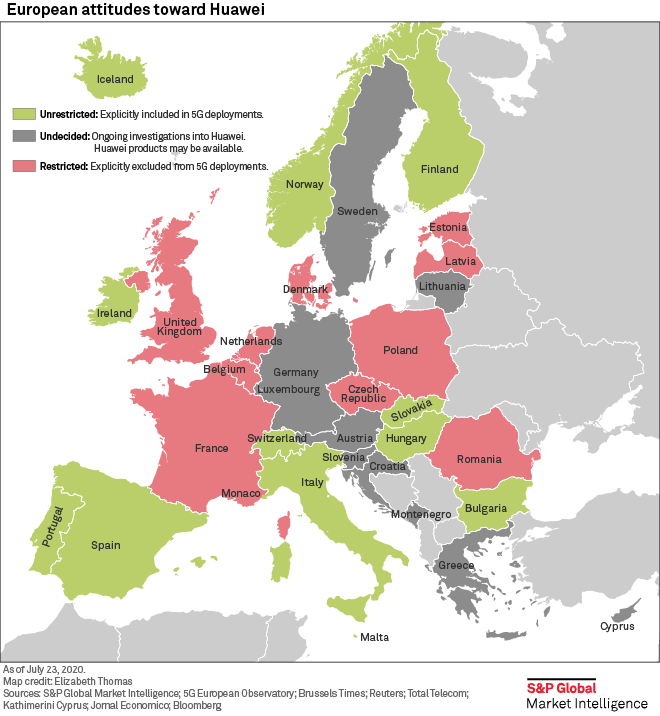
Over a year since the European Commission instructed countries in the region to review and strengthen the security of their mobile networks, data compiled by S&P Global Market Intelligence shows a patchwork of approaches.

Amid calls from the U.S. for countries to ban Chinese telecoms equipment supplier Huawei Technologies Co. Ltd., the EC issued a non-binding recommendation March 26, 2019, for member states to "take concrete actions to assess cybersecurity risks of 5G networks and to strengthen risk mitigation measures." Since then, the EU has created a "toolbox" for 5G security, aimed at ensuring a "coordinated approach" to next-generation wireless network rollouts.

While telecoms operators in the bloc have called for clarity on government policies towards Huawei, the region is still highly divided, with almost an equal number of countries excluding and including the Chinese company from 5G rollouts.

SNL Image

The majority of EU member states have begun phasing out unnamed "high-risk" 5G equipment suppliers from core parts of the mobile data network, an EU official announced July 24. While the region lacks a "harmonious" approach to 5G security, it does not at this stage wish to "name and shame" the countries that have yet to identify so-called high-risk vendors, the official said.

The bloc's goal is to implement a certification scheme to freeze out suppliers deemed a security threat and to legislate on the matter, according to a spokesperson for EU cybersecurity agency ENISA.

In the meantime, countries and businesses are taking it upon themselves to sever ties with Huawei in anticipation of restrictions. France's decision to place a de-facto ban on Huawei by granting local cell carriers shorter, non-renewable licenses on its 5G kit could signal another means of impeding the firm's local presence in the absence of legislation.

SNL Image

The EU said looming bans can be identified by the supply chain actions taken by local network operators in expectation of potential restrictions. In July, Telecom Italia SpA blocked Huawei from participating in an equipment tender for its planned 5G core network in Italy and Brazil, Germany’s Deutsche Telekom AG chose Ericsson to supply kit for its 5G radio access network, while French carrier Orange SA previously picked Nokia to do the same in Slovakia.

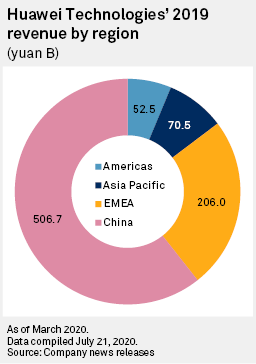
Losing access to European markets could derail Huawei's position as a global leader in telecoms equipment. The region was Huawei's second-largest market in 2019 and is home to alternative equipment suppliers Nokia Corp. and Ericsson.

The Link Lonk


July 28, 2020 at 01:17PM
https://ift.tt/30UIwdT

Europe lacks unified approach to Huawei despite yearlong assessments - S&P Global

https://ift.tt/3eIwkCL
Huawei

Deezer and Huawei talk about AppGallery and how both are using localisation to reach more users - Pocket-lint

huawei.indah.link

(Pocket-lint) - Deezer teamed up with Huawei back in June to bring the music streaming app to

Huawei’s own App Gallery

app store – the app has ‘hero status’ so is one of the top apps on the store.

So we joined a conversation with Huawei’s global senior marketing manager Peter Gauden and Deezer’s chief commercial officer Laurence Miall-d’Août to discuss the partnership and what it means for both.

“I guess there's a shared challenge mentality there where we're building [momentum],” says Miall-d'Août. ”I think both companies are building their experiences and trying to maximise them as much as possible. So yeah, there are definitely lots of shared values.

“I do think Huawei is an amazing company, first of all. I think the design is great. People talk a lot about the quality of the [camera] image, but I think the quality of the sound is also exceptional. So, really, choosing to be distributed…with Huawei was key, especially for mature markets, and to some extent, emerging markets as well.

“From our side I guess the biggest thing is an application with huge global popularity” adds Gauden, speaking about Deezer’s 16 million-strong userbase. “You've got a wealth of really high-quality content for those people who understand music.”

Miall-d'Août believes that Deezer’s strength is in its localisation. “We think we're the only [streaming service[ who really entertains customers through a local and inclusive music experience; we are music experts.

Would users see through Deezer’s approach if they didn’t have those editors? “I think so and the way we measure that is the people actually who follow the editors in the countries.”

“In France, we have six local editors and the same in Brazil. With all of these music genres, you need to have experts in them and they're very well trusted. So it's paramount our editors [find] the local gems, and we get the right mix of local sourcing and identifying new artists. It's harder obviously in the UK because it's global almost.”

Gauden says this fits well with App Gallery’s global-local approach, which he calls ‘glocal’. ‘You’ve got huge global applications, but also providing to users the ability to tap into the local services in front of them through AppGallery. And actually, there's a perfect match there with these as well obviously [Deezer is] full of amazing music from the big music houses, but also a lot of independent local studios as well as local indie labels. And that really matches that Glocal approach.”

“And I guess when you got a platform with over 420 million-plus monthly active users [AppGallery’s userbase], there are a lot of people who are looking for a lot of choices. They're looking for high-quality services through high-quality applications.

“Every app that joins us is that little one step forward. We really have only been working in a dedicated manner on AppGallery for a year. And already, we've grown so significantly. And it all goes [towards] AppGallery being a much more complete destination for power users - for their application needs they can find pretty much everything now and, as we said, this local approach is really important to us.

“Yes we provide access to all of the bigger applications but we also make sure that we cover a lot of the really local applications that are important to consumers with a lot of work. for example. on transport and travel. So we've got Lufthansa and Ryanair. We've done a lot of work in banking and finance so we've got big banks like BBVA.

“So there are a lot of new large and local applications that are joining us. And it really just makes it a much more comprehensive [offering]. The more people engage with us, the more that they find that there is actually the applications that they really need.”

Both companies also see audio quality as an area where they work together well.

“We are also known for audio quality,” says Miall-d’Août, “both on the Premium [tier] but also on our HiFi product, which delivers lossless FLAC quality -  so we like to be perceived as [being] very high quality and I guess similar to Huawei’s high-quality spec. That's where I think the innovation of both companies come together.

“We really want to bring that as what I mean by being an inclusive music experience we want to bring everybody on board with really high quality, and I'm delighted that the Huawei phones have such high-quality audio as well because it's would be a shame if the sound quality is lost [because of] the device quality.

Writing by Dan Grabham.

The Link Lonk


July 28, 2020 at 05:51PM
https://ift.tt/2OZCzHb

Deezer and Huawei talk about AppGallery and how both are using localisation to reach more users - Pocket-lint

https://ift.tt/3eIwkCL
Huawei

Featured Post

Huawei lawyers claim emails prove US has no grounds to extradite CFO from Canada - The Guardian

huawei.indah.link US justice department’s battle to extradite Meng Wanzhou from Canada has taken a fresh turn as lawyers for Huawei’s chie...

Popular Posts