Rechercher dans ce blog

Tuesday, May 25, 2021

Huawei founder urges shift to software to counter U.S. sanctions - CNBC

huawei.indah.link

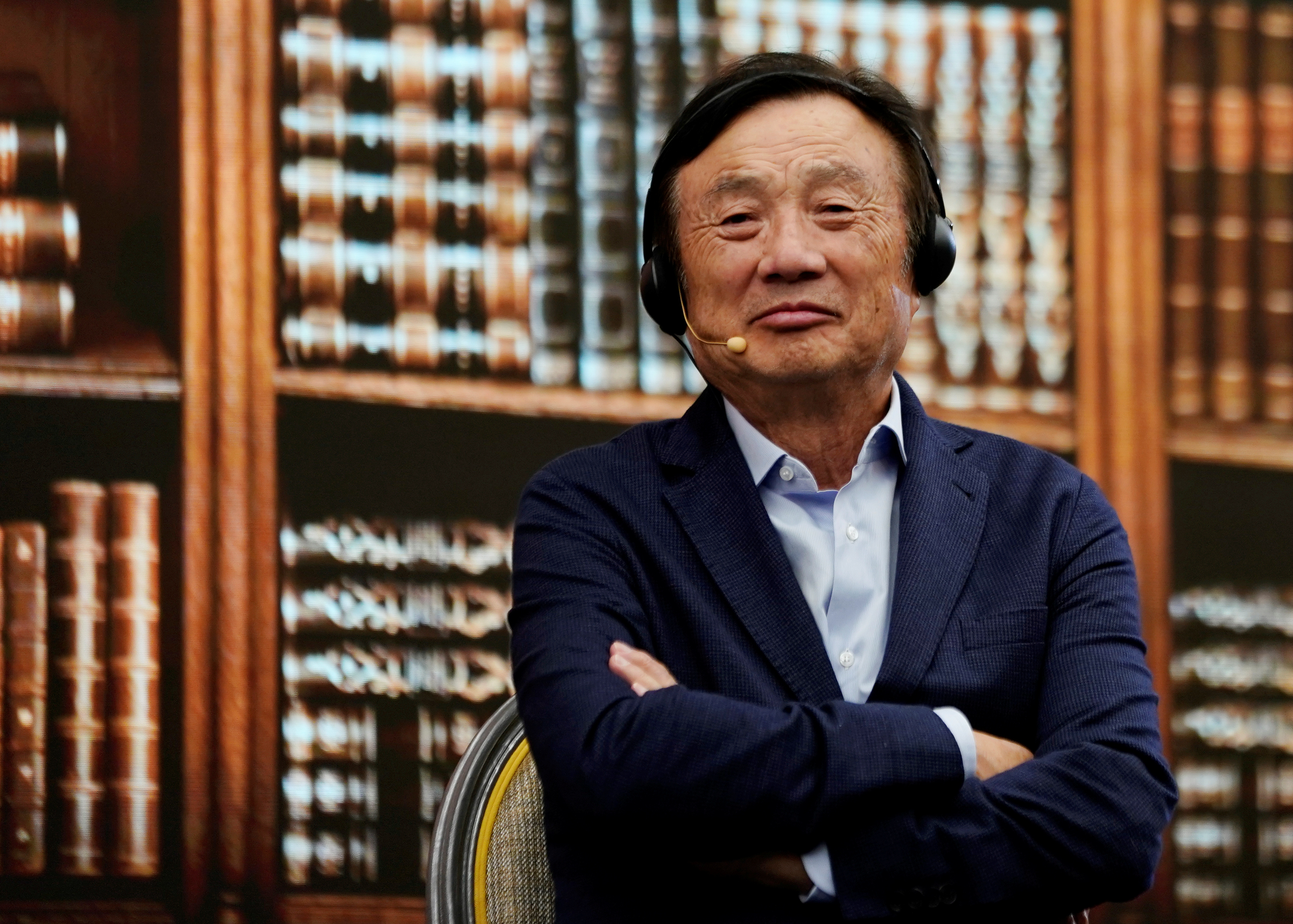
Huawei founder and CEO Ren Zhengfei speaks during a press briefing in Taiyuan, in China's northern Shanxi province on February 9, 2021.

Jessica Yang | AFP | Getty Images

Founder of Chinese tech giant Huawei Technologies Ren Zhengfei has called on the company's staff to "dare to lead the world" in software as the company seeks growth beyond the hardware operations that U.S. sanctions have crippled.

The internal memo seen by Reuters is the clearest evidence yet of the company's direction as it responds to the immense pressure sanctions have placed on the handset business that was at its core.

Ren said in the memo the company was focusing on software because future development in the field is fundamentally "outside of U.S. control and we will have greater independence and autonomy."

As it will be hard for Huawei to produce advanced hardware in the short term, it should focus on building software ecosystems, such as its HarmonyOS operating system, its cloud AI system Mindspore, and other IT products, the note said.

Former U.S. president Donald Trump put Huawei on an export blacklist in 2019 and barred it from accessing critical U.S.-origin technology, impeding its ability to design its own chips and source components from outside vendors.

U.S. President Joe Biden's administration has given no indication it will reverse Trump's sanctions.

The blacklist also barred Google from providing technical support to new Huawei phone models and access to Google Mobile Services, the bundle of developer services upon which most Android apps are based.

Huawei's 2020 annual report did not break down how much of its 891.4 billion yuan ($138.70 billion) revenue was from its software.

Open-source approach

Ren's note also said the software push would depend on finding the right business model and that the company should adopt an open source approach, calling on staff to "absorb nutrients" through open source communities.

He said the company's Welink business communication platform had relied on traditional software licensing, which was unsuited to cloud computing and inferior to a rival product from tech giant Alibaba.

Given the difficulty of working in the United States, Ren's note said the company should strengthen its position at home and build up its territory with a view to possibly excluding the United States.

"Once we dominate Europe, the Asia Pacific and Africa, if U.S. standards don't match ours, and we can't enter the U.S., then the U.S. can't enter our territory," it said.

Ren's note confirms a direction implied by previous announcements from the company that hinted at a shift away from handset hardware.

Rotating chairman Eric Xu in April said the company would invest more than $1 billion this year in its intelligent driving business.

It is also expanding its smart car partnership with state-owned Chongqing Changan Automobile to include the design and development of auto-use semiconductors, sources told Reuters earlier this month. 

Apart from the pressure of sanctions, Huawei is known for its grueling work culture and the note recommended the software teams should hire psychology professionals to help young recruits who might find the company emotionally challenging.

"Now some young people have high IQs, but their EQ might be low, and their mentality is not mature, and it's easy for them to get sick," Ren said.

The Link Lonk


May 25, 2021 at 10:35AM
https://ift.tt/3oLJ3u6

Huawei founder urges shift to software to counter U.S. sanctions - CNBC

https://ift.tt/3eIwkCL
Huawei

Monday, May 24, 2021

Autonomous Networks Is Industry 4.0 - Huawei - Light Reading

huawei.indah.link

What are the main benefits of autonomous telco networks?

Greater automation surrounding service fulfilment and assurance, through “closed loop” mechanisms designed to minimize the need for manual human intervention, is clearly a key plus side when it comes to reducing carriers’ operational expenditure and speeding up time-to-revenue.

But Dr Haiping Che, chief digital transformation officer at Huawei, draws attention to a much bigger picture.

In his recent presentations at Mobile World Congress Shanghai and FutureNet World – as well as in conversation with Light Reading – Dr Che is keen not to limit comparison of network automation to autonomous driving cars, which has become a common analogy.

Instead, Dr Che talks effusively about service “production” and “output.” A more accurate description of autonomous networks, he argues, is to see them as an example of best practice in Industry 4.0 manufacturing.

By adopting smarter, Industry 4.0-type flexible-production ways of running their networks, carriers can not only raise their own production levels through greater agility in service creation and provisioning, but they can also help accelerate digital transformation (and boost productivity) in different vertical industries, including smart cities, manufacturing, and autonomous vehicles.

“I think autonomous networks for communication service products is actually equivalent to Industry 4.0 manufacturing for physical products,” asserts Dr Che. “They have common business logic, structures and frameworks.”

He goes as far as to argue that “the foundation of social progress is closer collaboration between our entire industry, the telecom industry, and other vertical industries.”

New ways of working

In an era of “smart connectivity,” which can harness clever algorithms based on artificial intelligence and machine learning, Dr Che believes autonomous networks will help carriers develop new revenue streams through an on-demand production of “network-as a service” and “network-as a platform” products.

Network as-a-service capabilities in an autonomous environment – as described in a recent whitepaper from the TM Forum – will provide “a one stop, real-time, on demand, automated, end-to-end full lifecycle of network/ICT services.” Network as a platform products are designed to “enable ecosystem collaboration between verticals and network/ICT service providers.”

The goal for autonomous networks, explains the whitepaper, is to “support a set of innovative business models and network services” for vertical industries, “as well as the digital life of consumers through fully automated and intelligent business, ICT and network operations.”

It is a vision that Dr Che fully embraces, which is hardly surprising given that Huawei, in collaboration with BT, China Mobile, Orange, and Telstra, provided initial TM Forum input into what autonomous networks might look like. Together they began an industry push to move away from pre-defined and solidified processes to more flexible ones suited for an on-demand era.

Carriers’ transition to Industry 4.0-type ways of doing things, which means becoming much more service-orientated, requires a re-architecting of networks and organizational change. Dr Che describes it as a radical shift in how the telecoms supply side is structured, moving from a large-scale, standardized, hierarchical, and rigid production mode – typical of the original “weak-connectivity” era, he says – to a “flat, collaborative, and agile production management system.”

With the supply side transformed, explains Dr Che, carriers will be able to implement an “on-demand flexible production mode”, enabling them to provide as “network as a service” and “network-as a platform” offerings, as well as more intelligent computing and intelligent edge service products.

Let’s move together in the same direction

Huawei is keen to work with different industry organizations, various equipment suppliers, system integrators, and software suppliers to turn the autonomous networks vision into reality. One supplier working alone, no matter how big, will not be able to affect industry-wide change.

Dr Che is particularly keen that the supplier ecosystem should “upgrade as soon as possible” the functionality of NE (network element) equipment to intelligent autonomous domains in different network technologies – such as wireless, network core, fiber, IP, and data center networks – driven by “intent-based” APIs.

It is an approach which Huawei is exploring in depth with carrier partners. Autonomous networks not only promise to radically reduce operational expenditure but also to improve customer experiences and ramp up “production” that Dr Che speaks about.

Networks today are built on a plethora of NEs, yet to run the NE an operator must first configure lots of parameters to activate its function. All this requires heavy lifting if using conventional O&M methods, which are labor intensive. Moreover, there is no guarantee at the end of this process that services will be delivered and maintained as expected. With billions more devices expected to be connected to the network as Internet of Things continues to ramp up, carrier O&M is only to get harder (and more inefficient).

Autonomous Networks architecture, however, allows carriers to structure their NEs into intelligent autonomous domains in which intent-based APIs “tell” what kind of service is required in terms of quality and latency. The network then auto-executes those instructions. By using artificial intelligence and machine learning, for example, carriers can move towards “closed loops” where the network looks after itself in terms of service design, rollout, provision, assurance, and optimisation. No longer will NEs have to be “hand-cranked” to do their job. “[Equipment suppliers] can introduce resource-layer operational knowledge through carrier’s E2E network operation platform [to NE equipment] and create these intelligent autonomous domains,” asserts Dr Che.

With a “smarter” network architecture in place, Dr Che suggests carriers will have the opportunity to at least rival customer experiences offered by hyper-scalers.

He talks enthusiastically of “zero-X,” a concept developed by Huawei in collaboration with TM Forum and other partners. Zero-X refers to zero-wait, zero touch and zero trouble capabilities that are needed to support a diverse set of vertical use-case requirements.

It is another example of Dr Che’s Industry 4.0 comparison, where both carriers and enterprise customer can derive mutual benefit from autonomous networks – in this instance, “seamless experiences” and “improved operational efficiencies” to the end user, where end-to-end lifecycle complexity is hidden behind the scenes and experience assurance is in inbuilt.

“We hope to work closely with industry partners and our carrier customers to promote the development of the autonomous networks industry faster, better and more steadily, and facilitate the digital transformation of various industries,” says Dr Che.

This content is sponsored by Huawei.

Huawei Technologies Co. Ltd

The Link Lonk


May 25, 2021 at 12:50AM
https://ift.tt/3oJQ1js

Autonomous Networks Is Industry 4.0 - Huawei - Light Reading

https://ift.tt/3eIwkCL
Huawei

EXCLUSIVE Huawei founder urges shift to software to counter U.S. sanctions - Reuters

huawei.indah.link

Founder of Chinese tech giant Huawei Technologies (HWT.UL) Ren Zhengfei has called on the company’s staff to “dare to lead the world” in software as the company seeks growth beyond the hardware operations that U.S. sanctions have crippled.

The internal memo seen by Reuters is the clearest evidence yet of the company's direction as it responds to the immense pressure sanctions have placed on the handset business that was at its core.

Ren said in the memo the company was focusing on software because future development in the field is fundamentally "outside of U.S. control and we will have greater independence and autonomy".

As it will be hard for Huawei to produce advanced hardware in the short term, it should focus on building software ecosystems, such as its HarmonyOS operating system, its cloud AI system Mindspore, and other IT products, the note said.

Former U.S. president Donald Trump put Huawei on an export blacklist in 2019 and barred it from accessing critical U.S.-origin technology, impeding its ability to design its own chips and source components from outside vendors.

U.S. President Joe Biden's administration has given no indication it will reverse Trump's sanctions.

The blacklist also barred Google (GOOGL.O) from providing technical support to new Huawei phone models and access to Google Mobile Services, the bundle of developer services upon which most Android apps are based.

Huawei's 2020 annual report did not break down how much of its 891.4 billion yuan ($138.70 billion) revenue was from its software.

OPEN SOURCE APPROACH

Huawei founder Ren Zhengfei attends a panel discussion at the company headquarters in Shenzhen, Guangdong province, China June 17, 2019. REUTERS/Aly Song

Ren's note also said the software push would depend on finding the right business model and that the company should adopt an open source approach, calling on staff to "absorb nutrients" through open source communities.

He said the company's Welink business communication platform had relied on traditional software licensing, which was unsuited to cloud computing and inferior to a rival product from tech giant Alibaba (9988.HK).

Given the difficulty of working in the United States, Ren's note said the company should strengthen its position at home and build up its territory with a view to possibly excluding the United States.

"Once we dominate Europe, the Asia Pacific and Africa, if U.S. standards don't match ours, and we can't enter the U.S., then the U.S. can't enter our territory," it said.

Ren's note confirms a direction implied by previous announcements from the company that hinted at a shift away from handset hardware.

Rotating chairman Eric Xu in April said the company would invest more than $1 billion this year in its intelligent driving business.

It is also expanding its smart car partnership with state-owned Chongqing Changan Automobile Co Ltd to include the design and development of auto-use semiconductors, sources told Reuters earlier this month.

Apart from the pressure of sanctions, Huawei is known for its gruelling work culture and the note recommended the software teams should hire psychology professionals to help young recruits who might find the company emotionally challenging.

"Now some young people have high IQs, but their EQ might be low, and their mentality is not mature, and it's easy for them to get sick," Ren said.

($1 = 6.4270 Chinese yuan renminbi)

Our Standards: The Thomson Reuters Trust Principles.

The Link Lonk


May 24, 2021 at 08:12PM
https://ift.tt/3bPDdTl

EXCLUSIVE Huawei founder urges shift to software to counter U.S. sanctions - Reuters

https://ift.tt/3eIwkCL
Huawei

Huawei unveils its first post-Arm board - TechRadar

huawei.indah.link

Huawei’s HiSilicon subsidiary has released its first RISC-V board for the developers of its HarmonyOS family of operating systems.

The release is significant as it is the result of the US trade blockade that delivered a dramatic blow to Chinese manufacturers such as Huawei. Thanks to the trade war between the countries, Huawei’s HiSilicon subsidiary lost access to its semiconductor manufacturing, which centered around Arm.

As it continues to wean away from its dependence on US-based tech, the RISC-V board marks another departure for Huawei, which is reportedly making great strides with its software replacement for Android

The RISC-V open standard instruction set architecture (ISA) has experienced a kind of renaissance in recent years with multiple companies jumping on the bandwagon, including several like Huawei forced to look at alternatives to Arm.

Sign of things to come?

While the RISC-V board is described as a main controller chip, Huawei's documentation doesn't specify the intended purpose of the chip, according to Tom’s Hardware.

The RISC-V board is based on Huawei’s Hi3861 controller and sports a serial port controller as well as a USB-C port as well as GPIO (general-purpose) pins. 

Scrolling through its specs, Tom’s Hardware believes that the board named HiSilicon Hi3861 development board appears to have Raspberry Pi-like capabilities, at the very least, and is probably designed for the Internet of Things (IoT) market.

Traditionally, HiSilicon's development efforts were aimed at high-margin smartphones, tablets, PCs, and embedded systems, and Tom’s Hardware reckons that the new RISC-V chip could perhaps be a springboard to other, more powerful devices. 

Via Tom’s Hardware

The Link Lonk


May 24, 2021 at 08:10PM
https://ift.tt/3bR86GZ

Huawei unveils its first post-Arm board - TechRadar

https://ift.tt/3eIwkCL
Huawei

Jason Ding to move on from role as Huawei's IP chief - IAM

huawei.indah.link
[unable to retrieve full-text content]Jason Ding to move on from role as Huawei's IP chief  IAM The Link Lonk


May 24, 2021 at 05:36PM
https://ift.tt/3vlipei

Jason Ding to move on from role as Huawei's IP chief - IAM

https://ift.tt/3eIwkCL
Huawei

Sunday, May 23, 2021

Huawei's HiSilicon Develops First RISC-V Design to Overcome Arm Restrictions - Tom's Hardware

huawei.indah.link

In a bid to overcome US restrictions on its Arm designs, Huawei's HiSilicon has turned to the open-source RISC-V architecture and has even released its first RISC-V board for Harmony OS developers. Due to being blacklisted by the U.S. government, Huawei and its chip division HiSilicon do not have access to development and production technologies designed in America. The restrictions include many Arm processor architectures, including those used in various microcontrollers that Huawei uses widely.

HiSilicon's HiSilicon Hi3861 development board is based on the company's own Hi3861 controller. Huawei's documentation doesn't disclose exactly what the chip does, but it describes it as a main controller chip. The Hi3861 chip is accompanied by a serial port controller as well as a USB-C port. Among the more important aspects, the Hi3861 seems to have all the logic that enables USB-C functionality (e.g., synchronization and port alignment) and GPIO (general-purpose) pins. 

HiSilicon

(Image credit: HiSilicon)

Overall, the HiSilicon Hi3861 development board has rather vast (at least Raspberry Pi-like) capabilities, but not for a world that Huawei's HiSilicon is used to, at least in terms of public opinion.

HiSilicon

(Image credit: HiSilicon)

The Hi3861 is aimed mostly at the IoT market, whereas HiSilicon's development efforts were historically aimed at high-margin smartphones, tablets, PCs, and embedded systems. But Huawei needs computing platforms to use for its other devices, so the HiSilicon Hi3861 is just what the doctor ordered at this time.

When it comes to high-volume products made by Huawei, a non-Arm-based chip makes exceptional sense and also gives the company experience working with an open-source architecture. Only time will tell if the company uses its RISC-V experience to develop other, more powerful devices. 

The Link Lonk


May 24, 2021 at 03:25AM
https://ift.tt/3bQub8J

Huawei's HiSilicon Develops First RISC-V Design to Overcome Arm Restrictions - Tom's Hardware

https://ift.tt/3eIwkCL
Huawei

By: HUAWEI Mate X2 review: the phone I'd choose for the next 5 years – TheReviews - Pocketnow

huawei.indah.link

I’ll be honest from the get-go: I haven’t spent nearly enough time with the HUAWEI Mate X2. And no, I’m not referring to the fact that I would have preferred to have it forever, but, for the purpose of this HUAWEI Mate X2 review, having it for a little bit more than the one week I spent with it would have allowed me to experience it in a deeper fashion. That being said, if I am ever offered the opportunity to take it for a longer spin, I’ll look forward to elaborating on the below.


That being said, I used HUAWEI’s latest and greatest foldable for five days as my primary phone, and I think I have a pretty good grasp at what the product is, and who it is aimed towards. No, it’s not for everyone, even if everyone would afford to purchase it at this prohibitive price point.

Before we get into our HUAWEI Mate X2 review, it’s important to remember that the company made a huge design shift from the previous two models, the Mate X, and the Mate Xs, as I anticipated in my February editorial. You see, the predecessors had an out folding design, which had the advantage of utilizing only a single screen. The main disadvantage: the display was, at all times, exposed to the elements.

HUAWEI Mate X2 review

With the Mate X2, HUAWEI did what Samsung did all along. Added a secondary display to act as the main screen when the now in-folding Mate X2 is closed up. With that in mind, this is our HUAWEI Mate X2 review.

Design

There’s just something about the way HUAWEI designs its smartphones that I’ve always found intriguing. The Editor’s Choice Design award the Mate 40 Pro won is a testimony to that.

If it weren’t for the thickness and the tapering (more in that later), you’d be tricked into believing you’re holding a Mate 40 Pro from the front, and a P40 Pro+ from the back.

The ingenuity of the company’s engineers and designers lies in how they built the phone, at the concept level. The two halves, while almost identical in real estate, are varying in thickness, employing a wedge shape. That not only helps with the center of gravity of the device, making it easier to use while unfolded but plays an important role in the entire folding mechanism.

HUAWEI Mate X2 review

The second aspect to the actual “fold” is the revolutionary Teardrop hinge, replacing the old Falcon Wing hinge from previous models. This new approach, in order to avoid creasing up the display, bends the screen into a teardrop shape. And with the usage of zirconium-based liquid metal inside the hinge, HUAWEI claims this particular component is twice as strong as before on the Mate Xs.

The downside to this hinge is that, except for the two anchor points in the folded and unfolded states, anything in between is spring-loaded. This means that the device if left alone, will more often than not default to one of the two states: folded or unfolded. Because of this, you can’t easily prop it up by itself to use it half unfolded (like a laptop), but you can emulate this state with the use of a case that helps the device prop up.

HUAWEI Mate X2 review

Another aspect to consider is that it’s no easy task to unfold the device using one hand, because of the magnets that hold it in place in its folded state. Luckily, this isn’t such a big deal, because, opposed to its main competitor, the Z Fold 2, the Mate X2 has a larger outer display that doesn’t require you to resort to the inner display for day-to-day operations.

recommended award

Because of nifty tricks like these, and what it translates to (a really flat, relatively crease-free unfolded display) we believe the Mate X2 deserves our recommendation for the best foldable smartphone design.

Hardware

When it comes to horsepower, HUAWEI didn’t hold back and threw in everything they’ve got, including the kitchen sink. And, it makes sense, if you come to think of it. If you’re shelling out close to $2,800 (in Chinese Yuans, as the phone is only available in China), you better make sure it’s future proof.

HUAWEI Mate X2 review

At the heart of the Mate X2 lies the 5G Kirin 9000 chip, with eight cores and its Mali-G78 MP24 GPU. There’s only one memory option, at 8GB, but there are two storage variants to choose from: 256GB and 512GB, expandable via the company’s own NM memory cards.

The outer (cover) display is a 6.45-inch OLED panel with a 90Hz refresh rate and 1160 x 2700 resolution. Flip it open and you reveal an uninterrupted 8-inch panel with 2200 x 2480 resolution. Yes, by uninterrupted we mean that there are no punch holes or notches, which adds to the entertainment and media consumption but dials it back on the user experience side for those who would want to video-call while unfolded.

And, since we’re talking cameras, the cover display houses the front camera, a 16MP unit, together with sensors and other hardware in the oval punch hole.

HUAWEI Mate X2 review

The back features a quad-camera Leica system that is made up of the following:

  • 50 MP Ultra Vision Camera (Wide Angle, f/1.9 aperture, OIS);
  • 16 MP Cine Camera (Ultra-Wide Angle, f/2.2 aperture);
  • 12 MP Telephoto Camera (3x Optical Zoom, f/2.4 aperture, OIS);
  • 8 MP SuperZoom Camera (10x Optical Zoom, f/4.4 aperture, OIS), support AF.

The rest consists of the usual suspects, with notable mentions going out to Bluetooth 5.2 and Wi-Fi 6, a side-mounted fingerprint scanner (inside the power button), and a 4,500mAh battery with 55W fast-charging via HUAWEI SuperCharge.

Software

When it comes to the software, the story is unchanged. Android 10 AOSP-based EMUI 11, with no Google Services, but a continuously expanding HUAWEI ecosystem via HMS.

HUAWEI Mate X2 review

The software experience is pretty identical with the Mate 40 Pro, so check out the Experience segment of that review to get a general view of what to expect.

However, there are some foldable specific features that make the experience pretty smooth, even if these features are not in your face. Handing off between the two displays, as a result of folding or unfolding the device, is seamless.

The operating system itself is packed with some China-specific software out of the box, which makes sense, knowing it’s the only market this phone is available in.

App scaling works well, at least on the apps that we had access to and managed to use. It also helps that there’s a dedicated segment inside Settings especially for this. And, with an 8-inch display, it makes a lot of sense to use apps side-by-side, which (for the supported apps) the Mate X2 does a great job at.

There’s one caveat though: you can’t change the sizes of the apps that are being displayed side-by-side, but this might be my design, rather than a bug, in order to keep the aspect ratio and app scaling problems out of the equation.

Experience

When it comes to the experience, it is one you have to witness first hand in order to really appreciate. From the snappiness of the folding mechanism to sliding your finger across the barely visible crease, all the way to holding it easily with one hand due to the offset center of gravity. HUAWEI really nailed the Mate X2 in most of its aspects, which shouldn’t come as a surprise for a 3rd generation foldable smartphone.

HUAWEI Mate X2 review

Basic phone operation

Basic phone functionality just works. Nothing to report here. Calls and reception are good, data speeds are in line with every other device (only tested on 4G as 5G is not yet available on my carrier in my region).

A special shout-out is due for the speaker system, which is really loud, crisp, clear, and packs enough oomph to silence an entire room awed in surprise.

HUAWEI Mate X2 review

Battery life

Battery life is good for at least two days of regular use. Disclaimer: we didn’t count the amount of time we spent on the 8-inch screen compared to the Cover display. While it will influence your battery life, you won’t spend most of your time with the phone unfolded. But, it’s safe to say that with regular use, you’ll get through two days. If you ever need to charge it, you’ll be assured to know that 30 minutes will give you close to 80 percent of battery juice.

Cameras

When it comes to cameras, HUAWEI has been a benchmark for quite some time. Testifying to all of this is my colleague Adam Lein’s recent take on the Mate 40 Pro, and he’s a professional photographer.

That’s also the case with the Mate X2. Since we’re talking about a hyper-flagship, the company made sure to add all of the best features, sensors, and optics.

There’s no breakthrough here, just delivering the same solid performance we’ve gotten used to from the HUAWEI and Leica partnership. Whether you’re shooting wide-angle, regular, telephoto, day or night, portrait or classic, you can rest assured that you’re going to end up with great quality shots. If we were impressed by the camera on the Mate 40 Pro, the Mate X2 is almost entirely replicating the setup from the Mate 40 Pro+, so, you know, it takes it up a notch (or two).

When it comes to the front camera, since this is an in-folding design, you no longer have to turn the phone around, like with the previous two models, in order to take a selfie with the main cameras. Since it has a dedicated selfie shooter, you’re taking your selfies with the phone folded, like with any regular phone.

What we would like to see is the ability to have both displays on at the same time. This could be useful in showing a preview to your subject on the outer display, before snapping the picture while unfolded. You can, of course, use the main cameras to take a selfie, and it looks kind of awkward, as seen below.

HUAWEI Mate X2 review

HUAWEI Mate X2 review conclusion

Over the past couple of years, I’ve started breaking down flagships even more. Yes, the flagship category still defines a certain type of smartphone characteristics, but there are more levels to flagships. The way I see things is this: the Mate 40 Pro is a flagship. The Mate 40 Pro+ is a super-flagship. …and then the devices like the Mate X2 are, in my book, hyper-flagships. Yes, I guess you got my car analogy.

Whether you think spending north of 2,300 Euros ($2,800) is insane or not doesn’t really matter. The Mate X2 is a niche product, and, it not being for the masses, can wear the price tag with pride.

HUAWEI Mate X2 review

But even if you had the money you wouldn’t be able to buy it outside of China. For whatever reason, HUAWEI made this decision and they seem to be really determined to keep things this way.

Nonetheless, as I alluded to in the headline, if I had to choose a single device to use for the next quinquennial, the Mate X2 would be the one I would go for.

HUAWEI Mate X2 review

Pros

+ superb design;
+ awesome displays;
+ excellent cameras;
+ great battery life;
+ amazing speakers;
+ solid performer.

Cons

– no wireless charging;
– prohibitive price/limited availability;
– lack of Google Services (if that’s still a thing that bothers you).


Anton is the Editor-in-Chief of Pocketnow. As publication leader, he aims to bring Pocketnow even closer to you. His vision is mainly focused on, and oriented towards, the audience. Anton’s ambition, adopted by the entire team, is to transform Pocketnow into a reference media outlet.

Contact: [email protected]

The Link Lonk


May 23, 2021 at 08:00PM
https://ift.tt/3f8EUNH

By: HUAWEI Mate X2 review: the phone I'd choose for the next 5 years – TheReviews - Pocketnow

https://ift.tt/3eIwkCL
Huawei

Featured Post

Huawei lawyers claim emails prove US has no grounds to extradite CFO from Canada - The Guardian

huawei.indah.link US justice department’s battle to extradite Meng Wanzhou from Canada has taken a fresh turn as lawyers for Huawei’s chie...

Popular Posts