SINGAPORE, March 25, 2021 /PRNewswire/ -- HUAWEI Video, the video-on-demand (VOD) streaming platform by Huawei, is looking to celebrate its first-year anniversary with its fans in Singapore. In conjunction with its anniversary, the streaming platform today announced the launch of its limited-time 'HUAWEI Video Turns 1' contest, where users in Singapore can compete to win Huawei's latest products and free subscription to its service.
HUAWEI Video, the video-on-demand (VOD) streaming platform by Huawei, is looking to celebrate its first-year anniversary with its fans in Singapore. In conjunction with its anniversary, the streaming platform today announced the launch of its limited-time ‘HUAWEI Video Turns 1’ contest, where users in Singapore can compete to win Huawei’s latest products and free subscription to its service. (PRNewsfoto/Huawei Mobile Services)
Since launching its all-in-one video streaming app on March 2020, HUAWEI Video has become one of the fastest-growing video streaming services in Asia Pacific. The app, which comes pre-installed on HUAWEI devices, offers an extensive library of video content for its users – ranging from child-friendly content, to dramas, movies, documentaries, as well as concerts. Currently available across six markets in the Asia Pacific region, including Hong Kong (China), Japan, Malaysia, Philippines, Singapore and Thailand, the platform is also set to launch in Indonesia later this year.
"The growth of HUAWEI Video in the past year shows that there is a huge demand for streaming content in Asia and we are committed to delivering quality content through our curation and new partnerships," said the Director of Huawei Asia Pacific Consumer Cloud Service, Shane Shan.
HUAWEI Video Announces Exciting New Content and Deals
Ahead of its one-year anniversary, the streaming platform has announced the addition of exciting simulcast content such as the hit Chinese reality series Sisters Season 2 from MangoTV, and TVB Drama Beauty and The Boss. The app also features popular content such as The World of the Married from dimsum entertainment, A Quest to Heal from Mediacorp as well as Say Yes to the Dress from Discovery.
In conjunction with the celebration, HUAWEI Video is also launching the 'HUAWEI Video Turns 1' contest exclusively to all HUAWEI Video users in Singapore, starting from now to 4 April 2021. Users can complete different tasks and earn chances to spin the lucky draw wheel to win HUAWEI prizes such as HUAWEI devices and HUAWEI Video subscription package.
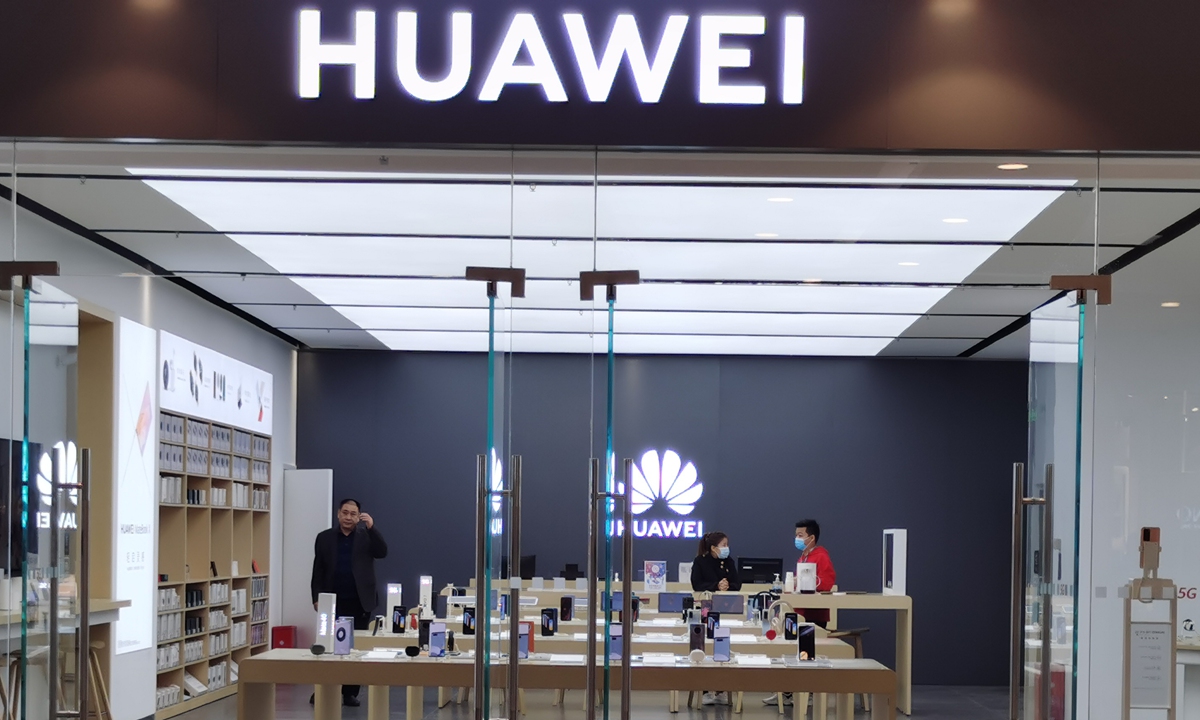
A view of a Huawei store in Central China's Henan Province in November 2020 Photo: cnsphoto
Chinese telecommunications firm Huawei has received a mobile payment license in China through acquisition, expanding its presence in a lucrative business, according to media reports.
Analysts said Huawei's new move could pose a direct challenge to the market dominance of Ant Group and Tencent, which have already drawn close attentions from regulators.
According to a report from the China Securities Journal on Sunday, Huawei acquired the license by purchasing licensed digital payment provider Shenzhen Sharelink Network Co. Data from company information provider Tianyancha also showed that Huawei holds 100 percent of Sharelink.
Huawei has had a presence in the mobile payment field for years, but the license may help it avoid working with Alipay or WeChat as well as saving a large amount of third-party fees, Liu Dingding, an independent tech analyst, told the Global Times on Sunday.
In August 2016, Huawei started to operate Huawei Pay, a payment service that uses near field communication technology. But at that time, bank card provider China UnionPay was responsible for transaction processing, according to previous media reports.
"With the new license, Huawei may be able to operate online stores with its own financial system or offer paid services through its vast range of equipment without paying commissions to third-party payment companies," Ma Jihua, a Beijing-based independent tech industry analyst, told Global Times on Sunday.
Smartphone maker Xiaomi, ByteDance and e-commerce platform Pinduoduo have all received payment licenses.
"With Huawei's large base of phone users and its complete ecosystem and software, it has an advantage in developing the payment sector and posing a threat to its counterparts," Liu said.
Nevertheless, it may still be hard for Huawei to compete with Alipay and WeChat in the short run due to its late entry, analysts said, while noting that Huawei may have already seized the initiative in the future payment scenario.
During the launch of its Mate 40 phone series in October last year, Huawei said that the series was the world's first smartphone that supports digital yuan hardware wallets, paving the way for using the digital Chinese currency that's been under rapid development by China's central bank.
Ma believed that there are also possibilities for Huawei to push its payment method into the international market, but it still needs to cooperate with local financial authorities in other countries.
Huawei's acquisition also comes as Chinese regulators have tightened regulations governing the fintech sector, which could have deep impact on operations of industry giants, including Ant Group.
I became a professional writer and editor shortly after graduation. My degrees are in biomedical sciences; however, they led to some experience in the biotech area, which convinced me of its potential to revolutionize our health, environment and lives in general. This developed into an all-consuming interest in more aspects of tech over time: I can never write enough on the latest electronics, gadgets and innovations. My other interests include imaging, astronomy, and streaming all the things. Oh, and coffee.
If there’s one Chinese phone brand of which you will be aware, it’s Huawei. The super-giant tech company is a huge player, second only to Samsung in the mobile market.
Other phone brand guides
Huawei frequently makes the news, both the tech news and global, whether that’s for launching new, super-powerful camera phones, or for getting banned from the US by Donald Trump.
Much of the company’s business concerns hardware, including smartphones, watches, tablets and more, but it’s also big on infrastructure, since it’s part of the push to set up 5G networks in countries around the globe.
We won’t be delving into the infrastructure side of Huawei, nor will we explore accusations levelled at the company for spying for the Chinese government or other such allegations. Here, the focus will be the brand’s smartphones and consumer tech.
A brief history of Huawei
Huawei P40(Image credit: TechRadar)
Huawei was formed in China as a telecoms company in 1987, but brought its first smartphone to market in 2004. However, it took until 2009 for the company to release an Android phone, and from there we’ve seen a steady stream of the handset types you see today.
In 2013, Huawei created sub-brand Honor, which produces much of the same tech. Huawei sold Honor in late 2020. We have a separate guide to Honor phones, which you can read here.
In 2019, Huawei revealed HarmonyOS, its own operating system to rival Android and iOS, and 2021 has seen the company begin user testing by smartphone users – although, at the time of writing, there haven’t been any handsets to appear with it. Alongside smartphones, Huawei entered the markets for wearables in 2015, laptops in 2016, and tablets in 2019.
The biggest change for Huawei in recent years came in early 2019, in what has been dubbed the ‘Huawei ban’. This is when then-US-president Donald Trump placed Huawei on the ‘entity list’ of companies that US corporations could no longer work with – and this included such firms as Google.
Until that point, Huawei phones – like all Android handsets – had come with Google apps installed including Maps, Gmail and, most importantly of all, the Play Store for downloading new apps. The ban meant that Huawei phones were barred from these apps, a situation that has continued to this day.
As a result, the company’s market share has dwindled, although Huawei has taken steps to mitigate the damage. These include introducing the AppGallery, the company’s own take on the Play Store that holds a limited number of apps; and Petal Search, which on occasion will let you download apps that aren’t available on AppGallery.
Since the Huawei ban, new phones from the company haven’t been met with the level of fanfare they once were, and we’re still waiting for the company to make a big comeback.
What phones does Huawei make?
(Image credit: Future)
Huawei has a number of phone lines across the globe, but here we’ll detail only those that make their way to the West – and, for reasons described above, we’re not including Honor phones.
The company’s main line of phones is the P series. These fantastic camera phones typically come with a standard device as well as a Pro, Lite and even Pro Plus model. Their launch will often see the introduction of new camera tech.
There’s also the Huawei Mate series. Typically higher-end than the P series, these handsets are known for presenting supercharged specs and designs, and are intended for professional users. A good comparison is to view these as Samsung’s Note phones, which again are for pro users, although the Mate devices don’t have styli.
Huawei puts out foldable phones, too, under its Mate X banner – in fact, after Samsung it’s the most prolific maker of folding handsets. So far, all Mate X devices have been ‘book-style’ foldables; Huawei hasn’t yet put out a clamshell-style phone.
Fans of budget devices have found plenty to like in Huawei’s P Smart line, whose models have previously topped our list of the best cheap phones. These low-cost devices bring specs from the P series but at lower prices than those phones.
Huawei phone availability information
(Image credit: Future)
Huawei tends to follow fairly predictable release schedules, which makes this section easy to write.
The Huawei P series usually launches around April or May, although the Lite device is often unveiled a few weeks ahead of the main phone. The Mate device then follows around six months later, near the end of the year.
There’s less of a pattern for the Mate X phones, since these are fairly new – but, so far we’ve usually seen them near the beginning of the year, in close proximity to the P phones.
The Huawei P Smart handsets aren’t accompanied by big launch events, and it’s harder to pin-point their release. Typically we see a new model each year, and it tends to be named after the year – for example, the Huawei P Smart (2019).
Other tech Huawei sells
(Image credit: Ida Blix)
Huawei is a huge tech company, and as such launches numerous products all the time – but we’ll look at its consumer ones.
When it comes to wearables, the company sells both fitness trackers such as the Huawei Band line, and smartwatches such as the Huawei Watch Fit and Watch GT Pro. In the past, the company’s wearables have been near-identical to those launched by Honor, but with the latter now sold, future products are likely to have more differences.
Huawei started selling tablets in 2019, under the MatePad line – but, like its phones, these tablets don’t have Google apps.
Finally, there’s the MateBook line of laptops. These devices tend to be quite stylish and premium-looking, and sometimes offer extra functionality if you also own a phone from the brand. Here at TechRadar, Huawei MateBook laptops have impressed, earning very high scores in our reviews.
The 2020 release of the Huawei P40 Pro and its siblings marked the first entries in the P series without Google apps. It was a big deal then and it remains the headline issue for Huawei today. The lack of popular Google apps and services made the phones a tougher sell to Western audiences than the previous generation. Ultimately, this move halted Huawei’s rapid rise toward the top of the market in its tracks.
Months have passed since then and Huawei’s market share is still reeling from the US trade embargo. Its Honor sub-brand has been sold off and rival brands, such as Xiaomi, are quickly growing to fill the void. Huawei has plugged along, attempting to paper over the software cracks with improvements to App Gallery and Petal Search functions. There’s even been some dubious-looking progress on its “in-house” alternative, Harmony OS.
The Huawei P40 Pro may have suffered these same software woes, but it also offered bleeding-edge hardware, particularly in the camera department. The package hasn’t gone out of style in just a year. In our review, we praised the handset for a range of sizzling specs, from tweaks to Huawei’s already excellent camera system, to a new 90Hz display, and stellar ergonomic design. One year on, have Huawei’s software efforts finally made the Huawei P40 Pro a phone worth spending your hard-earned cash on? Let’s find out.
Before we dive in, be sure to check out our original video review of the Huawei P40 Pro above and read our written review.
About that software …
The Huawei P40 Pro has been running the company’s latest EMUI 11 software version for months now. If you’re a fan of Huawei’s Android skin, EMUI 11 is a familiar refinement. Huawei made a few changes to its interface, animations, and the always-on display. EMUI 11 also presented closer integration with the brand’s other devices, like multi-screen collaboration for laptops. It’s a heavily customized skin loaded with Huawei flavor on top, but in keeping with the direction EMUI has been heading over the years. Even without Google, EMUI still feels like EMUI.
However, EMUI 11 remains running on Android 10 rather than the more modern Android 11. Even though Huawei’s in-house features go above and beyond the basic Android package, EMUI 11 doesn’t include everything that Android 11 offers. Huawei told Android Authority that it plans to integrate select Android 11 features into EMUI 11. We’re still not sure what this means for the future of Huawei’s handsets regarding OS and security updates, though. Going forward, Huawei’s software situation remains a big unknown for potential customers, and that doesn’t compare well when other manufacturers are increasingly promising three years of upgrades.
Still, Huawei’s Play Store alternative — App Gallery — has been given a couple of makeovers lately. It’s more pleasant to look at and use, with many familiar app store features. Although the store start-up ads and home screen app recommendations remain an irritant. Searching for apps is better than before, but it’s still very hit-or-miss if you’ll be able to find what you’re after. Petal Search steps in to pull a wider range of apps from websites and third-party APK stores like APKPure and Apitode. It has also expanded to become a more comprehensive search tool and, to Huawei’s credit, Petal Search has grown into a reasonably good workaround. Although, it still can’t find every app you need, as it’s pulling from GMS not HMS compatible APK stores.
We still can't recommend the app setup to anyone looking for a 'just works' smartphone experience.
It is easier to find apps now than when the phone launched. Unfortunately, the broader process is still patched together (see running web apps in a browser), and sourcing from multiple locations is less secure than Google’s ecosystem. Despite the growing capabilities of HMS core, some apps are still built to be Google-first. The ability to find apps you want and that actually work remains a hassle. It’s still not a setup we can recommend to anyone looking for a “just works” smartphone experience.
The rest of the Huawei P40 Pro’s package fairs better a year down the line. While not boasting bleeding-edge processor specifications, the phone’s Kirin 990 chipset is more than fast enough for most tasks and moderate gaming. I’ve included some benchmarks below for those who are interested.
The key takeaway is that Huawei’s last-gen chip is rather underwhelming for gaming and definitely isn’t one for performance enthusiasts. For the rest of us, the Huawei P40 Pro is a reliable day-to-day performer.
While the processor may be a little behind the curve, the Huawei P40 Pro still packs in very competitive hardware across the rest of its spec sheet. The package is still competitive with slightly new high-end smartphones. With 5G support in tow, this device comes with an IP68 rating, an in-display fingerprint reader, 40W fast wired and 27W snappy wireless charging, and a 90Hz QHD OLED display. The 4,200mAh battery is also plenty for a full day of use and then some.
The Huawei P40 Pro has a few niggles, though. The company’s comparatively expensive proprietary expandable storage — dubbed Nano Memory — remains an irritant when a microSD card would do the same job. I can well imagine that power users with just 128GB of internal storage may have run into this issue a year down the line. I also find the phone rather bulky which, combined with a slippery glass back, makes it a little more awkward to hold than other flagship phones.
Overall, the Huawei P40 Pro’s hardware package is a steal as you can now grab it well below its original price-tag.
Still a solid camera package
Credit: Robert Triggs / Android Authority
One of the biggest reasons to own a Huawei P series smartphone is for the camera. The Huawei P40 Pro is no exception. It’s not as powerful as the 10x periscope zoom options appearing at the ultra-premium end of the market or its larger sibling, the Huawei P40 Pro Plus. However, with a high-quality wide-angle lens, large main sensor, 5x periscope zoom, and dual selfie setup, the Huawei P40 Pro still offers a very competitive camera package at around the €700/£700 mark.
I’ve spent a lot of time with some of the best smartphone cameras on the market today, and the Huawei P40 Pro still ranks pretty highly in my estimations. Although it’s not without some issues and isn’t as consistent as some other cameras. I’ve grabbed a few snaps against the Samsung Galaxy S21 Ultra, Google Pixel 5, and more in the past few months. I’ll let you be the judge of the results.
Without writing out thousands of words on the differences, the Huawei P40 Pro remains very competitive with both phones. Camera technology doesn’t change all that fast anymore, after all. I’d say it’s a fraction behind the much more expensive Samsung Galaxy S21 Ultra in terms of image quality and shooting flexibility, but not by much.
For me, photography is still the handset’s biggest selling point. There’s a reason it came out on top in our 2020 mega shootout. You can dive deeper into the Huawei P40 Pro’s camera capabilities at the links below:
Huawei P40 Pro long-term review: The verdict
Credit: Robert Triggs / Android Authority
Huawei handsets rose to popularity on the back of great hardware, and the Huawei P40 Pro remains compelling. Processor aside, the Huawei P40 Pro still offers specs a year down the line that compete with other phones at this price point and even above. Throw in a camera that remains one of the better packages on the market — especially if you spend a little more on the P40 Pro Plus variant — and you have a recipe for a smash hit.
Hardware is just half the equation, though. There’s no escaping that Huawei’s recent phones are hard to sell to Western audiences who are ingrained in Google’s ecosystem. Even if you don’t use Google apps, the situation with updates and the difficulty with finding apps isn’t up to par with what we expect from a flagship smartphone. You shouldn’t have to turn to ad-infested third-party stores to find the apps you need. Even a year down the line, the Huawei P40 Pro hasn’t solved these issues completely.
Petal Search is surprisingly powerful but it shows how poor the AppGallery's selection is.
I took another look at the Huawei P40 Pro six months after release, and my conclusions are surprisingly unchanged since then. At the time, it felt like Huawei had gained some momentum towards solving its app issues; introducing Petal Search and its Celia assistant, for example, to fill in the gaps left by Google. App Gallery also underwent a few improvements and Huawei, to its credit, has worked with a small selection of developers to offer replacements to popular Google apps like Maps.
Credit: Robert Triggs / Android Authority
That momentum feels like it has slowed down in the past few months. Yes, Huawei likes to talk about the hundreds of millions of active App Gallery users, but its best efforts can be found in Petal Search. It’s a reasonably good way to find apps from third-party stores, such as Netflix or Spotify, and has grown into a more universal search tool too. However, it still can’t guarantee the availability of your favorite banking or fitness subscription apps. The app experience remains second class when compared to Google’s ecosystem, not to mention Apple’s.
Apps are still by far the phone's biggest weakness, and not enough has changed to recommend Huawei's phones to most consumers.
A year from release, it’s looking more like these patchwork solutions are the best the Huawei P40 Pro will ever see. A few more popular apps may be months down the line, but who knows. It’s also looking likely that the handset will remain stuck on Android 10, or some hybrid form, while other smartphones will see Android 12 this year. What we’ve seen and heard about Harmony OS looks no more promising for solving these issues either.
There are certain consumers out there who can happily live outside of the Google ecosystem and could love the Huawei P40 Pro, warts and all. However, as much as I’ve tried to fall for the phone’s solid hardware, the software situation is still the heart breaker.
Huawei P40 ProA stunner of a device, with caveats
A great screen, superb build quality, incredible battery life, and of course that world-class camera system. A shame Google apps are missing.