Between this and a stockpile of chips, Huawei could theoretically keep its telecom hardware business running with relatively little disruption. While its chips from 2021 onward might lag behind international rivals, they could be good enough for the domestic market until Huawei can further improve its designs.
Huawei and the IC R&D Center both declined to comment to FT, with the research firm calling the matter “rather sensitive.”
Huawei might not have to worry about its long-term future if reports are accurate. As you may have noticed, though, there’s no mention of phones in this plan. Mobile devices need highly advanced chip processes to remain competitive at the high end (the Kirin 9000 in the Mate 40 Pro is a 5nm chip), and the reported Shanghai plans wouldn’t help. Huawei can turn to fabrication allies like SMIC for more modest phone chips, but it’s still likely to scale back its phone offerings once their existing supplies dry up.
When I look back at 2020, the first thing that comes to mind will obviously be the world-stopping pandemic, but the next thing I remember might be that this is the year slab smartphones reached its apex—every smartphone brand mastered the art of making a great smartphone.
This is a great thing for consumers, because every recent smartphone above, say, $600, offers premium build quality, high refresh rate screen with super smooth animations, and a main camera that is very capable in all lighting conditions. It just makes my job as a reviewer much tougher because every phone is very good.
The reason phone performances have become more similar than ever is because they all copied from each other. I first came to this realization earlier this year when I reviewed the OnePlus 8 Pro. It was yet another ultra fluid, ultra fast smartphone from the company known for producing the fastest and zippiest phones. But the 8 Pro was not significantly faster than rivals anymore, because others had followed OnePlus’ lead and used a high-refresh screen, sped up animations, and use copious amount of RAM.
Recommended For You
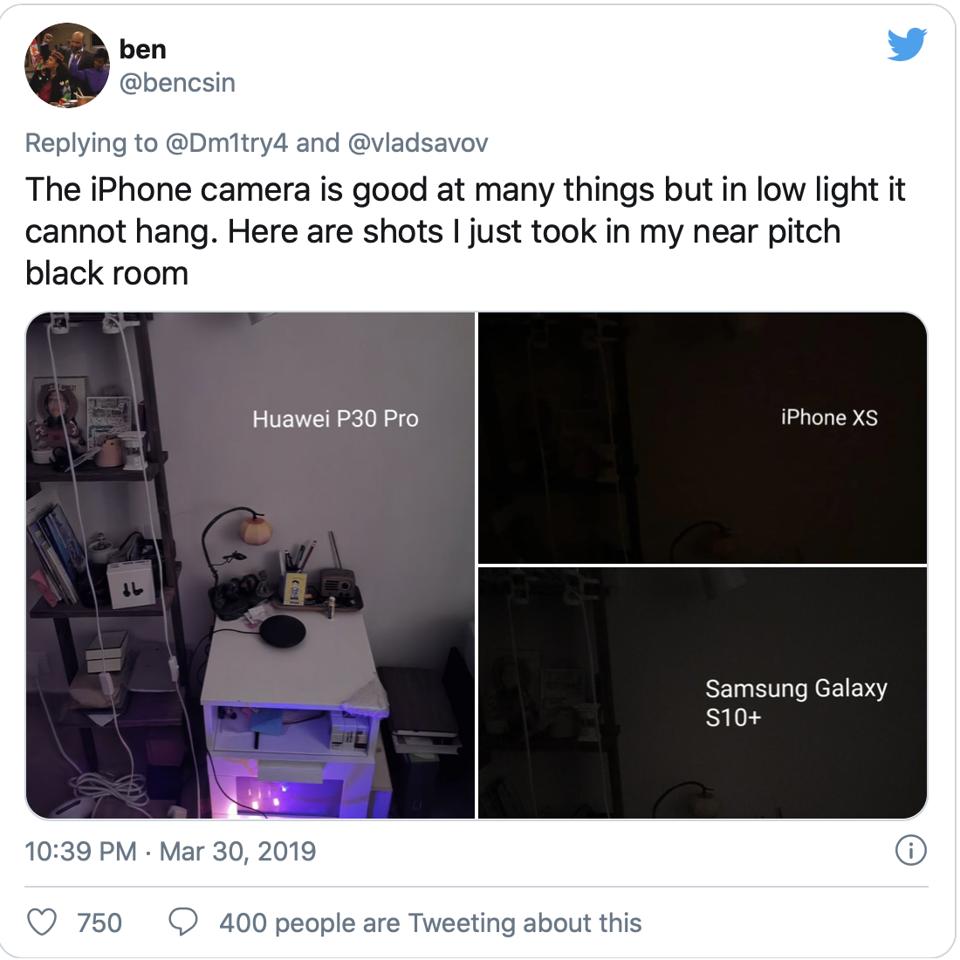
The same has happened to Huawei’s smartphones. Just a couple of years ago, Huawei flagships had battery life and low-light camera performance that lapped competitors. And I mean literally: Huawei phones from 2016 to 2018 had battery life that lasted at least six to eight hours longer than an iPhone or Samsung under the same usage scenario, and its ability to pull light into a pitch black scene was so far ahead of what the iPhone could do I posted comparison photos to Twitter, which was used by a writer at The Verge in an article criticizing Apple’s cameras.
A tweet I posted showing Huawei's dominating camera performance
Twitter
How did Huawei achieve such dominance in camera? It used a larger image sensor and a higher megapixel camera (40-megapixel at a time when brands were all using 12- to 16-megapixel) than competitors. The larger image sensor pulls in more light, and the more pixels are put through a process called “pixel-binning” which combines four pixels into one so each pixel has more information than usual.
This superior hardware is also backed by smart software image processing that uses a multi-image stacking algorithm to further tweak lighting and dynamic range in a photo.
All of these moves have been adopted by competitors. Samsung began using a larger image sensor earlier this year with the S20 Ultra, and Apple will do the same with its upcoming iPhone 12 Pro Max. Apple also adopted the image-stacking software technique known as “night mode” beginning with last year’s iPhone 11, and further refined for this year’s 12.
The improvements made by Apple and Samsung are immediately noticeable—both the latest iPhones and Samsung phones can now also “see in the dark” in the same way Huawei phones can. I can’t take comparison photos and have them turn out as lop-sided as the tweet above anymore.
At least not with the main camera. Huawei, perhaps realizing the main camera tech has reached its apex, began focusing on the secondary ultrawide camera last year, and it is this lens where the Mate 40 Pro shines above the rest. But is it enough?
Design and hardware
Huawei’s Mate series has traditionally been Huawei’s top dog phone, because its release coincides with the official launch of Huawei’s newest Kirin chip. This year, the Kirin 9000 powering the phones is a bleeding-edge silicon built on 5nm technology—the same as Apple’s A14 Bionic—but the Kirin 9000 one ups the A14 Bionic in that it has an integrated 5G modem built in.
This means whether it’s benchmark scores or real world performance, the Kirin 9000 is quite a bit ahead of the Qualcomm Snapdragon 865 powering other Android phones right now.
On the outside, the Mate 40 Pro is a gorgeous piece of hardware as usual. The overall aesthetic of the Mate 40 Pro follows the design language set by the Mate 20 Pro, with a centrally located camera module, curved screens, and a real 3D facial scanning system for iPhone-like face unlock.
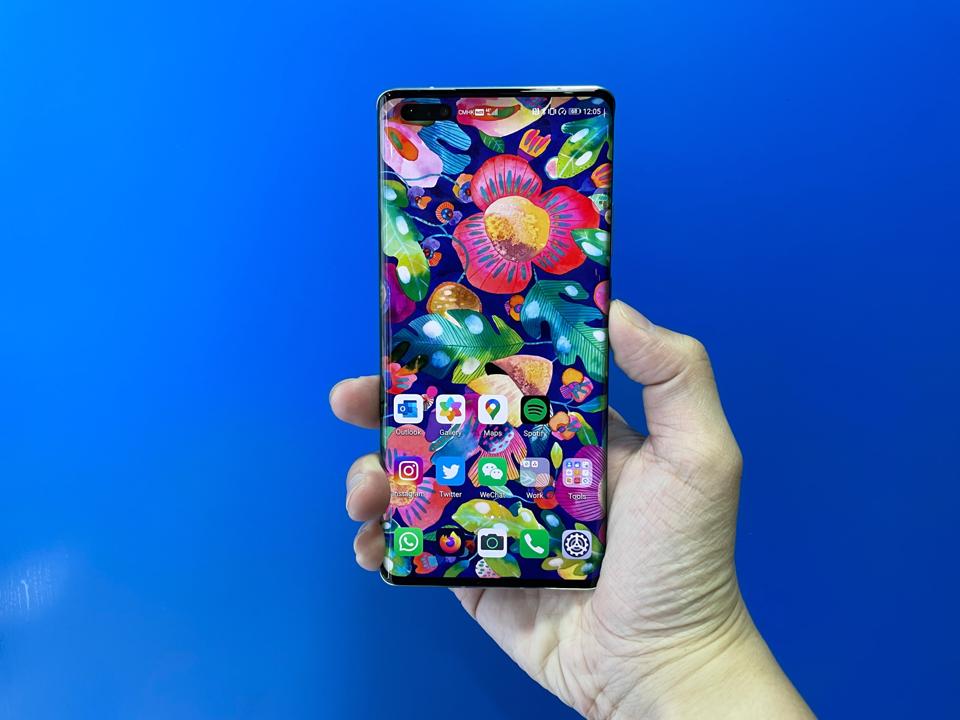
The drastic curved screen introduced in last year’s Mate 30 Pro—the left and right side slopes at 88-degrees, which Huawei has dubbed “Horizon Display”—returns, and it is as striking as ever.
Don’t worry about accidental unwanted palm touches—Huawei’s software algorithm does a flawless job of preventing them.
The Huawei Mate 40 Pro with its drastically curved screen.
Ben Sin
Mate 40 Pro
Ben Sin
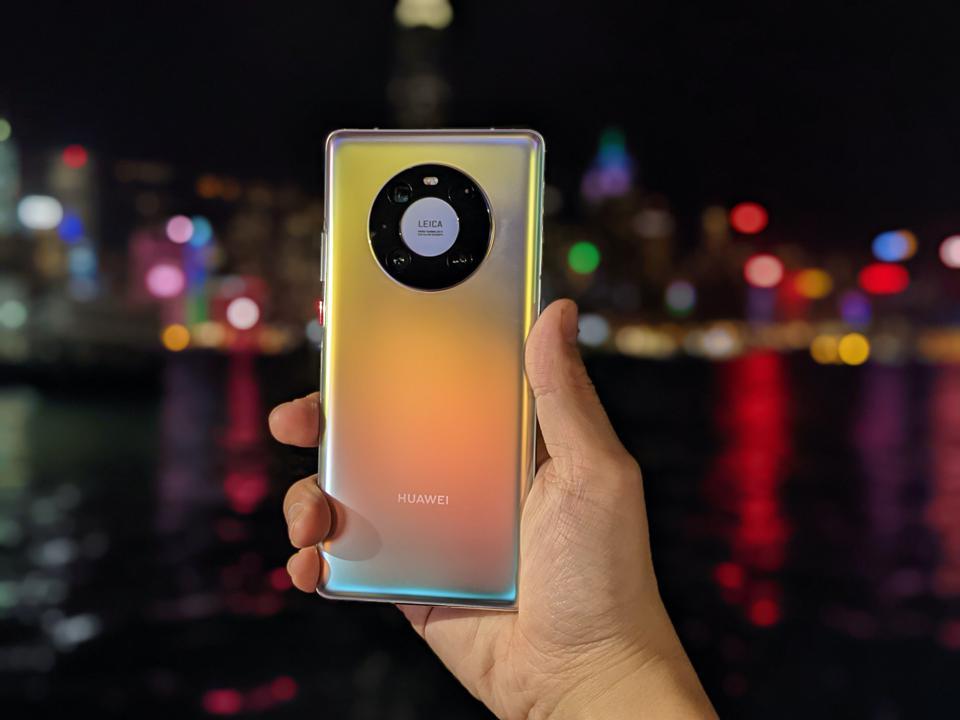
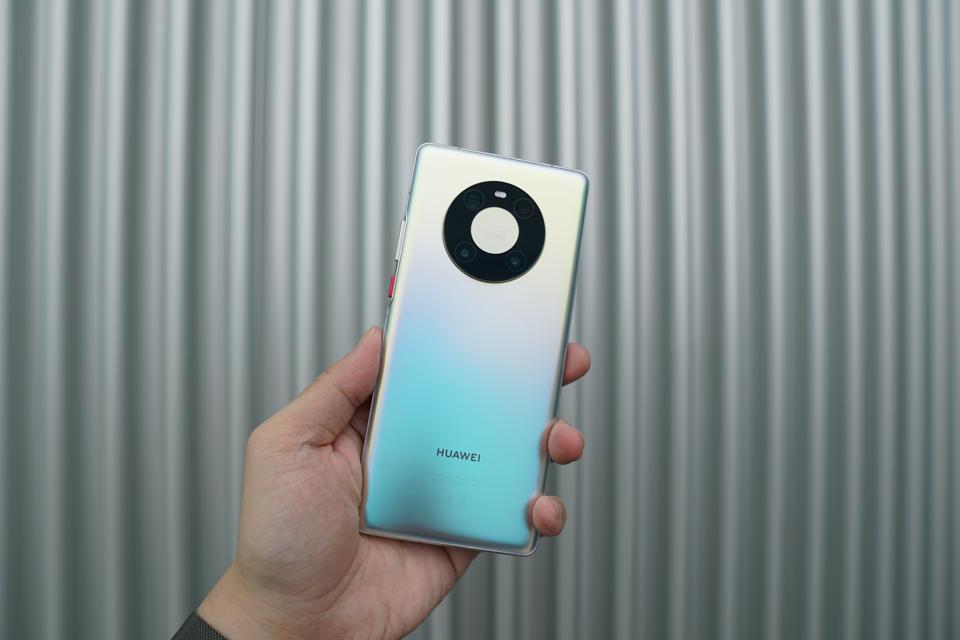
The back glass is coated in this soft matte finish, which feels soft to the touch and is resistant to fingerprints. It also shimmers in different colors depending on how the light hits the back—albeit much more subtle than before.
The back of the phone shimmers when light hits it from different angles.
Ben Sin
The screen being 6.67-inches, the Mate 40 Pro is a rather large phone, but the curvature and matte back helps it sit comfortably in the hand.
The screen refreshes at 90Hz, which is not the fastest on the market, but animations appear smooth enough. It’s a gorgeous, vibrant panel, with maximum brightness and viewing angles that matches the best screens on the market.
There is a larger-than-usual (for Android) screen cut-out in the upper left corner of the display, but it’s for good use: this is where Huawei houses its powerful front-facing camera system, which includes a 13-megapixel selfie camera, a wide-angle camera with a field-of-view of 100-degrees, and an infrared camera for face scanning.
That Huawei managed to cram a real 3D face scanning system into an area that small makes the notch in iPhones look bad. And that ultrawide selfie camera works great, too—more on this in the next section.
Cameras
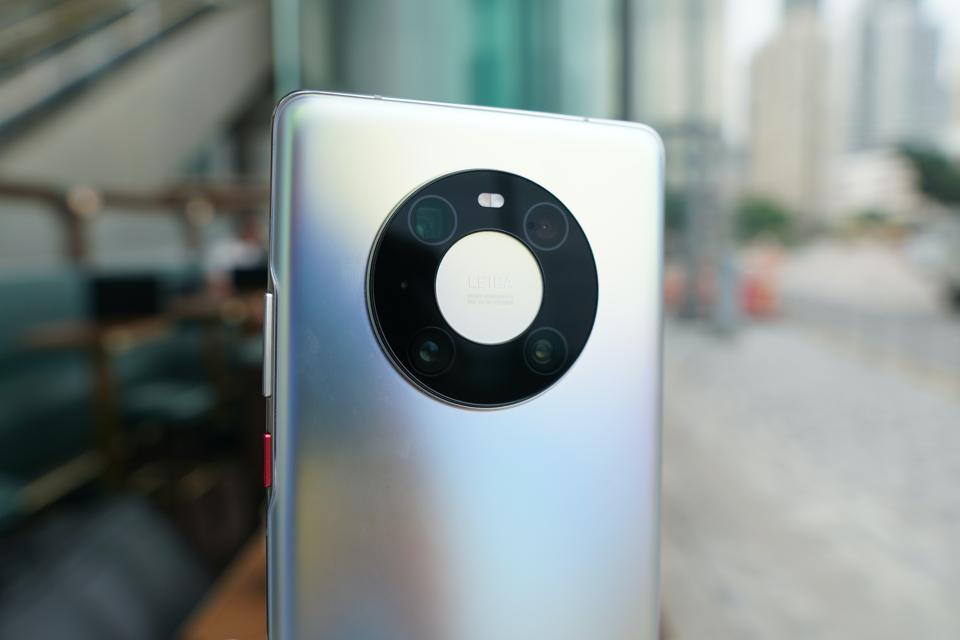
The Mate 40 Pro camera module
ben Sin
The Mate 40 Pro’s main camera system consists of a triple lens set-up, headlined by a 50-megapixel main sensor and 20-megapixel ultrawide-angle camera and flanked by a 13-megapixel Periscope camera.
Notice I gave the ultrawide angle camera top billing alongside the main 50-megapixel sensor, which I had never done in my reviews before. That’s because on the Mate 40 Pro, the ultrawide camera is not an afterthought.
Dubbed “Cine Lens” by Huawei, this ultrawide angle camera shoots at a 4:3 aspect ratio, and is the default video camera. It’s got a narrower field-of-view than the ultrawide lens on an iPhone or Samsung, but Huawei’s 20-megapixel ultrawide camera packs significantly more details in the shot thanks to more pixels and a larger sensor. In other words, the same tricks Huawei pioneered with the main camera that other brands have adopted—but not yet for the secondary cameras.
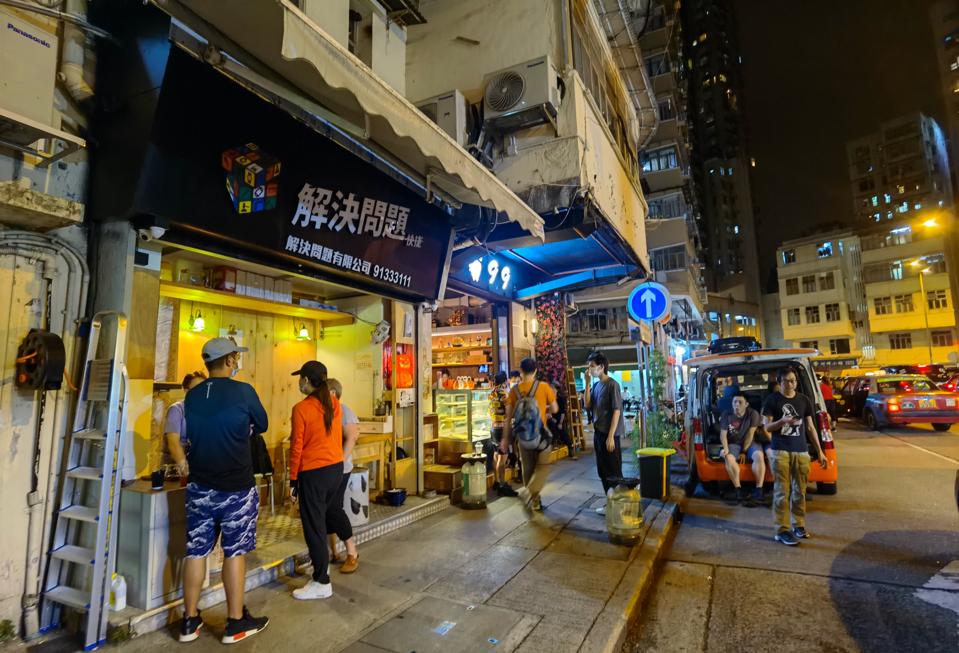
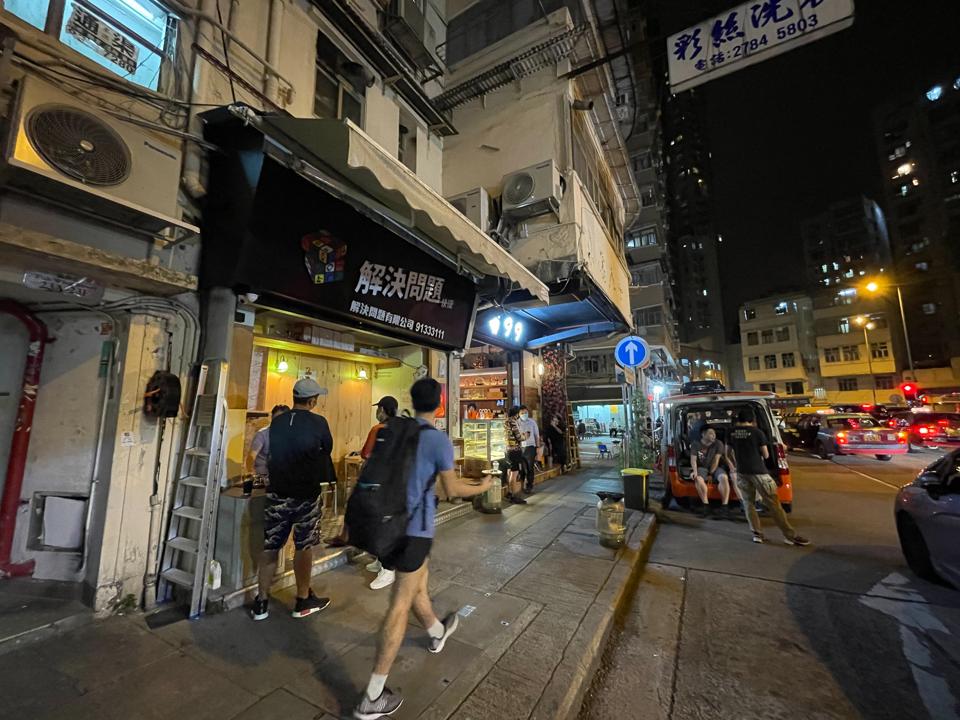
The results speak for themselves. Take a look at this ultrawide angle shot captured by the Mate 40 Pro.
Mate 40 Pro ultrawide shot
ben Sin
Now look at the same shot but captured with an iPhone 12.
iPhone 12 ultrawide angle shot.
Ben Sin
If your eyesight is great, you should already be able to see the extra sharpness in the details in Huawei’s shot. Not to mention, the superior dynamic range.
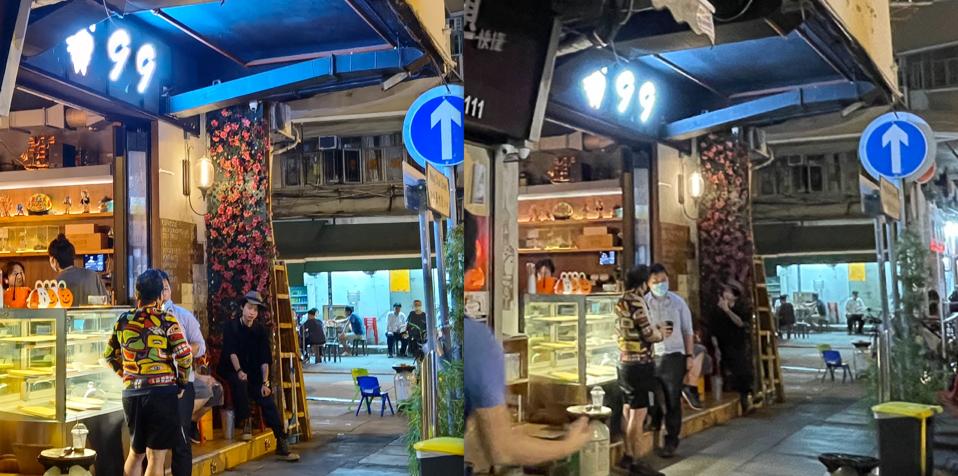
But for those of you who can’t quite see the difference from a far, here’s a zoomed in crop of both photos.
Mate 40 Pro (left) and iPhone 12 (right)
Ben Sin
Everything in the Huawei shot (left), from the blue street sign, to flowers on the wall, to the texture of the colorful shirt worn by the person closest to the camera, is clearly sharper than in the iPhone 12 image.
Here’s another set of samples. Let’s start with Mate 40 Pro ultrawide:
Mate 40 Pro ultrawide
Ben Sin
And iPhone 12 ultrawide.
iPhone 12 ultrawide
Ben Sin
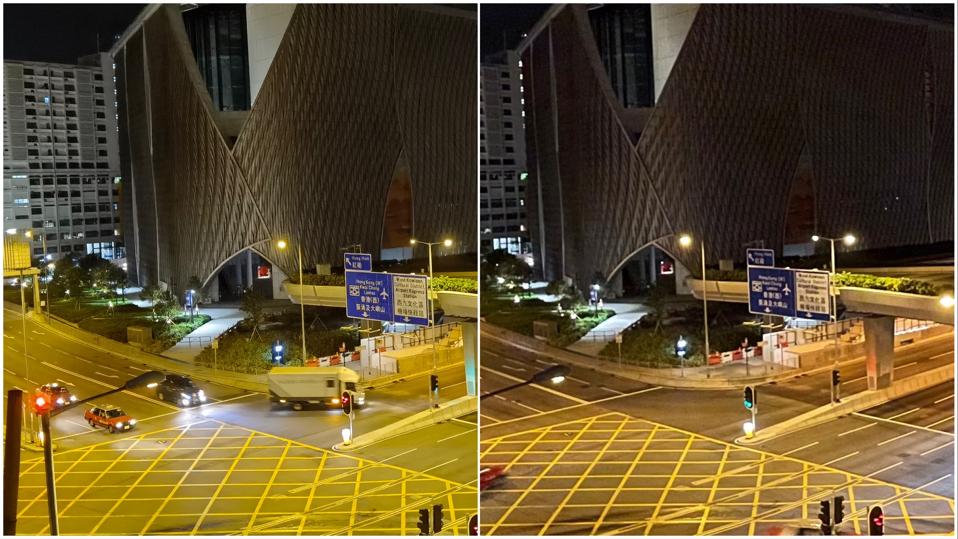
And here’s a closer look at both pictures side-by-side.
Mate 40 Pro (left) and iPhone 12 (right)
Ben Sin
You can still read the words in the traffic sign on the Mate 40 Pro’s image; whereas it’s a blur in the iPhone 12’s shot.
Now, is this a huge deal to most people? Probably not. One can easily argue that the point of taking an ultrawide angle photo is to show the entire photo, since it has a wider field of view and thus is great for sweeping landscape shots. However, there are instances when you do want to crop in, and it’s just nice to have that extra detail in Huawei’s cameras.
What’s more, this is a level of consistency that other phone cameras should strive for: on a Huawei Mate 40 Pro, shooting with the second or third camera doesn’t mean a significant step down in camera performance. You can’t say the same on an iPhone or Samsung Galaxy Note 20 Ultra, which clearly prioritized the main camera above all else.
Huawei’s focus on polishing the ultrawide lens carries over to that front-facing ultrawide selfie camera, too. Like the one on the back, this lens keeps sharpness and exposure consistent with the main selfie camera, allowing a much wider field of view. Throw in good digital image stabilization and the Mate 40 Pro is instantly one of the best vlog cameras around, allowing users to film themselves without a selfie stick and still get wide enough framing so their head doesn’t take up half the scene. I have selfie vlog footage at the 2:57 mark of the video below (along with many more photo samples).
Huawei’s main camera, as I mentioned at the beginning, used to be heads and shoulders above the competition in terms of night photography. The gap has closed significantly as Samsung and Apple has caught up, but that’s not to say Huawei’s main camera isn’t still great. That main 50-megapixel lens still has the largest image sensor in all of smartphones at 1/1.28-inch, and Huawei’s custom-built RYYB sensor still allows it to take the crown as the best camera in low-light situations. It’s just the win is smaller than in previous years.
Mate 40 Pro main camera.
Ben Sin
Mate 40 Pro main camera
Ben Sin
Night shot with the Mate 40 Pro.
Ben Sin
The zooming capabilities of the Mate 40 Pro is still among the strongest, though the 13-megapixel 5x optical Periscope zoom lens here is not Huawei’s best offering. That’s because there’s even a higher tier Mate 40 Pro+ that houses a 10x optical Periscope camera, the same one used in the P40 Pro+.
Still, any zoom under 20x appears well-detailed, and anything 10x or under appears sharp as if it was regular photo. Below is a collage of photos captured at 1x, 10x, 20x and 50x.
Mate 40 Pro zoom shots at 1x, 10x, 20x, 50x
Ben Sin
Software
By now, most readers should know the software restrictions that have been placed on Huawei’s phones by the U.S. government. The Mate 40 Pro cannot run core Google services, including YouTube, Gmail, Google Drive, Google Docs, among others.
Other than YouTube—a monopoly with no credible competition outside of China—all the other Google services have alternatives from Microsoft or a dozen other companies that can get the job done. As a consumer, you have to decide if you can live without those apps. For me, the situation will never be ideal, but I can make do without them.
The Mate 40 Pro runs EMUI 11, the newest version of Huawei’s Android skin, and the biggest improvement this year come in multi-tasking. You can now swipe from the side of the screen at any time to open a quick app launcher, and these apps open in a floating window that can be resized. They can also be minimized into a floating ball on the screen. In this setup, the app is still running but it takes up just a tiny portion of screen space unless you enlarge the ball.
Huawei split-screen multi-tasking.
Ben Sin
This has been particularly useful for me as I’ve had to juggle constant WhatsApp and Slack messages lately due to a new work situation. On an iPhone, anytime I need to read a new message, I have to switch away from whatever I’m doing (maybe it’s a video, maybe it’s an article), and go into that particular app. On the Mate 40 Pro, I leave Slack and WhatsApp running in floating ball state, and when I do have a new message, I enlarge it to a small floating window that takes up maybe 1/3 of the screen, leaving me enough space to continue scrolling Twitter, or writing that email.
Mate 40 Pro
Ben Sin
Despite uncertainty, Huawei chugs along
There’s no sugarcoating this: the Google situation, and the nonstop attacks by the U.S. government has severely hurt the appeal of Huawei smartphones to average consumers.
The Mate 40 Pro will still have plenty of interested buyers (even outside of China), because it has a unique design, silicon, and still best-in-class cameras. But those who pay 1,199 euro for this will almost certainly be enthusiasts, or Huawei loyal fans.
Where your political stance lay will play a big part in whether you think this is a shame or not.
someone123, 9 hours agoI don't think you know what 'near-majority' means. Ask GSMArena to make anothe... moreI agree 90% --Interseteller
s357
Anonymous, 12 hours agoI don't think you know what a majority is. If 35% don't want a huawei the other 65% ... moreI don't think you know what 'near-majority' means.
Ask GSMArena to make another poll: I will not buy the Mate 40 Pro because:
- it's too expensive
- lack of GMS
- I don't like Huawei
- I will buy it anyway
And with that I imagine there will be a clearer picture. I would like Huawei to gain market share, I might even consider buying one, but not at this price and with lack of GMS, plus their phones are too big for my pockets. But nobody asked me and phone size is never an argument in any of these biased polls.
The polls and results are just made up to gather "interaction", so it pays off the more controversial they are. I should just stop posting anything here and promoting shit material.
A
A..
Nx9
So I've owned a P30+ for one year, and quite honestly has been far superior to any other phone I've ever owned, and I've had them all. Based on the accusations by the USA regarding Huawei. I am going back to Samsung. Hopefully they will one day match Huawei's performance and reliability. Damn shame Huawei turned out to be yet another despicable Chinese manufacturer...
?
Anonymous
Bb%
someone123, 20 hours agoI think the post author jumps to some conclusions and misses the obvious. First, the near-majo... moreI don't think you know what a majority is. If 35% don't want a huawei the other 65% want it with some caveats, but they still have a positive sentiment towards the devices. So no, they read it correctly. As for the other poll only 25% actively disregard every model of the mate 40 series while 75% have their interest peeked one way or another. This means that hate it or love it Huawei's got people's attention.
3087651
1200euro vs 1400euro, having no free form lens, another tele vs having it all. Obvious.
RS temperature sensing is too premium though, would expect some crazy tech for that price, like also UV light or IR camera.
Can say though its more exciting than half year from other brands, they not only managed to bring it despite manufacturing concerns, they also came stronger and brought power and productivity with that. Sadly they are limited in collaboration with Microsoft, but Microsoft may bring web based apps soon so I hope.
N2425812
Anonymous, 19 hours agolook at Huawei phones since their first P phones, exact replicas of Galaxy S2 and Xperia Z, lo... more"not to mention when they decided to go with their own designs it was horrible too"
In your own opinion only.
N2425812
NotAnOpinion, 23 hours agoThat's where you are wrong, though. I'm pro-consumer not pro-industry. Because I cal... more"they just redefined on old products and make them better and clone others ideas"
I mean, what matters the most is who has managed to execute the idea the best, not who has actually invented the idea (though this is not to say the latter is not important at all). Samsung has been taking a lot of ideas from other companies in smartphone industry (especially from Sony) but they are praised because the way they implement features onto their smartphones has been generally superiour to others.
?
Anonymous
PZa
Anonymous, 19 hours agobruh what kind of argument yeah bro 5G was entirely made by Huawei 💀💀💀 and more patents ... moreYou think 5G is easy? It's not or otherwise every other company would be making them. Huawei is making the best and most affordable 5G equipment. No other company comes close.
H
Huawei fan
m5u
Best Huawei phone is Mate 20 X
?
Anonymous
PZa
Anonymous, 19 hours agolook at Huawei phones since their first P phones, exact replicas of Galaxy S2 and Xperia Z, lo... moreThe P series generally adopts a utilitarian design with focus mainly on the cameras. Still, you won't confuse the design with another phone. When they were released, which other phones have gradient coloured backs? Which other phones have a square lens for a periscope sensor? And which other phones have 4 sided curves like in this year's P40 series? They're uniquely P series features that identifies P series phones and Huawei pushes and innovates on new designs each year.
?
Anonymous
TLP
Anonymous, 20 hours agoI don't see any other phone maker making phones with the camera prowess that is present i... morelook at Huawei phones since their first P phones, exact replicas of Galaxy S2 and Xperia Z, lol talk about "original phone design" lol
not to mention when they decided to go with their own designs it was horrible too
their P series nowadays literally just copies other android phones, vertical camera, teardrop, chin, holepunch, notch
?
Anonymous
TLP
Raky, 19 hours agoHuawei is not just good camera. Ever heard of 5G??? Look whose technology is there in it. ... morebruh what kind of argument
yeah bro 5G was entirely made by Huawei 💀💀💀
and more patents = innovation 💀💀💀
R
Raky
xt7
NotAnOpinion, 23 hours agoThat's where you are wrong, though. I'm pro-consumer not pro-industry. Because I cal... moreHuawei is not just good camera.
Ever heard of 5G???
Look whose technology is there in it.
Your statement that Huawei is not innovative is so wrong too...it is one of the companies with most patents in few years now.
And talking about how they just makes other ideas working better, and then praising Apple for being innovative???
I mean wtf!?
Apple is the company that is famous for taking other companies ideas, making them better, and presenting them as new and innovative in their own world where nothing else doesn't exist.
Congratulations for getting 5G in 2020, and possibly high refresh rate screens in 2021.
R
Raky
xt7
Sorry Huawei, but not for that prices.
I am one of few, that supports Huawei here...but just don't value in this proposition.
I know it is Huawei's flagship device, that should compare to all Galaxy Notes and iPhones out there, but Huawei forgets that there are some great options for much less money. (A 1/3 less to be more specific).
And no matter how good hardware here is, Huawei have a huge problem with not having Google or real replacement that would support all the apps needed (banking apps in my case).
Now, my thoughts went to an idea that they could fight it with lowering their prices, but I guess they have some other ideas.
Ideas, which are not working, at least not in Europe.
?
Anonymous
PZa
NotAnOpinion, 23 hours agoThat's where you are wrong, though. I'm pro-consumer not pro-industry. Because I cal... moreI don't see any other phone maker making phones with the camera prowess that is present in Huawei's phones. Not Samsung, not Sony and definitely not Apple. Huawei is the only company using RYYB sensors and has a 10x optical zoom periscope camera. And I don't see any other phone maker designing unique phones and innovating as hard as Huawei in the last 3 years. You do realise that Apple copied the square camera module from the Mate 20 series? It's a shame Apple is not able to copy the 66w wired charging and the 50w wireless as well. Apple still doesn't have reverse wireless charging that was already present in the Mate 20 Pro. Anyway, your Apple bias is obvious and Huawei has been leading at Smartphone innovations for the past 3 years whether you realise it or not. But I think you already know that.
s357
I think the post author jumps to some conclusions and misses the obvious. First, the near-majority don't want a Huawei. Next, people who might want it, avoid it for one OR more reasons. Most likely all reasons.
So yes, bringing the price down and having access to GMS will gain the two groups of people, but bringing just one does not mean it will gaine one camp. it's just the first reason they don't want to buy the phone.
a1360306
Lukhanyo, 21 hours agoPeople are buying iPhones more than these other phones, deal with it.... Its not going to chan... moreThat's not true is it?
More Android devices are sold than iOS devices. It's fact.
More choices in the Android space than iOS space. It's fact.
iOS devices have greater profit margin. It's fact.
iOS devices are sold more in the US than other country. It's fact.
L8427
Anonymous, 21 hours agoIt's not our problem that iOS is limited to one company. Jokes on you pal. The public a... morePeople are buying iPhones more than these other phones, deal with it.... Its not going to change anytime soon
?
Anonymous
sUw
NotAnOpinion, 22 hours agoWow! First, right on schedule, they censor my posts that has no vile words, etc. 2nd, Bahah... moreIt's not our problem that iOS is limited to one company.
Jokes on you pal.
The public at large (80%) has rejected Apple and want nothing to do with these money grabbing thugs.
N773220
Anonymous, 01 Nov 2020The iPhone sales pale in comparison to Android phones. If 80% prefer Android in the real wor... moreWow! First, right on schedule, they censor my posts that has no vile words, etc.
2nd, Bahahaha, are you really comparing ONE COMPANY against TENS-OF-ANDROID manufactures?!
Wow! I'm sure if Apple bothered to tead from this site, they nust got a stiff one one!
BANGKOK – Once known for shoddy manufacturing of low-cost goods for American markets, China has grown against the odds into a true innovation powerhouse. Now, as the American economy descends into a downward spiral, the China-led digital economy is under unprecedented siege.
Leading Chinese technology vendors now face a US campaign to block their wares wherever and whenever they are deemed as too competitive. The precipice of this political attack is 5G, based on a disproven narrative that Chinese technology poses security threats.
Chinese 5G vendors including Huawei have openly submitted their products and codes for independent review over and over again, only to have unintentional coding problems labeled by American officials and echoed by media as intentional “backdoors” designed to subvert Western security.
The reality, however, could not be further from the truth. In May 2020, Huawei was awarded the world’s first Common Criteria (CC) Evaluation Assurance Level (EAL) 4+ certificate for 5G products.
The certificate indicates that the security of Huawei 5G base station products reaches the world-leading level and can provide trusted security assurance for 5G wireless access. The Common Criteria, in effect since 1999, is an internationally recognized security certification evaluation.
The criteria originated from and unified three top standards, namely Europe’s ITSEC, Canada’s CTCPEC and America’s TCSEC, and was developed by the governments of Canada, France, Germany, Netherlands, UK and US – Western nations the US is now pressing to ban Huawei from their 5G rollouts for alleged security reasons.
There are seven EAL certification levels, with EAL 4+ being the highest for the telecom industry. It requires that the source code be tested and certified by independent analysts.
A Beijing shop for Chinese telecom giant Huawei features a red sticker reading ‘5G.’ Photo: AFP / Nicolas Asfouri
In July 2020, Huawei was also the first to pass the 5G cybersecurity test by China’s IMT-2020 (5G) Promotion Group. These test specifications are based on the 3GPP for 5G security assurance.
3GPP is an umbrella term for a number of global standards organizations with its headquarters at the European Telecommunications Standards Institute in France.
Huawei was the first in China to complete a recent 5G equipment security test with a 100% pass rate. This test is based on the IMT-2020 (5G) Promotion Group’s 5G security standard, which is based on the 3GPP 5G safety and security international standard (SCAS).
Most recently, in August 2020, Huawei’s 5G wireless and core network equipment (5G RAN gNodeB, 5G Core UDG, UDM, UNC, UPCF) and LTE eNodeB passed the GSMA’s Network Equipment Security Assurance Scheme (NESAS). GSMA represents the interests of some 750 mobile operators worldwide.
NESAS is a standardized cybersecurity assessment mechanism jointly defined by GSMA and 3GPP, together with major global operators, vendors, industry partners and regulators. It provides an industry-wide security assurance framework to facilitate improvements in security levels across the mobile industry.
It is a voluntary scheme through which network equipment vendors subject their product development and lifecycle processes to a comprehensive and independent security audit against the currently active NESAS release and its security requirements.
GSMA NESAS, which is widely accepted across the industry, ensures that the relevant equipment meets the scheme’s 5G network security and reliability requirements.
In the last three decades, Huawei has provided more manpower and resources to such international bodies than any other company and is the top contributor of 5G security proposals that have been accepted and adopted by the industry.
Workers setting up a 5G base station at the border near the Hong Kong-Zhuhai-Macau Bridge. Photo: China Mobile
In March 2019, Huawei opened the Brussels Huawei Cyber Security Transparency Centre specifically to communicate with key stakeholders on cybersecurity practices, explore and promote the development of security standards and collaborate with industry organizations (GSMA, C4C WEF), standard organizations (3GPP, IETF, ITU-T) and EU cybersecurity verification organizations (ENISA, BEREC).
Currently, Huawei products and solutions have obtained more than 270 security certificates, including CC, FIPS, and CSA. Countering US efforts to further block Chinese technology from other like-minded countries’ networks, China has even launched its own initiative to set global standards on data security.
With the intention, according to Chinese Foreign Minister Wang Yi, to “develop a set of international rules on data security that reflect the will and respect the interests of all countries”, China is tackling head-on America’s bogus narrative that Chinese technology presents security risks.
That is fortified by the fact that numerous technical organizations have concluded that there are no intentional measures or “backdoors” in these products to subvert the technology or open the way for surveillance or remote-controlled shutdowns.
In the past, Chinese vendors have eagerly submitted their equipment to these testing organizations to validate that they meet international security requirements as collaboratively established by leading groups.
Still, the American political machine continues to steamroll ahead and force allied nations into a polarized “with us or against us” choice between China and the world.
To be sure, security in 5G is paramount as the latest generation in mobile networking will play an ever-increasing role in the digital economy and power critical vertical industries including finance, manufacturing, healthcare, logistics and others.
5G will extend on the mobile economy of previous generations and add the scale, bandwidth and low latency required for more demanding enterprise applications.
Japan’s top telecom operators are preparing to make a splash on 5G infrastructure. Image: Facebook
5G at its core leverages cloud-native technologies with a microservices-based architecture. This will introduce new security concerns that simply didn’t exist with 4G. But this model brings with it unprecedented scalability, reliability and integration into a whole new world of digital applications.
Having recently passed the first phase of the GSMA/3GPP security accreditation, leading Chinese 5G providers are already ahead of the pack, even in the face of an American campaign to limit China’s global telecoms influence.
The Chinese government’s formation of another security standard highlights its commitment to delivering products and solutions that are trustworthy and reliable; Huawei and ZTE have already proven their capabilities to drive innovation.
Combined with Europe’s security standards, China’s efforts illustrate a greater concern that while security is paramount, we’re living in a state of fear over the nascent digital economy and letting that paralyze us from enjoying the benefits of ubiquitous high-speed communications that will enable billions to have access to information in real-time.
While the rest of the world pushes ahead with mantras of “connecting the unconnected”, and bringing “digital to every person, home and organization for a fully connected, intelligent world”, America is attempting to thwart those aspirations and the technology-driven march of progress.
The US has let its technology leadership slip on the assumption that the rest of the world couldn’t possibly take up the torch and bypass its slowfooted companies and engineers.
But the torch has irrefutably been passed from the US to China and it’s high time that America stops trying to snuff out the ignition of an emerging 5G digital economy and all it means for the betterment of humankind.
Michael MacDonald is Chief Digital Officer at Huawei Asia Pacific
Asia Times Financial is now live. Linking accurate news, insightful analysis and local knowledge with the ATF China Bond 50 Index, the world's first benchmark cross sector Chinese Bond Indices. Read ATF now.
If the surprising new Huawei speculation is to be believed, it could be a nightmare scenario for Google. It’s clear now that the world’s second largest smartphone maker, with some 600 million users on its ecosystem, has declared battle with Android. This, it says, it a “fight” it will win. Until now Google has been fairly ambivalent—the U.S. has cut Huawei’s access to premium chipsets, signalling a steep decline in Huawei smartphones next year. But that might be about to change.
Now, according to the Financial Times, “tough U.S. sanctions this year against [Huawei] could be less threatening to its overall business than previously thought,” and according to analysts, “the company’s important smartphone arm might have a chance to recover.” Less threatening to Huawei means more threatening to Google and its lock on the worldwide Android ecosystem.
First thing first—no-one knows whether this is true or not. One suspects that even the Commerce Department is subject to the vagaries of White House policy setting when it comes to Chinese tech in general and Huawei in particular. And next week’s election will be a critical factor.
Recommended For You
Should Trump win, Huawei will expect little respite, and that might prompt an Honor sale, maybe even a break-up into a number of less threatening mini-Huaweis. But should Biden win, while there’s little chance of a major U- turn, there could be a change of emphasis. Remember, much of U.S. tech is lobbying hard for Huawei. It’s also clear that Huawei, backed by China, is searching for a domestic solution to the chipset restrictions, one that’s free from dependence on U.S. tech
Regardless, it’s now almost inevitable that the world’s mobile ecosystems have changed irreversibly. The Android/iOS dominance that looked unshakable when Trump announced his blacklist in May last year is now being shaken—hard. Huawei has cemented its global second place for smartphone shipments, with only Washington’s chipset sanctions looking likely to knock it down. Huawei even took the top spot for a while, earlier this year, buoyed by China’s recovery from the first coronavirus market impact.
But there are two brand new, post-blacklist factors that are both potential game-changers. First is the sharp rise of other Chinese smartphone brands in key export markets, initially propelled by Google-less Huawei’s user churn, but now driving their own momentum. Xiaomi has been on a tear for some time, having moved quickly to replicate Huawei’s export success. The smaller Chinese player has just overtaken Apple to take the third spot globally behind Huawei—that’s a major change. But there’s also BBK, the Chinese giant behind Oppo, Vivo, OnePlus and RealMe, which is now seeking to follow suit.
Second, there’s Huawei’s blacklist response—the combination of HarmonyOS, its Android OS alternative and HMS, its Google Mobile Services replacement. Until the latest sanction speculation, the HarmonyOS threat to Android was tempered by the chipset sanctions. But if Huawei’s smartphone sales can recover, that materially changes. Furthermore, Huawei has now confirmed that HarmonyOS will be available as an open-source OS, pushed at other Chinese OEMs, to build bridges, Huawei says, between China and the West.
So, now this gets interesting. Because the other actor in play here is China. The country now has two of the top three smartphone manufacturers, a stated intent to push domestic capabilities at the expense of imports, and Huawei fast building an ecosystem that it says will compete with Android and iOS, to create a third global OS for the industry.
With each passing month, Huawei’s ecosystem pushed further into Google territory. We now have multiple mapping options, for example, to replace Google Maps. And now, critically, we also have a search alternative as well. This is beginning to feel more like the real thing. Yes, Huawei is short on apps and a global developer network, but it’s ploughing in money to its community and it knows consumers worldwide want its recipe of premium smartphones for less—a recipe now being replicated by those other Chinese OEMs.
This was not surprising. Huawei’s domestic market share will fall sharply absent any relaxation of chipset sanctions next year anyway. As market analyst Canalys points out, “if the position of the U.S. administration does not change, Huawei will attempt to pivot its business strategy, to focus on building the [Harmony] OS and software ecosystem, as the Chinese government is eager to nurture home-grown alternatives to global platforms.”
And it’s this last point that’s so critical. As I’ve commented before, the legacy of Trump’s blacklist on Huawei will inevitably be change in the global smartphone industry. The risk has always been that the U.S. loses its lock on global standards and staple software, maintained by Google’s and Apple’s dominance. Suddenly that’s looking under serious threat.
“The world is looking forward to a new open system,” Huawei chairman Guo Ping said just a few weeks ago. “And since Huawei helped Android to succeed, why not make our own system successful… it’s plausible to have two systems in a world. And Huawei will be able to survive and take the lead even in an extremely hostile environment.”
Huawei is working on plans for a dedicated chip plant in Shanghai that would not use American technology, enabling it to secure supplies for its core telecom infrastructure business despite US sanctions.
Two people briefed on the project said the plant would be run by a partner, Shanghai IC R&D Center, a chip research company backed by the Shanghai Municipal government.
Industry experts said the project could help Huawei, which has no experience in fabricating chips, chart a path to long-term survival.
US export controls imposed in May and tightened in August leverage American companies’ dominance of certain chip-manufacturing equipment and chip-design software to block semiconductor supplies to Huawei.
If it succeeds, it can become a bridge to a sustainable future for their infrastructure business
Industry experts said the planned local facility would be a potential new source for semiconductors after stocks of imported chips Huawei has been accumulating since last year ran out.
The fabrication plant will initially experiment with making low-end 45nm chips, a technology global leaders in chipmaking started using 15 years ago.
But Huawei wants to make more advanced 28nm chips by the end of next year, according to chip industry engineers and executives familiar with the project. Such a plan would allow Huawei to make smart TVs and other “internet of things” devices.
Huawei then aims to produce 20nm chips by late 2022, which could be used to make most of its 5G telecoms equipment and allow that business to continue even with the US sanctions.
“The planned new production line will not help with the smartphone business since chipsets needed for smartphones need to be produced at more advanced technology nodes,” said a semiconductor industry executive briefed on the plans.
“But if it succeeds, it can become a bridge to a sustainable future for their infrastructure business, in combination with the inventory they have built and which should last for two years or so,” he said.
“They possibly can do it, in maybe two years,” said Mark Li, a semiconductor analyst at Bernstein in Hong Kong.
He added that while the chips Huawei needed for making mobile network base stations would ideally be made on 14nm or more advanced process technology, using 28nm was possible.
“Huawei can make up for the shortcomings on the software and system side,” he said. Chinese producers could tolerate higher costs and operational inefficiencies than their offshore competitors.
The project, first reported by Chinese newspaper Caixin last month, could also jump-start China’s ambitions to shake off its dependency on foreign chip technology, particularly from the US, which wants to slow China’s development as a technology power.
Huawei has already been investing in the domestic semiconductor sector, especially among smaller operators, a chip industry executive said.
“Huawei has strong abilities in chip design, and we are very happy to help a trustworthy supply chain develop its capabilities in chip manufacturing, equipment and materials. Helping them is helping ourselves,” rotating chairman Guo Ping told journalists in September.
According to chip engineers and industry executives, Huawei plans to eventually equip its domestic production exclusively with Chinese-made machinery. But analysts caution that such a goal is several years away.
“Such a facility would most likely run on a combination of equipment from different Chinese suppliers such as AMEC and Naura, plus some used foreign tools which they can find in the market,” Mr Li said.
He added that manufacturing chips in such an environment would be less efficient and more costly. But Huawei could afford this because the volume of the semiconductors needed for base stations was much lower than for a mass product like smartphones.
Huawei and ICRD declined to comment on the plans for the production facility.
“You will not obtain any information from us here, we cannot give you anything,” said Huang Yin, an ICRD spokeswoman. “This is rather sensitive.”
A major shareholder of ICRD is state-owned Huahong Group, which also controls contract chipmakers Huahong Grace and HLMC.
Last week’s poll shows that Huawei’s new phones can stand on their own feet, even without the Google software ecosystem. However, there are several factors that will impact how the new models will perform in the market place.
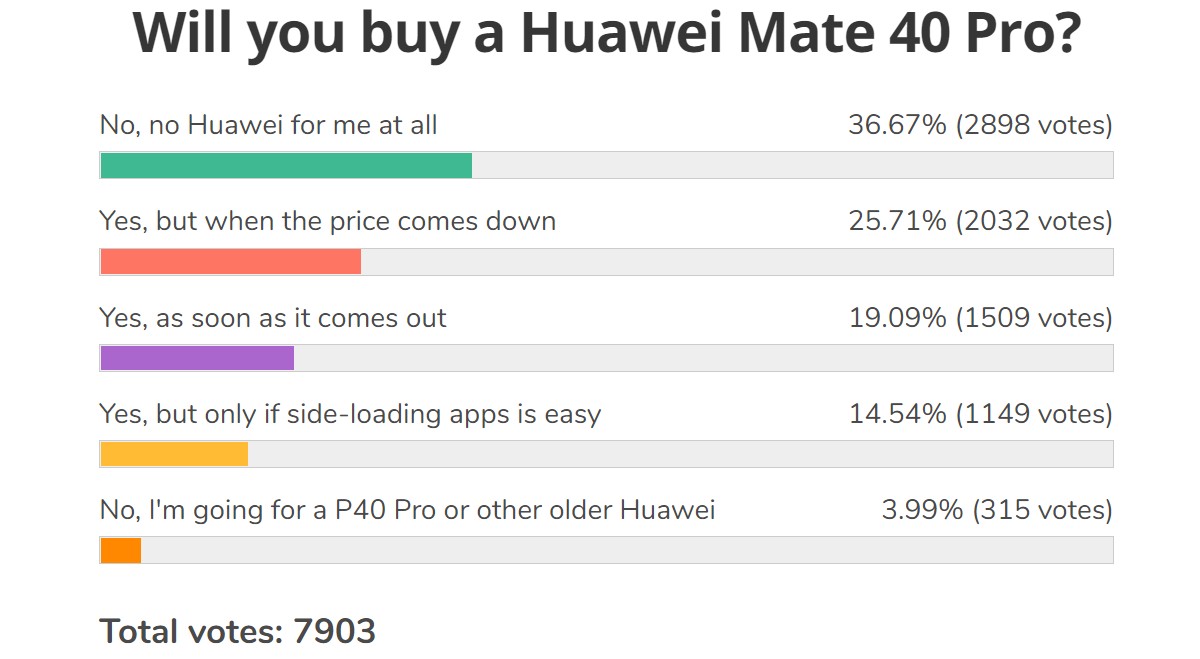
We gave the Huawei Mate 40 Pro its own poll as this one will first get a global release – units will be available in Europe next month. About 20% of voters are ready to grab one as soon as local stores open sales.
Slightly more people are interested, but think that the €1,200 price tag is too steep. There’s still time before pre-orders kick in, so maybe Huawei will be able to change their minds with a good pre-order bundle. And if not, prices of Huawei phone fall with time, unlike some other brands.
The group of potential buyers is even bigger if modders find an easy enough way to side-load apps that are not available in Huawei’s AppGallery (and we should note that the company is busy bringing over or replacing all the key apps).
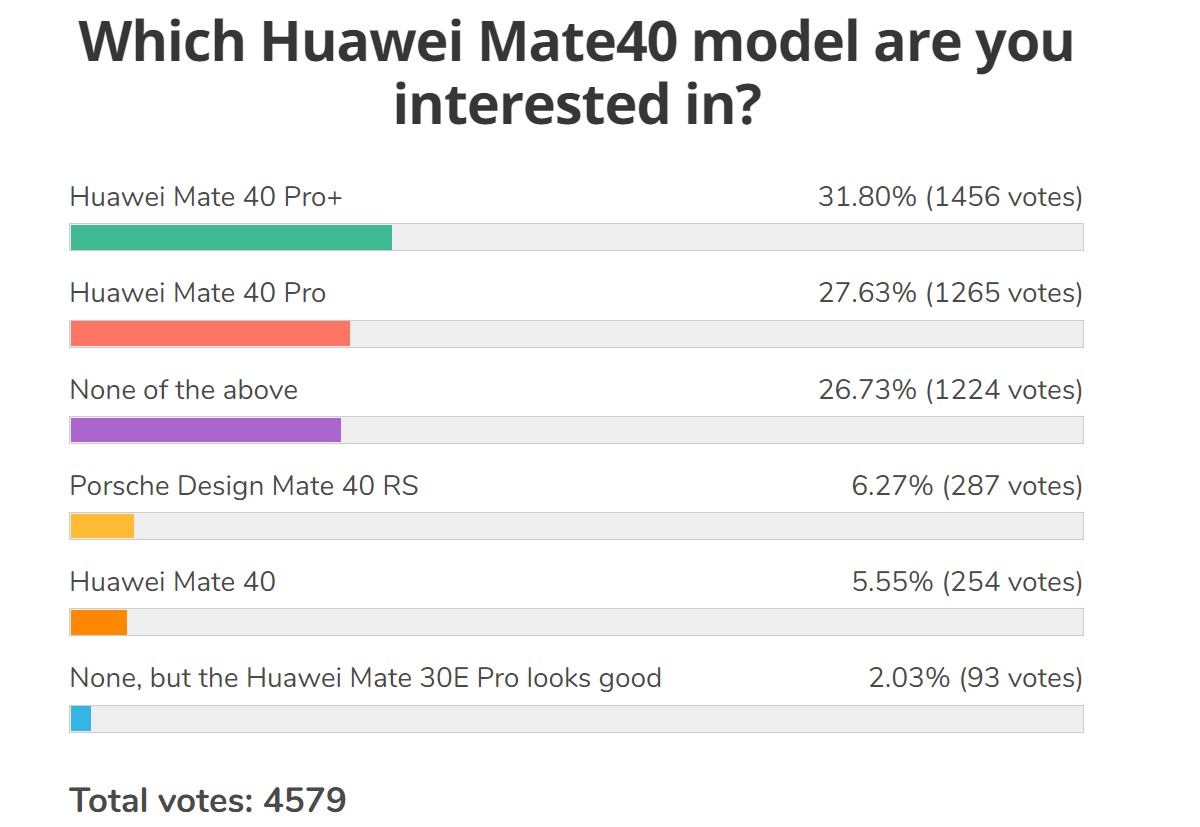
Things will get interesting if the Huawei Mate 40 Pro+ gets released globally as it edged out the Pro in the second poll. One of the major reasons to buy a Huawei is the excellent Leica camera, so it makes sense to go for the top model – even if it costs €200 more.
That money buys you OIS on the main 50MP cam, a wider ultrawide lens, an extra telephoto camera, a longer periscope reach and 4 more gigs of RAM. However, the P40 Pro+ remains a China exclusive, so we don't have high hopes for this one doing the world tour.
Predictably, all other models garnered little interest. It appears Europe isn't even getting the non-Pro model this year, but it looks like it won’t make much of a difference either way. And the reheated Mate 30E Pro might as well not exist.
The results of the two polls combine into an interesting conclusion – the perfect camera mix can justify the purchase of a top shelf flagship and, conversely, missing camera features can make a phone appear pricey.