For a measure of the pressure on China’s Huawei Technologies Co., consider the map of countries restricting the company’s telecommunications equipment. Shenzhen-based Huawei is the market leader in 5G, the next generation of wireless broadband that could catalyze a new industrial revolution of smart cities and factories. The U.S. claims Huawei’s proximity to Beijing’s government constitutes an unacceptable security threat, which the company denies. Through lobbying and sanctions the U.S. has pushed allies such as the U.K. to exclude the company from mobile networks, to mixed success.
Next month, Chinese leaders will ratify a plan to dominate the world’s semiconductor industry by 2025, in response to US restrictions on Chinese imports of high-end computer chips made with American equipment.
Directed against China’s telecom equipment makers Huawei and ZTE, the new US regulations published in July stop Huawei from producing its house-designed chips at Taiwan’s state-of-the-art fabricators.
Computer chips, the core technology of the digital age, are a top priority in China’s proposed US$1.4 trillion, five-year plan to leapfrog the US. Chinese initiatives include:
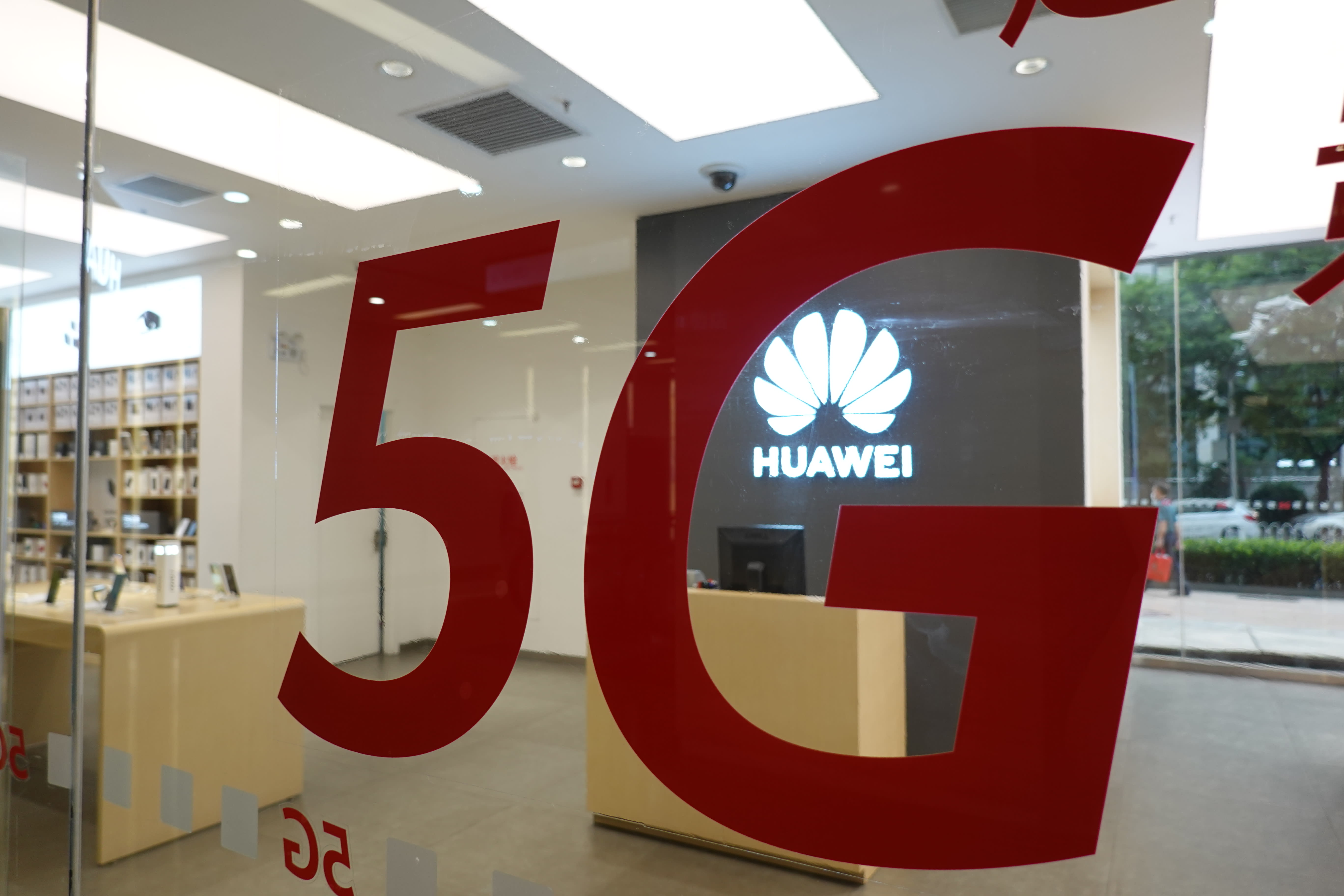
A logo of 5G is seen at a Huawei authorised experience store on May 29, 2020 in Beijing, China.
Qin Luyao | VCG | Getty Images
Less than six months ago, it appeared Chinese telecom giant Huawei was winning over America's European allies. Now, countries that decided to allow Huawei to build their 5G networks are waking up to the dangers posed by allowing Chinese state-directed companies into their infrastructure.
In July, the British government reversed its decision to accept Huawei's assistance and banned the Chinese tech giant from its telecommunications network. In France, authorities recently announced a similar ban on Huawei, which will go into full effect by 2028. Similarly, Singapore has rejected Huawei and decided to go with Ericsson and Nokia.
For some, the reversal comes down to growing awareness of the serious accusations aimed at Huawei, ranging from intellectual property theft to enabling Beijing's digital authoritarianism. Until recently, too many foreign leaders dismissed warnings about allowing Huawei into their telecommunication infrastructure from the Trump Administration as bluster amid trade negotiations.
However, Beijing's horrific abuses this year are showing the world the true nature of the Chinese Communist Party, forcing countries to be wary of partnering with China on sensitive projects. From covering up the COVID-19 virus in the early days of the outbreak to the crackdown in Hong Kong to its continued human rights violations in Xinjiang, China has provided zero reason for trust.
The shift provides an opening for the U.S. and our partners to work together to ensure alternatives exist. Because Huawei has so far competed against private telecom firms with the force of the Chinese government backing it, legitimate competitors find it difficult if not impossible to compete. Beijing has tilted the playing field by subsidizing Huawei and providing financing to its customers. The more nations ban or otherwise restrict Huawei, the more effective market-based solutions among the no-Huawei zone will be.
Beijing's horrific abuses this year are showing the world the true nature of the Chinese Communist Party, forcing countries to be wary of partnering with China on sensitive projects.
Countries cutting out Huawei and its cheap, high-risk hardware will have to look for trusted alternatives, such as newer, interoperable open radio access networks (ORANs), which bypass the need for Huawei's end-to-end proprietary gear and thus are more open to market innovation.
Governments should support innovative telecom companies that are leading the way when it comes to ORAN solutions. In the United States, I have worked with my colleagues on bipartisan legislation, the USA Telecommunications Act, which would provide $750 million in federal funding for research and development of these open and adaptable technologies.
Defending against Huawei -- and other Chinese state-directed companies -- will require an aggressive, global effort to support innovative technologies, grow our economies, and increase secure 5G access. To that end, my legislation devotes $500 million specifically to encourage the spread of open-access technologies.
America should lead in coordinating a coalition of like-minded nations -- such as our Five Eyes partners, other European countries, Japan, and South Korea -- to develop safe and affordable alternatives without having to sacrifice security. From there, telecommunications firms should use their business in the developing world to help expand new technologies and regulation regimes abroad. Rejecting China's technological imperialism will require more than just a series of bans, but a broad network of dedicated nations.
Of course, the Chinese government will not go down without a fight. Huawei is aggressively working to lock in client nations and to create facts on the ground before governments set new regulations about high-risk vendors, so it will be on us and our partners to keep the pressure on.
It will be significantly more difficult to remove Huawei technology from telecommunication networks once it has been installed because of the exclusionary, closed-off nature of much of its technology. We already have a taste of how China might retaliate, as well, in the form of Beijing's threats in July against market competitors Ericsson and Nokia. America should be alert to Chinese attempts to intimidate or destroy them.
Halting Chinese state-directed companies like Huawei -- as well as building a robust, competitive, and secure 5G market internationally -- is in the interest of all nations, particularly democracies. As our international partners continue to reject Huawei's presence, Americans should lead the way in developing the market-based infrastructure that will fill the gap.
The choice between one future characterized by Communist China's domination, repression, and surveillance and another by collaboration among partner nations is obvious, and now is the moment to begin building it.
Sen. Marco Rubio (R-FL) is the acting chairman of the Senate Select Committee on Intelligence, as well as a senior member of the Senate Committee on Foreign Relations
PLANO, Texas, Sept. 3, 2020 /PRNewswire/ -- Huawei Technologies USA's SVP of Public Affairs, Joy Tan, will join The Information's 2020 WTF Summit to lead a breakout session. Hosted virtually on September 9-10, The Information's WTF Summit is an intimate summit for women from the tech, media and finance industries that provides attendees with the opportunity to learn from one another and build connections between New York and Silicon Valley. Tan will join a group of high-powered female speakers who will lead discussions around driving global innovation and social change during unprecedented times. Speakers include, Sheryl Sandberg, COO of Facebook, and founder of Leanin.org and OptionB.org, Maria Renz, EVP and Group Business Unit Leader at SoFi and former VP of Global Delivery Experience for Amazon, Linda Yaccarino, Chairman of Advertising & Client Partnerships for NBCUniversal, and Laurene Powell Jobs, Founder of Emerson Collective, among others.
The breakout session, titled, "The Tech Reset: The tension between the tech industry and government," will take place on Thursday, September 10 at 1:45 p.m. ET. The discussion will focus on how technology companies and governments can work together to establish standards, best practices and regulations that benefit everyone. Over the past few years, everything from ride sharing and social media to 5G and AI has been closely scrutinized, breeding increasing tension between the technology industry and governments. Geopolitical conflicts have only exacerbated these tensions, which have destabilized the global supply chain and impacted tens of thousands of workers and their families. As a result, we're headed towards a tech reset, which provides a significant opportunity for technology companies and governments to collaborate on effective policies. Together, this can bring out the best of what the technology industry has to offer: breakthrough innovation, good paying jobs, and solutions to some of the most challenging problems.
About Huawei Huawei is a leading global provider of information and communications technology (ICT) infrastructure and smart devices. With integrated solutions across four key domains – telecom networks, IT, smart devices, and cloud services – we are committed to bringing digital to every person, home and organization for a fully connected, intelligent world.
Huawei's end-to-end portfolio of products, solutions and services are both competitive and secure. Through open collaboration with ecosystem partners, we create lasting value for our customers, working to empower people, enrich home life, and inspire innovation in organizations of all shapes and sizes.
At Huawei, innovation focuses on customer needs. We invest heavily in basic research, concentrating on technological breakthroughs that drive the world forward. We have more than 188,000 employees, and we operate in more than 170 countries and regions. Founded in 1987, Huawei is a private company fully owned by its employees.
TomTom Go Navigation arrives on Huawei AppGallery.
TomTom
Huawei’s latest devices have no access to Google’s Play Store, instead relying on its own store, called Huawei AppGallery. This means many crucial apps aren’t available. Now, an important arrival means one area with a big gap – navigation – suddenly has enough apps to make AppGallery a potent alternative.
This week, TomTom Go Navigation launched on AppGallery. This means it’s now available on Apple’s App Store and Google’s Play Store as well as on Huawei phones.
As reported by fellow Forbes contributor Zak Doffman earlier in the year, AppGallery previously took a big step forward in mapping terms when the excellent Here WeGo Maps debuted on Huawei’s store.
Here WeGo offers special benefits such as offline use thanks to free downloads of country maps in advance. But using it offline means no traffic information, for instance.
And though Here WeGo has an impeccable pedigree – it began as Nokia Maps when the Finnish company bought NavTel – it has never reached critical mass.
TomTom, however, is an unquestionable big beast in the world of mapping with huge name recognition. It also has an offline setting, something that’s strikingly important for navigation apps, since you may well be using it abroad where roaming costs can be high. With TomTom Go Navigation, detailed 3D maps are stored on the phone.
Go online and traffic information and speed camera warnings are available.
Don't miss the turn-off on the freeway with TomTom Go Navigation Lane Guidance.
TomTom
TomTom specialities include moving lane guidance which helps drivers navigate intersections by indicating which lane is best. You can also customize maps by adding or deleting regions as needed.
The only downside is that TomTom Go Navigation, unlike Here WeGo and indeed Google Maps, is not free. There’s a 30-day free trial, after which it costs $12.99 per year, $8.99 for six months or $1.99 per month.
This is not TomTom’s first collaboration with Huawei. The company uses TomTom’s mapping solution in its Huawei Mobile Services kits, which developers can use – ride-share apps need mapping kits, for example. Those are not accessible to consumers, of course, but this app, based on the same mapping, is.
Oh, and that’s not the end of the story. Huawei’s own Maps app is coming and is being developed in conjunction with TomTom. It Huawei gets it right, it could diminish the loyalty to Google Maps decisively.
You can, of course, use Google Maps already, through a web browser, but that’s hardly the same. You can even download the app on to Huawei phones, but its features are not as comprehensive. No, the big change will come with Huawei Maps, but this week’s TomTom Go Navigation addition is a very welcome arrival which works flawlessly and has the best mapping in the business.
The U.S. Department of Commerce’s Bureau of Industry and Security (“BIS”) recently adopted measures substantially impacting Huawei-affiliated companies and their non-U.S. supply chains. Earlier this year, on May 15, 2020, BIS issued a proposed, but immediately effective, amendment to the Foreign Direct Product Rule (hereafter, the “FDPR”) of the Export Administration Regulations (“EAR”; 15 CFR part 730 et seq.) that substantially restricted the supply of certain non-U.S. produced products to Huawei companies on the U.S. Entity List (“Huawei”). Under the amendment, a non-U.S. produced product that was the direct product of certain designated U.S. software or technology (or produced by plant facilities that were the direct product of such software or technology), was considered “subject to the EAR,” and thereby subject to a U.S. export license requirement, even if transferred from outside the United States, if the non-U.S. product was: (1) designed or produced by Huawei; and (2) being supplied to Huawei (hereafter, the “Huawei Direct Product Rule” or the “Rule”).
On August 17, BIS adopted the amendment as a final rule, but substantially expanded the scope of the FDPR with respect to Huawei by extending coverage to any subject non-U.S. produced product, even if not designed or produced by Huawei (such as off-the-shelf products), if either: (1) Huawei is a party, in any capacity, to the supply transaction; or (2) the product is supplied with knowledge that the product will be incorporated in a product that will be supplied to Huawei (directly or indirectly). In conjunction with the final adoption of this new Rule, BIS also placed additional Huawei companies on the Entity List and terminated the Temporary General License (“TGL”) which had previously authorized certain activities with Huawei relating to cyber security and product development.
MAY 15 AMENDMENT TO THE DIRECT PRODUCT RULE
On May 15, 2020, BIS amended the FDPR (General Prohibition Three of the EAR) as applied to Huawei entities designated on the Entity List. The FDPR generally provides that any non-U.S. produced item that is produced using national security-controlled U.S. software or technology is considered subject to the EAR and, thereby, to any export license requirement that would be applicable if the product was produced in the United States. Under the May 15 amendment, an add-on to the FDPR was adopted in connection with the supply of certain items to Huawei companies on the Entity List (this was implemented through a new footnote 1 to the Entity List which applies to all the Huawei companies included on the Entity List). The new Rule potentially applied to any non-U.S. produced product that: (1) was the direct product, or was produced by a plant (or major equipment of a plant) that was the direct product, of U.S. software or technology enumerated in the new Rule (“subject product”); and (2) was produced or developed by, and being supplied to, Huawei.
Subject Products. As implemented on May 15, the Rule potentially applied to any non-U.S. produced product that:
is the direct product of technology or software subject to the EAR and specified in the following Export Control Classification Numbers (“ECCNs”) of the EAR’s Commerce Control List: 3D001, 3D991, 3E001, 3E002, 3E003, 3E991, 4D001, 4D993, 4D994, 4E001, 4E992, 4E993, 5D001, 5D991, 5E001, or 5E991; or
is produced by any non-U.S. plant or major component of a plant that is a direct product of U.S.-origin technology or software subject to the EAR that is specified in ECCNs 3D001, 3D991, 3E001, 3E002, 3E003, 3E991, 4D001, 4D993, 4D994, 4E001, 4E992, 4E993, 5D001, 5D991, 5E001, or 5E991.
However, as implemented on May 15, a product was subject to the EAR and required a U.S. export license only if it was a product that was produced or developed by Huawei and was being sold to Huawei.
AUGUST 17 FINAL HUAWEI DIRECT PRODUCT RULE
When adopting the final Huawei Direct Product Rule on August 17, however, BIS implemented amendments to the Rule to further “prevent Huawei’s attempts to circumvent U.S. export controls to obtain electronic components developed or produced using U.S. technology.” As described by BIS, “[t]his amendment further restricts Huawei from obtaining foreign made chips developed or produced from U.S. software or technology to the same degree as comparable U.S. chips.” Under the final, amended Rule, although the scope of subject products potentially subject to the new Rule remains the same (the direct product, or a product produced by a plant or major component that is the direct product, of U.S. software or technology specified in the enumerated ECCNs), there is no longer a requirement that the subject product have been produced or developed by Huawei.
Instead, as finally adopted, the Huawei Direct Product Rule now applies to any subject product when the company exporting, reexporting, or transferring the item (including transfers within the same country) has “knowledge” that either: (1) a Huawei company on the Entity List will be a party to a transaction involving the item (including as a purchaser, consignee, or end-user); or (2) the item will be incorporated into or used in the production or development of any part, component, or equipment produced, purchased, or ordered by Huawei. “Knowledge” is defined as actual knowledge or reason to know based on the circumstances of a transaction.
As a result of this revision to the Huawei Direct Product Rule, non-U.S. manufacturers and other suppliers involved in Huawei supply chains must carefully determine which, if any, of their products are within the scope of the Rule and ensure such products are only exported, reexported, or otherwise transferred in compliance with the new Rule. The changes to the Rule became effective immediately upon its issuance on August 17, 2020. However, there is a savings clause that allows for shipment without a license of items that are within the scope of the Rule because they are the direct product of covered “plants or major components of plants,” provided: (1) production of those items started by August 17, 2020; and (2) they are exported, reexported, or transferred before midnight (local time) on September 14, 2020.
OTHER MEASURES IMPACTING HUAWEI
Huawei Affiliates Added to Entity List. The Rule also further expands the scope of Huawei export restrictions by adding 38 additional entities affiliated with Huawei to the Entity List, bringing the total to 153 Huawei companies. As a result of these designations, companies must obtain a BIS export license before exporting, reexporting, or transferring to these entities any item, software, or technology that is “subject to the EAR.” This includes any item (commodity, software, or technology) that is: (1) U.S.-origin; (2) located in the United States; (3) non-U.S.-origin but incorporating more than a de minimis percentage of controlled U.S. content; or (4) non-U.S.-origin but subject to the EAR as a result of the direct product rules discussed above. License applications in this context are subject to a general policy of denial by BIS.
Export restrictions for the 38 Huawei affiliates added to the Entity List became effective on August 17, 2020, although shipments that were already in transit by August 17 can be delivered without a license.
Temporary General License. The Rule also expands the Huawei export restrictions by providing for the expiration of a TGL issued originally in May 2019 that authorized certain transactions with Huawei related to cybersecurity research, ongoing support and operations of networks and equipment, and 5G standards conducted by an established standards body.
The original TGL, which has been renewed and modified over time, expired effective August 17, 2020. However, BIS has issued a more limited authorization by adding a footnote to the license requirements for designated Huawei entities on the Entity List which authorizes the export, re-export, or transfer of items subject to the EAR, provided it is limited to “information regarding security vulnerabilities in items owned, possessed, or controlled by Huawei or any of its non-U.S. affiliates when related to the process of providing ongoing security research critical to maintaining the integrity and reliability of existing and currently ‘fully operational network’ and equipment.”
CONCLUSION
These actions by BIS represent the latest in a series of measures by the U.S. government to cut off Huawei from U.S. commodities, software, and technology, most recently by focusing on preventing reliance on U.S. software and technology in producing products outside the United States for Huawei supply chains. These measures are intended to send a signal, not only to Huawei’s suppliers who are most directly impacted by the new BIS Rule, but also to Huawei’s customers who are being urged by the United States to develop non-Huawei sources for technology and equipment.


 The Link Lonk